
The small print: The welcome news broke last week that the Norwegian Minister of Fisheries and Oceans, Marianne Sivertsen Næss, had finally commissioned a new scientific review of salmon farming’s impact on wild fish populations. This is good news indeed. Salmon Business reported that the Minister had asked the Norwegian Scientific Committee for Food and the Environment (VKM) to review the existing evidence on aquaculture’s impact on wild salmonids including the contribution of sea lice from fish farms to mortality among wild salmon.
The Minister announce the news during a meeting with Sjømat Norge (Seafood Norway) to discuss plans for offshore aquaculture. CEO of Seafood Norway Geir Ove Ystmark said that they had repeatedly requested such an independent investigation to ensure the broadest possible professional knowledge about the impact of sea lice on wild salmon, He also said that this is in line with the recommendation of the Storting to look at the actual and relative impact of aquaculture.
Seafood Norway welcomes the involvement of VKM saying it is positive that they will review the knowledge base as it affects one of Norway’s most important export industries.
I very much hope that this investigation will be a thorough examination of the impacts of sea lice on wild salmon, but part of me worries that it will simply go through the motions to enable the government to continue to pursue its planned policy of sea lice quotas.
Salmon Business say that no timetable for the VKM assessment has been disclosed. In fact, very little information has been disclosed at all. For example, will VKM conduct their review behind closed doors, or will they invite representations from stakeholders? Will the review be of only published science or will VKM include unpublished but verified evidence?
The VKM website includes a section titled independent and transparent. They say they carry out independent risk assessments for the Food Safety Authority and the Environment Agency. They say that Scientific results and data used in our risk assessments are obtained from peer-reviewed articles and published documents, including risk assessments from national and international bodies, and from national and international surveillance and monitoring. They say that the whole process is conducted in an open and transparent way.
The question of sea lice can be viewed as a risk assessment for wild salmon so VKM might be considered qualified to conduct this new assessment. However, there are still concerns.
VKM consists of ten scientific panels, two of which might be considered as candidates to undertake this review. However, both panels have at least one member who is inextricably linked to Norwegian research on sea lice and thus have a potentially preconceived view of wild salmon interactions with sea lice, which could influence the whole panel.
It remains to be seen how the review will be conducted including when it is expected to be completed. I can only hope that VKM are open to hearing from all sides about this vexed issue to ensure that any outcome is fair and honest. We will have to wait and see but for the time being, this review is welcome news.
Marine Directorate science: The second day of the recent MASTS meeting coincided with the Fisheries Management Scotland annual conference. Interestingly, for such a contentious issue, salmon farming did not feature on the programme. However, what caught my eye was the last talk of the day by senior scientist, John Armstrong of the Marine Directorate who spoke about evidence for management and future prospects. I think this is about the fourth time, that I am aware of, that Dr Armstrong has addressed a FMS conference. Over the same period of time, I do not believe that Dr Armstrong has ever addressed the salmon farming industry even though his name has appeared on several papers about sea lice. His near regular spot at the FMS conference simply confirms the view I have expressed previously that there are strong links between the Freshwater Fisheries Laboratory and the wild salmon sector which have influenced the direction of the science and advice used by Scottish Government in their policies on salmon farming.
Over my sixteen years of independent research, I have had several contacts with Dr Armstrong, none of which have been very fruitful, as he has been reluctant to speak to me. The last contact was during a Teams meeting arranged by the Head of Marine Directorate science as a result of my complaint about sharing information with Norway about me. During this meeting I was permitted to ask three questions the first of which was why my graph showing declining catches from west and east coast rivers is not considered evidence that salmon farming and sea lice is not having an impact on wild fish populations. The ensuing discussion was followed up by comments in writing dated 12th June this year.
During the meeting, Dr Armstrong insisted that the graph was not proof that salmon farming had no impact on wild salmon because the data consisted of both rod and net catch data and net data is from an interceptory mixed stock fishery and it therefore not possible to know where the fish were headed. In my opinion, as the data is combined for all rivers, it doesn’t make any difference whether the fish were destined for the Tay or the Tweed. It is possible some of the fish were actually headed for the main east coast English rivers such as the Tyne, Tees and Esk but comparatively the numbers of salmon in these rivers are small and over fifty years, the numbers of English fish caught will even out. The graph is so clear in its comparison, that it is impossible to understand how any scientist can simply dismiss the graph so out of hand, yet Dr Armstong kept repeating that net catch data is from an interceptory fishery as if this justifies his rejection of the data.
More interesting is the follow up letter because this begins:
Marine Directorate provides an objective view and provides information to support the Scottish Government goal to support the sustainable development of aquaculture. In doing so MD encourages publication of formal analyses of data, including all sources and explanations for data selection, so that an objective assessment can be made by peers on the basis of a full understanding of the analysis.
The letter continues:
Overall, Marine Directorate do not agree with the suggestion that the graph is evidence for no effect of sea lice from salmon farming on the West Coast because as stated and explained by Middlemas, S.J., Smith, G.W. and Armstrong, J.D. (2016), “It is very important to note that analyses of fishery catches cannot be used to prove whether or not fish farming has an impact on wild fish as there are many other factors that may cause changes in fish populations and may differ between the regions of coast that were considered.”
I refer to this specific response because Middlemas et all (2016) is not a formal analysis of data that has been peer reviewed and published in a scientific journal. This means that it is difficult to make an objective assessment of their analysis. It is simply the views of three Marine Directorate scientists published in a Marine Directorate report that has not been peer reviewed. This is a document that in my opinion does not provide any evidence of anything. It is just an attempt to subdue any criticism of the science used by Marine Directorate to justify their policy on salmon farming.
The letter continues that rod catch alone is a better indication of impacts because fish captured in rivers are most representative of those homing to the region from which they originated. However, their graph from the 2016 document uses percentage of total catch for each coast and this can be interpreted in two ways. Fish have declined in the west because of factors such as salmon farming or the percentage catch in the west has declined because the catch in the east has increased, and we know this to be true as even Marine Directorate admit the closure of net fisheries mean more fish returning to their home rivers where they were accessible to rod fishers. They continue that:
It does not seem to be reasonable to use a combination of fisheries catches and ignore correlations from rod fisheries alone (although neither approach would be evidence of no effect of aquaculture).
What is interesting is that if Marine Directorate scientists including Dr Armstrong, who wrote this, do not think catch data can be used to assess whether salmon farming has an impact on wild fish, then why did they go to the trouble of writing a report on the subject? The answer is simple; it was written to undermine the attempts by people like me to show that salmon farming does not have an impact on wild salmon.
The Marine Directorate scientists have just completed a 10-year study to assess the interactions and effects of sea lice on wild salmon populations – Project FW0050. The final report was quietly published on the Scottish Government publications website. I might have thought that after ten years, the scientists would have arranged an event to which industry would have been invited so they could promote their findings of this decade long study. However, no such event was arranged. This is because these Marine Directorate scientists don’t want to put themselves in front of people to be asked questions that would demonstrate that this ten years study was simply intended as a way to support the wild salmon sectors demands that the salmon farming industry be controlled, even if it cannot be shown that the industry has an impact. The conclusion of the study states
Outputs of this project have made a significant contribution to develop Scotland’s policy and regulatory framework to consider and manage the risk that sea lice from fish farms negatively impact upon wild populations, leading to the development of, and contributing to, delivery of SEPA’s new sea lice risk assessment regulatory framework, with further development on future monitoring and research needs underway.
This cannot be clearer. Yet the contributing scientists are not willing to face the industry and be challenged on their findings. They shy away from any confrontation. Yet, surely, the industry should be able to challenge work which has led to the imposition of pointless and potentially damaging regulation. Dr Armstrong is happy to address the wild fish sector but has yet to do so when it comes to the salmon farming industry.
Finally, I should mention that the letter concludes
Discussion noted that research has moved on from correlative catch analyses to a combination of experimental testing of impacts of sea lice (where that is feasible) and modelling.
I wouldn’t say that there was any discussion on this just a statement of this is what we do. Marine Directorate science may have moved on from correlative catch analysis because they cannot explain the findings. Instead, as they say they have moved on to modelling. It is worth pointing out that it is the same Marine Directorate scientists who have constructed the models so their conclusions about salmon farming impacts are not exactly of any surprise.
Challenge: The SAMS sea lice workshop held during the MASTS meeting included a surprise speaker. Dr Stephen Ives of Marine Directorate science who spoke about ‘Sea lice sampling on wild sea trout – insights from statistical modelling’. Unfortunately, for reasons best known to themselves, no questions were allowed to be asked of any of the speakers including Dr Ives, so yet again Marine Directorate scientists have avoided direct public challenge.
Dr Ives first reviewed his previous 2024 paper that he wrote with Dr Armstong that considered data from 2013 to 2017. He went on to describe his latest work using data from 2018 to 2023 and later he hoped to include 2025 data too. The 2026 dataset has yet to be published.
In his 2024 paper, Dr Ives states that individual trout were samples using a standardised protocol (SFCC 2009) so it must be assumed that the same methodology also applies to any new paper that has analysed the data from 2018 onwards.
In his presentation given at the sea lice workshop. Dr Ives referred to the follow image which shows the purported association between lice on farms and lice on wild sea trout from the Flowerdale sampling site in Wester Ross.
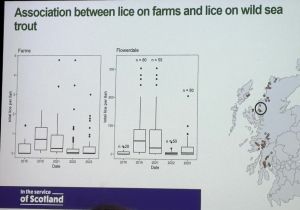
The graph implies there is a link between farm infestations and those on wild sea trout. However, as the dataset used in this study is in the public domain, it is possible to analyse the same data used by Dr Ives. The one immediate observation is that not one of the fish sampled at Flowerdale meets the criteria of the 2009 SFCC protocol. This means the data is invalid and cannot be used in this latest study. Dr Ives indicate that Flowerdale is one of eight sites analysed. I therefore will be reviewing all this data and seeing how much of it actually meets the protocol criteria. I know Marine Directorate will respond saying that it is difficult to obtain sufficient fish to meet the criteria. I would argue that a protocol was drawn up for a reason then what is the point of having such a protocol if the specific criteria are just ignored. It has been apparent for many years that the collection of accurate data only applies to the salmon farming industry not to others.