
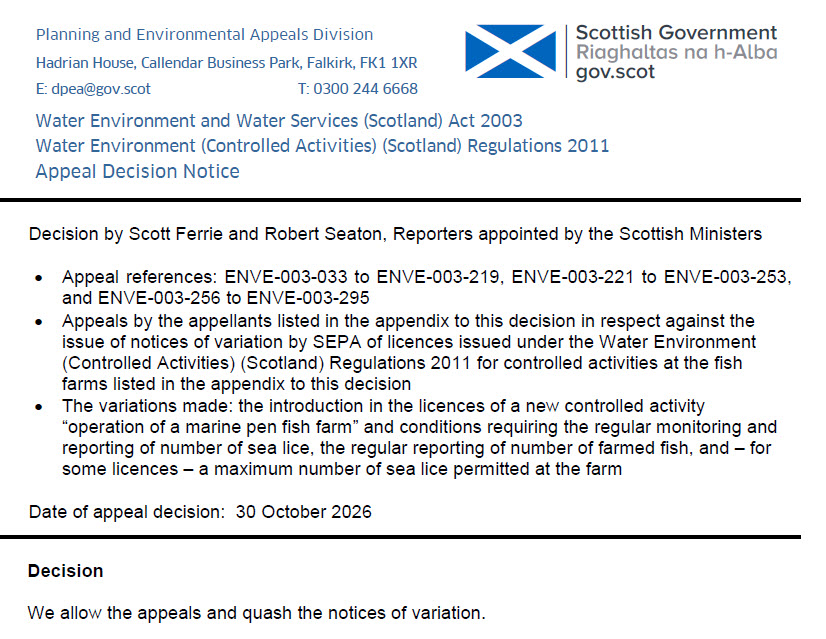
Very appealing: By the time this commentary has been despatched, it will be over a week since news broke that the Scottish salmon farming industry had won their appeal against licence changes imposed by SEPA in support of their Sea Lice Risk Framework. This was a decision for common sense and should be widely welcomed,
The DPEA decision runs to 58 pages and is too detailed to discuss in this commentary. It is sufficient to know that the DPEA decided that SEPA were in the wrong in trying to vary salmon farm licences.
Fish Farming Expert reported the news soon after it was announced. I was interested in a comment from Salmon Scotland who said that:
“We have always supported strong environmental protections, including for wild salmon. Our objective throughout has been to ensure regulation is effective, proportionate, and grounded in sound science. “We want to work constructively with the Scottish Government and SEPA to agree an appropriate way forward. Regulation must be based on robust evidence, good science and reliable data. This decision provides a route map for achieving that.”
This has been the problem all along as regular readers of reLAKSation will now know all too well. The SEPA Sea Lice Risk Framework simply has not been based on robust evidence, good science or reliable data. Yet I do not blame SEPA for what is now a shambles. The fault lies firmly with Marine Directorate scientists who have actively favoured the angling sector over anything else. This is not surprising since the Freshwater Fisheries Laboratory was established to support wild salmon populations and those working there were attracted to this work precisely because of their interest in angling. By coincidence many of these who pioneered salmon farming were attracted to the sector exactly for the same reason.
A negative policy towards salmon farming appeared quite early on in the industry’s development as recorded by former head of the laboratory Richard Shelton (1982-2001). In his memoir, The Longshoreman, he refers to 1989 and writes that a couple of ghillies had been speaking to Dr Andy Walker of the lab (although his doctorate was not awarded until 1994). His careful sampling had convinced him that west coast sea trout populations were in mortal danger from the very same cause he had seen first had when visiting fellow scientists in Ireland.
Trout & Salmon magazine reported in June 1991 that the Scottish team for the World Fly Fishing Championship in New Zealand was chosen following two heats both of which were won by 1990 Scottish National Champion Andy Walker from Pitlochry, a member of Pitlochry Angling Club.
It is not easy to see how these two worlds of science and angling might have been separated and the reality is that they have not. Whilst Marine Directorate scientists have actively promoted the message that sea lice associated with salmon farms have a negative impact on wild fish and in doing so have aided move to sea lice regulation, they have done very little to protect wild fish populations from the pressures of angling. It is only necessary to see that in these modern times, the collection and publication of catch data takes nearly six months and by the time it appears, the next fishing season is well underway. At the same time, Marine Directorate scientists have never recommended closure of rivers to fishing and still rely on flawed conservation measures that they say will protect wild fish. As wild salmon populations remain in crisis, these measures have clearly failed to work.
As Salmon Scotland point out, they support strong environmental protections, but it is only salmon farming that is in receipt of what Fish Farming Expert calls Draconian regulatory changes? The Marine Directorate has identified many other pressures affecting wild salmon, but none have received the same level of attention as salmon farming. As I mentioned it is interesting that Fisheries Management Scotland immediately put out a statement saying how disappointed they are at the DPEA decision. They say that the fundamental principle that the interaction between wild and farmed fish must be managed is unchanged. They add that this was reinformed by the Chief Scientific Advisers report from March 2026 which concluded that the full SEPA framework represents a proportionate response to the current evidence and that its scientific basis is defensible.
Unfortunately, FMS are misinformed as the CSA report focused on published scientific papers and nothing else. At least that is what the CSA told me. The CSA may think that the scientific basis is defensible, but I suspect that he has not delved too deeply into the research. For example, Marine Directorate scientists have been collecting sea lice infestation data of wild sea trout since 1997. Sometime ago I asked the Marine Directorate what analyses they had conducted on this data. The answer was none but a couple of years later a paper was published titled ‘Association of ectoparasite L. salmonis counts on farmed Atlantic salmon and wild sea trout in Scotland’. The paper was authored by Marine Directorate scientists Ives, Murray, and Armstrong who concluded that a significant positive association is identified between adult female lice abundance on farms and juvenile lice in wild trout. The paper doesn’t reveal too much how they came to this conclusion, but the work involves some modelling and there is mention of a standardised trout.
I discussed this paper in reLAKSation when it was published but I intend to do so again soon. I have concerns about this work before the data is even analysed. In the section about lice on wild fish, the authors state that the trout data comprise of lice counts on 5042 wild sea trout sampled from 31 localities between 2013 and 2017. I have the full dataset and the total number of fish sampled from these 31 sites is 5043. If the number is taken as 5042 fish, then the number of sites sampled was just 30. One fish was sampled from one locality during the five-year period, and this accounts for the difference. It is not clear why this extra site or fish was included in the study but none of these three scientists failed to pick up this error. This brings into question whether in their rush to get the paper published, other errors have also appeared.
The paper also states that the fish were sampled using a standardised protocol (SFCC 2009). This recommends a minimum sample size of 30 fish yet of the 265 samplings that took place just 23.7% met this requirement. Clearly the data from the other 202 samplings should have been discarded as not meeting the criteria for fair sampling but of course, the authors included all the samplings in the study even those that caught just one fish. The question remains whether the fish used provide a representative picture of sea lice infestation. I would ask the authors for their view, but they don’t seem to want to talk to me.
Whilst the DPEA decision must be welcomed, it seems that not everyone is happy about the outcome. Fisheries Management Scotland (FMS) issued a statement after the decision was published. They say that they are disappointed that the process has failed to deliver effective regulation of farm derived sea lice. FMS will have t remain disappointed because the reality is that the SEPA Framework will never deliver effective regulation as the Norwegians have found with their Traffic Light System.
FMS say that the focus now be on moving forward and delivering the protections that our wild salmon and sea trout urgently need. Of course, FMS mean protections against salmon farming and not about protecting wild fish from possible death associated with angling.
Whilst Salmon Scotland have said that the DPEA decision provides a route map for achieving regulation that is based on robust evidence, good science and reliable data, my view is that the SEPA process should be paused and there should be a new focus providing the evidence, science and data that is urgently required.
I am reminded that when the Salmon Interactions Working Group, that ultimately led to the development of the Risk Framework, was underway. For reasons they kept to themselves, they three times rejected my offer to present new evidence, new science and new data.
It is essential for everyone that all such evidence, science and data be put on the table and fully discussed otherwise the SEPA Risk Framework will remain what it always has been – one massive, big stitch up of the salmon farming sector.
Quotas: I can only wonder that someone in the Norwegian Ministry of Trade, Industry and Fisheries, is a passionate salmon angler and who, like fellow anglers, blames sea lice and salmon farming for the current wild salmon crisis. This is the only reason I can arrive at that would explain why the Ministry seems so intent on damaging one of Norway’s key industries.
Having overseen the flawed Traffic Light System which has failed to protect Norwegian wild salmon they seem keen to transfer the rather pointless management of sea lice regulation from modellers to economists. The Ministry commissioned Menon Economics to propose a system of sea lice quotas or levies to replace the Traffic Lights.
The result is a 130-page document with a three-page summary from which it is difficult to draw any conclusion as to whether quotas are a good idea or not. This is made harder because it is clear that the science on which any quotas system will be based is flawed.
Because I would need to translate all 130 pages to enable a thorough examination of the Menon report, I am indebted to Aquablogg (www.aquablogg.no) for summarising the key point.
The first paragraph of the Aquablogg assessment says all that needs to be said:
“Menon hit the nail on the head: the consequences of regulation via sea lice quotas or levies are absurd. While they do not state this in so many words, they hint at it in several passages. On the other hand, they explicitly state that they lack the basis to quantify the harmful effects of sea lice emissions—and, consequently, the socio-economic benefit of reducing those emissions.”
Aquablogg concludes that the Ministry may just end up putting this report in a drawer and then forget about it. The blog also suggests that this might be exactly what Menon think should happen to it too.
Standard reply: I thought that the news that sea lice levels in Canada remain high in areas where salmon farms have been removed was worth sharing with the Scottish Cabinet Secretary for Climate Change and Rural Affairs and this has prompted a reply from one of my regular correspondents at the Marine Directorate, who provided the usual fob off.
The reply would not be worth mentioning other than the inclusion of the following paragraph about BC. This states that:
There are important differences between the situation in British Columbia and that in Scotland. While British Columbia farmed Atlantic salmon, the wild species present there are Pacific salmon which are generally considered less susceptible to Lepeophtherius salmonis the key sea louse species of concern in Scotland. In addition, there are significant differences in wild fish population dynamics and environmental conditions. As a result, direct comparison between Scotland and British Columbia are not generally informative for assessing likely impacts of salmon lice on wild Scottish salmon.
Thus, according to the Marine Directorate scientists, we in the UK, cannot infer anything from the fact that when salmon farms were removed, sea lice levels remained high on wild fish because Scotland and BC are very different.
This reminds me of a project conceived and run by Marine Directorate scientists over ten years ago. This was SARF SP010 titled ‘Piloting a network for determining spatial and temporal variation in marine survival of Atlantic salmon and effects of anti-sea lice agents. It is the section on the project background that is of relevance here of which selection from the section, written in 2018, are repeated here.
Lack of knowledge on the impacts of Atlantic salmon farming on Scottish wild salmon is an impediment to further development of the salmon aquaculture industry in Scotland.
The project is an assessment of the impact of sea lice on wild Scottish salmon by adapting an experimental approach that already has been used in Norway and Ireland.
However, the results of these Norwegian and Irish experiments, especially in terms of scale of impact, are not necessarily readily transferred to quantify effects of sea lice emanating from salmon farms in Scotland. This is because potential differences compared to the Norwegian and Irish situations, in the Scottish aquaculture industry, the susceptibility of wild Scottish fish stocks (including both genetic and general resilience status) and the environment where interactions can take place.
So, what these scientists are saying is that the impacts of sea lice on wild salmon could be very different in Scotland to that of our near neighbours. This is extremely hard to believe.
As to the project, it was an abject failure. It was ill-conceived from the outset. In 2015, they tagged and treated a total of 2,002 wild caught smolts from the Lundy and Loy burns, not one of which was recaptured. In 2016, a further 1,229 fish were treated and released with none recaptured in the Lundy burn but two fish were caught from the Loy, one of which was treated and the other a control. I believe that he total cost of the project was £600,000, which I said at the time was a total waste of money as there was sufficient knowledge obtained from the Norwegian and Irish studies to ascertain the actual impact.
The big question is what happened after the project finished. The answer is that we are now directed to Norwegian studies for impacts. It seems that Scottish salmon, whether farmed or wild are no different to those in Norway after all.
The fact that what is happening in BC is dismissed so easily as different, shows that the scientists here simply don’t have an answer. Perhaps, if these scientists had instigated a study as to what happens when a farm is removed as happened five years ago in Loch Ewe then we might have a Scottish experience of the current events in BC.
It is worth mentioning that the Marine Directorate letter ends with the following:
“However, Marine Directorate scientists will continue to consider relevant peer-revied evidence as it becomes available as assess its applicability to the Scottish context.”
It is clear that Scottish scientists are not interested in evidence unless it is peer-reviewed and fits in with their narrative otherwise they are simply put aside. It is only necessary to look at the key Irish study that the SARF project was supposed to prove wrong, to see how selective the science really is. This seminal work is generally ignored.