
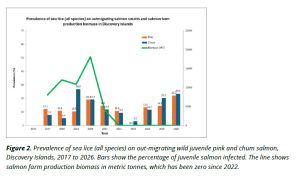
Discovery (an error): Apologies, there is currently a lot going on in my world and I forgot to add the graph for the sea lice counts on wild fish around the Discovery Islands. These now follow (Prevalence and Intensity) :
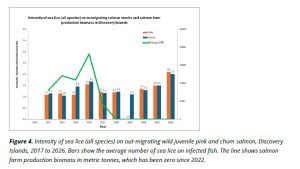
It was also pointed out to me that sea lice counts on wild fish sampled around the Broughton Archipelago were also high, of which I was aware. However, the main point I aimed to male was that all the farms around the Discovery Islands had gone and thus there was no possibility at all that the sea lice could have come from farms.
Apologies again for the omission.
Zero listening: The Minister of Fisheries and Oceans, Marianne Sivertsen Næss, has announced that she will be launching a new zero emissions scheme for all of Norway. According to the Minister, this is a zero-emission scheme not one of low emissions. The aim is to have closed pens to prevent the release of lice and lice larvae.
However, whilst the Minister talks about a no-emissions scheme which will cost the industry billions of kroner, there is very little evidence that salmon farms are releasing large numbers of sea lice as the wild fish organisations and scientists claim. The current estimations of lice numbers are based on models using theoretical lice production not real life.
A 1997 science paper from Karin Boxaspen of Havforskningsinstituttet states that ‘surveys in the area around Austevoll Aquaculture Research Station have failed to reveal the presence of a large number of the free-swimming stage of sae lice. However, lice were abundant on salmon cafes held in cages in this area’. During the recent court case, Dr Boxaspen said that she had found 107 larvae over three years and this was in an area relatively close to the infected salmon pens. Thirty-five lice larvae per year does not exactly represent a major threat to wild salmon.
Even though there are now hundreds of scientific c papers about sea lice and salmon farms, none address the issue of finding lice larvae in the waters of Norwegian fjords or elsewhere. A paper By Skarðdhamar and others from 2019 states that ‘Direct sampling of lice from Norwegian water to determine concentrations has never been published scientifically and has been considered non-feasible for monitoring purposes.’
Why is it considered non-feasible. The answer is because researchers cannot find the lice larvae the models say are present.
Scottish researchers undertook seven-month long lice finding mission during the summer of 2021 in an area surrounded by eight farms. According to Scotland’s angler’s organisation, every farm released about 2 billion lice larvae every week so this area should be flooded with16 billion lice larvae every week or 3,360 billion lice larvae during the project period.
After 372 samplings, researchers found a grand total of 20 lice larvae. In their report, they said in desperation that just because we couldn’t find them doesn’t mean that they are not there. Actually, yes, it does.
The reason why was published as a scientific paper in 1996 but has been ignored by the scientific community because doesn’t fit their narrative. Costelloe and others measured lice concentrations in the middle of a farm and then measured again at increasing distances away from the pens. By one kilometre, the lice numbers had been so diluted that they were almost impossible to find. A second paper from Canada by Nelson in 2017 and presented at the international sea lice conference found similar results.
There is another reason why the lice levels are not as predicted by the models. Scientists estimate lice production by taking the average lice count on farm and then applying it to all the fish in the pen. However, recent information that has come to my attention is that over a five-year period, 86% of fish sampled from commercial salmon farms were lice free.
Before the Minister advocates that farms should move to zero lice emissions, we should establish whether salmon farms are flooding the fjords with lice larvae that the anglers claim are killing their wild salmon.
Shoot the messenger: Back in January this year, I was invited to speak about sea lice at the Aqkva Conference that took place in Bergen in front of the Norwegian Fisheries Minister. Whilst I was in Norway, I was given a copy of a document concerning sea lice infestation. The document was written by four ‘sea lice’ scientists from the Institute of Marine Research in response to a request from the Norwegian Government for input regarding a number of issues relating to sea lice. The document is titled Appendix 46 and was dated June 2024. What is most interesting about this document is that three pages of its ten pages are devoted to criticising me and my research.
The background to my appearance in this document is that, in my opinion, there has never been a proper discussion about the science underpinning SEPA’s Sea Lice Risk Framework. It is based on too many assumptions and too much modelling, as is the Norwegian Traffic Light System that was the inspiration for its introduction. As I have extensively analysed the data generated by the Traffic Light System, I thought it would be interesting to write a critique of the data and the science to share with SEPA and Scottish Government scientists in the form of a discussion document. I sent off the 80-page document to the two organisations in April 2024, both of whom didn’t bother to acknowledge or respond, but that is nothing unusual when it comes to sea lice and wild fish interactions. I also sent a copy of my critique to the Norwegian government, who also didn’t bother to respond.
Although the Norwegian government didn’t respond they asked the four scientists to provide an assessment of my expertise and an evaluation of the conclusions and finally, whether I offered anything new that the IMR experts didn’t know. As my critique effectively questioned the sea lice work undertaken at IMR, the conclusions drawn in their response were not unexpected.
The tone is set within the first sentence with the statement that he appears to hold a doctoral degree. Clearly, either I have a PhD or I don’t. They also say that their research has found no evidence that I have published anything related to this matter. They obviously didn’t look too hard because I have indeed published papers, but in common with other scientists they prefer to believe that they don’t exist, because they don’t fit with their narrative. They also say that I appear to work on my own and therefore cannot rely on any expertise but my own. This contrasts with the papers produced by scientists at IMR that can list up to twenty co-authors. It seems that they have all been robbed of individual thought with the focus on a communal view. I wonder if they are so institutionalised that they fail to recognise that a single scientist can develop ideas on their own without the support of others. I can only wonder why, if the Norwegian government wanted to understand my expertise, they simply didn’t ask me directly. Instead, they received what amounts to an attack on the messenger rather than address the message.
However, the four scientists did also respond to the request for an evaluation of my conclusions. They first suggested that I have ignored the recommendations made by the international Evaluation Committee, which I did simply because they did not address the same issues as I raised. They also say that I have not uncovered anything already reported by the Expert Group, which is clearly wrong. I would like to pick up on two specific points they make. Firstly, they say that I have said that the Traffic Light System has not protected wild fish but that I have not included any serious analysis of this matter nor any references to such analyses. This is simply because the Norwegian media is repeatedly full of warnings that wild salmon are in crisis together with announcements of increasing numbers of river closures to fishing. There doesn’t need to be an in-depth analysis to know or understand this and if they think that the TLS has helped safeguard wild salmon then the announcement by Norsk Lakseelver (Salmon Rivers) towards the end of September that they expect the 2026 fishing season to be the second lowest on record could not be clearer.
The second point concerns the aggregated distribution of parasites. The scientists say the fact that a distribution is aggregated does not means that the majority of individuals carry no or few lice.
I will use a quote from the university textbook – Introduction to Animal Parasitology by J D Smyth (Third edition 1994) to reply. Page 1 (of 549) states:
What is a parasite? – An important conclusion is that instead of parasites being randomly distributed within the host population – they tend to be over dispersed i.e. a few hosts harbour large numbers of parasites, and many hosts harbour only a few. That this type of frequency distribution is a major characteristic of parasitism was first postulated by Crofton (1971) and has since been confirmed by numerous studies on many host parasite systems.
The four scientists highlight a few other issues about which they disagree, mainly about the way I present the data and ideas. They clearly do not understand the difference between a discussion document and a peer reviewed paper because it seems they have treated this document as they would peer reviewed science.
What I find most disappointing is that they were ready to perform a demolition job on me and my research, but they are not willing to do it face to face.
One of the scientists once told the mainstream media in response to criticism of their science that ‘people’ simply don’t understand, and they should leave the science to the experts. What I do understand is that the scientific establishment don’t like their science to be challenged, which is exactly the reason why it should be, whether in Norway or Scotland or any other salmon producing nation.
(as appeared in Fish Farmer magazine).
Chickenfeed: According to the Times newspaper, earlier this year Nofima found that consumers in Britain and France described the idea of feeding chicken to salmon as ‘unnatural and disgusting’. Of course, it all depends on how the idea is portrayed to consumers, if at all. The anti-salmon farming organisations have ensured this non-story has been covered in the national press.
Before BSE hit Britain, there were a wide range of animal-based protein available for incorporation in animal feeds with one of the best being bloodmeal due to its extremely high protein content. Only a small amount was needed to boost protein levels in animal feeds. I remember that feather meal was also available.
Then BSE struck and many of the animal proteins were banned. The problem was not in their use but the fact that imported meals had not been treated correctly during their manufacture and heated to a sufficiently high temperature to kill any harmful bacteria etc.
BSE brought attention to the public that animal proteins were being used in animal feeds with talk of feeding cows to cows and now chicken to fish. The reality is very different. The material in question is first cooked and then ground down into a meal of consistent nutritional value. Anyone seeing feather meal for example wouldn’t know the origin.
The use of waste food to feed to animals is nothing new. Pigswill was commonly used, and this consisted of waste food and liquids which had to be cooked and then was fed to pigs. In fact, my own PhD was based on the fact that commercial food waste which was being sold for pigswill was finding its way back into the human feed chain. This was because it was being sold in its consumer wrappers. The manufacture was looking for alternative uses of its waste food over which it might have more control. My research identified that there was a commercial bakery waste product available from the USA showing viable waste was being recycled for all sorts of food.
The fact is that whatever the origin, the fish, or other animal that eats the feed, extracts the nutritional components and then excretes the rest. I don’t believe that the public have an issue with this except when the media, prompted by others, creates a negative issue from what is really nothing.
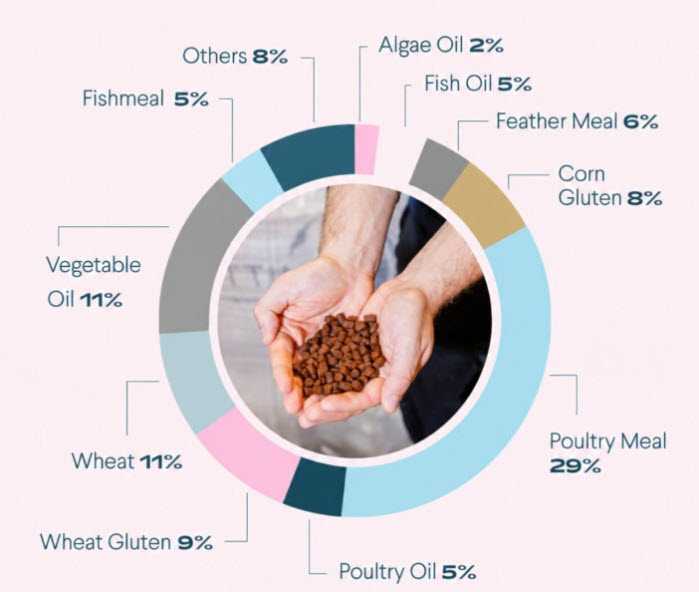
Fish Farming Expert reports that Atlantic Sapphire are actually proud to declare that they use poultry meal, feather meal and poultry oils in their salmon feed up to 40% of the total feed. The company say that it was always their aim to reduce their reliance on marine ingredients.
The reality is that whatever salmon farmers do, they will be criticised by their detractors.