
More lice: Writing a weekly commentary sometimes means that some news has already been well publicised by the time I write about it. The Discovery Islands sea lice data is a case in point. BC Salmon Farmers announced on Oct 5th that the latest tranche of sea lice monitoring data from around the Discovery Islands was being published. Salmon farms were removed from the Discovery Islands in 2022 largely due to the claims of activists who said that salmon farms were responsible for high sea lice counts on out migrating wild salmon smolts. Yet after four years, the sea lice counts on wild fish in the same area remain as high as ever. It seems the same critics have remained strangely silent. This does not surprise me for I have circulated the official press release to the leading sea lice researchers in Norway, Norwegian Government officials, the Marine Directorate’s science section, the Chief Scientific Adviser to the Marine as well as to representatives of SEPA and I have not heard back from even one. Those supporting the sea lice narrative appear to have gone very quiet.
For those who have not seen the press release, the following two graphs show the prevalence and intensity of sea lice on wild fish around the Discovery Islands. The blue bar is for pink salmon, the orange bar for chum salmon and the green line represents farmed salmon production.
One of the most significant observations that has been omitted from the official sea lice narrative is the total removal of any discussion about natural sea lice infestation. Not only has natural infestation been ignored, but there is also no understanding of how sea lice infest wild fish naturally or even any attempt to understand the process. What I am absolutely sure about is that when sea lice release eggs in the wild they do not depend on the fish being carried by wind and current over 50 kilometres in the hope pf finding a host. Instead, I firmly believe that infestation occurs over a very small area. As I have written previously, parasites have complex life cycles that depend on finding a host. What is certain is that they do not leave infestation to some random connection when in fact they are extremely targeted in their approach.
It is very telling that there have been hundreds of scientific papers written about sea lice infestation of wild fish from salmon farms but not one about natural infestation. I don’t have the resources to investigate fully, but it is interesting that some of the farms in Norway that have had the highest farm levels of sea lice are located in the upper reaches of the fjord systems, often on their own. If these farms are infested from other farms, then the larval sea lice have had to travel away from the sea.
As might be expected the established sea lice scientific community are not interested in talking about natural infestations, presumably because it would spoil their narrative.
It will be interesting to see how long it is before government, not just in Canada but also in Norway and Scotland, can no longer ignore the truth about why wild salmon are infested with sea lice and it hasn’t to do with salmon farms.
Warning: Kyst.no reports that the Institute of Marine Research (IMR) has issued a warning that there will be increased pressure on wild salmon if salmon farms are moved out to sea. This is IMR’s view after being commissioned by the Ministry of Trade, Industry and Fisheries on July 9th, 2026, to answer some key questions. IMR states that:
The request asks for input from the Institute of Marine Research regarding the ongoing development of plans to establish offshore aquaculture zones (HTH). Specifically, input is requested on:
- The size and boundaries of areas designated for licensing
- Possible measures to mitigate the risk of negative impacts on wild salmon
- Wild salmon migration routes and habitats from 2032 onwards
- The potential for implementing “accompanying research” in conjunction with the establishment of offshore aquaculture
It is further specified that the assessment must be limited to effects on wild salmon, and it is requested that—in addition to the Institute’s wild salmon researchers—researchers specializing in sea lice and the spread of infection also be involved in this work.
In their response IMR stat that it is particularly important that the pressure on wild salmon does not become greater than it already is. This means that infection and escapes from fish farms at sea must be kept to a minimum. They say that their input is based on what they know about the challenges faced by wild salmon including that many wild salmon die as a result of being infected by sea lice from fish farms and that fewer wild salmon are returning to Norwegian rivers every year.
IMR say that any new development must take into account that sea lice can cause big problems for wild salmon, which is why the farming sector is regulated by the Traffic Light System. They add that as they don’t know where wild salmon actually migrate, it is important to have measures that reduce the risk of sea lice spreading from these new farms to wild fish. They say that new farms must consider technology like submersible cages as well as fallowing and appropriate treatment capacity.
IMR are also concerned that any fish that might escape from these new facilities might end up in other countries. They say that the closer the farm is to the Norwegian coast, the greater the risk that any escaped fish will end up in Norwegian fjords however, they may also end up in other countries.
Clearly, the Ministry of Trade, Industry and Fisheries has a close relationship with IMR because they seem to rely heavily on IMR advice with regard to salmon farming. It is no wonder that there is such uncertainty about the way regulation is applied because this report shows how little IMR understand about salmon farming and the wider environment and of course sea lice.
It isn’t very clear whether IMR recognise that farmed salmon are lice free when they are stocked in the sea but if they are unfortunate to be in contact with a wild fish carrying lice, some may transfer from wild to farmed fish. This is how farms become infested. It depends on circumstances whether these lice become a problem for the farm or not but once infected, the farm needs to monitor and control the lice, although probably not at the ultra-low levels set by the regulator.
For farms located well out at sea, the chances of being infected by a passing fish are many times lower than in a fjord. Offshore farms are more likely to remain lice free. Far from warning about the perils of offshore farming, IMR should welcome such development and encourage them. Sadly, IMR have become so blinkered by their own models that they cannot see the sea for the fjords.
Interestingly, I have been a long-time advocate for offshore farming. In 1999, I gave a presentation in Brussels about the opportunity for offshore farming using decommissioned oil platforms. The cost of decommissioning is so high that I argued a collaborative venture between the oil and aquaculture sector could be extremely beneficial all-round. I argued that an all-in all-out approach would making farming out at sea considerably easier with little human interference. Of course, technology has moved on over the last twenty-five years making the potential for farming offshore more interesting than ever.
I have never thought IMR to be considered experts about salmon farming and therefore wondered why the Ministry relies so much on their advice.
Dee: The Daily Telegraph has published a long article on the slow death of salmon fishing and that the angling community built up around the River Dee risks extinction. The article spends most of the times talking to ghillies, anglers and associated businesses, all reminiscing how the fishing used to be and lamenting the fact that there are now less fish than ever. Ten years ago, the catch was 9.300 fish, now it is less than 1,500 salmon. The River Dee fishing report for the week beginning 5th October says that the total catch for the week was 110 fish.
What is interesting about the Telegraph article is that there is no mention or discussion about why the river is a shadow of its former self and why it has been downgraded from a grade one river to grade two, something which had been inconceivable for one of the big four rivers. Over twenty years ago, the local fishery board made the river mandatory catch and release because of the state of the stock. I can only wonder why they have never used any of the intervening time to actually try to find out why the river is doing so poorly, especially when rivers around them were doing ok, although that’s not the case now. Outside the newspaper report, there is talk of climate change, pollution, predation etc, but nothing concrete.
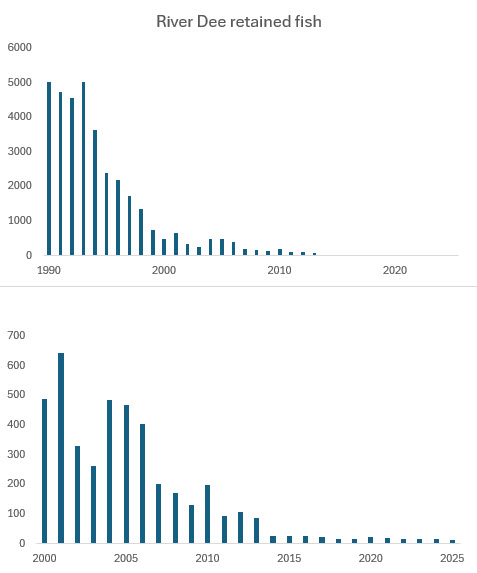
The newspaper article states that anglers on Deeside are quick to point out that their sport is not to blame for the decline as catch and release policy has been in place since 1994. Catch and release may have been mandatory since the late 1990s. but that hasn’t stopped the killing. Since 1994, river Dee anglers have caught and killed a total of 16,331 adult breeding salmon despite that mandatory catch and release policy. Of course, anglers have nothing to do with the collapse of stocks in the river. Since records began, anglers have caught and killed a total of 337,114 river Dee salmon so clearly, anglers are not to blame for the collapse.
River Dee retained salmon from 1994 to preset (top) and 2000 onwards (bottom)
The sad truth is that the river Dee showed signs of collapse long before the other major east coast rivers. One difference is that the river Dee enters the sea through Aberdeen harbour, which is a major working harbour with its obvious problems. Some work has been done looking at salmon and the harbour, but I believe any findings are inconclusive.
Meanwhile, the angler’s AI SLICE expert, who has a wide readership on Facebook, has written in response to this article that the answer to the river Dee crisis is visible to those who can see past the end of their nose. He says that post 2011, catches have collapsed down to 1,500 as reported in the paper because this was when farmed salmon developed resistance to SLICE and thus millions of farmed salmon flooded the migration routes with parasitic sea lice. He cannot understand why the 1300-word Telegraph article failed to mention salmon farming. Could it be because sea lice are not the reason the river Dee is in crisis.
If his theory was correct, with sea lice pouring out of farms in Orkney, Shetland and Norway, then why is it only the river Dee that initiated mandatory catch and release in the late 1990s because of declining stocks. Surely, the northern rivers would have been equally affected due to their close proximity to Orkney farms. Why too were not rivers in the northeast of Scotland also affected and not just one river many miles south of the nearest farm. Such inconveniences do not let anglers like the AI expert spoil their narrative,
The Telegraph ends by mentioning the Atlantic Salmon Trust Save the Spring project along with the local salmon fishery board. The main thrust of the project has been to plant one million trees to mitigate flooding and high temperatures. The latest news is that the project was just won the Conservation category at the 2026 Scottish Land and Estates Helping it Happen Awards. This might have been a little premature as there is no evidence that all these trees have helped wild salmon stocks recover. The Telegraph article would suggest not.