
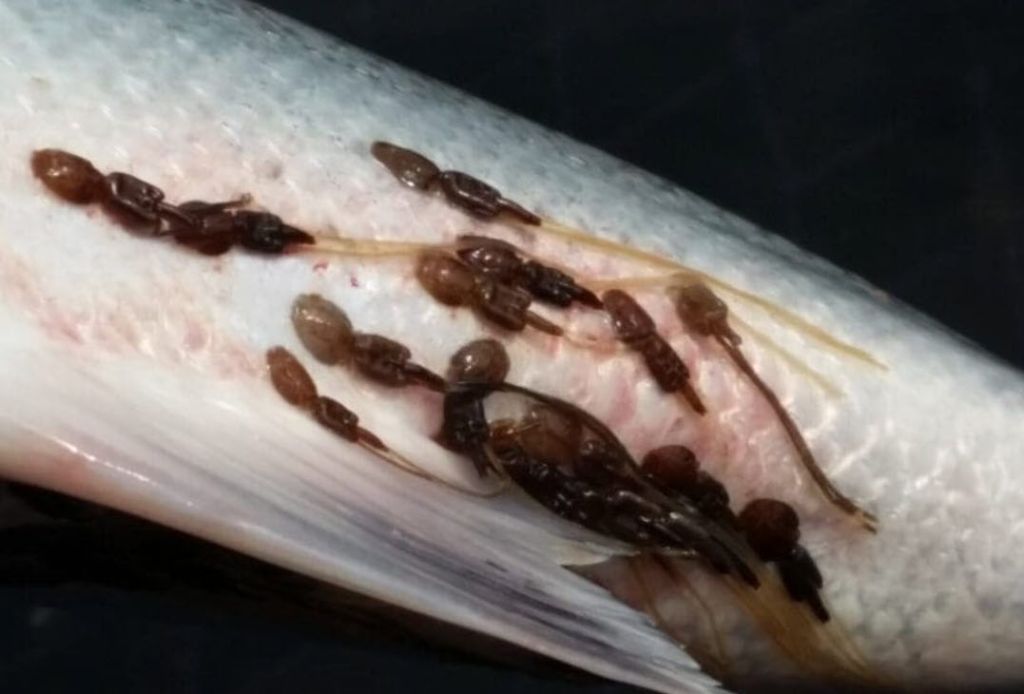
£1.572 million jackpot: Would anyone who reads reLAKSation like a share of £1.572 million (NOK 20 million) or know of other people who might like a share of this bonanza. In the week after the court case about sea lice and the Traffic Light System between PO3/PO4 Knowledge Incubator and the Norwegian Government came to an end with scientific representatives of the Government saying that the uncertainties are minor and the knowledge base is strong, Fiskeri-og Havbruksnæringens Forskningsfinansiering (FHF – The Norwegian Seafood Research Fund) has just announced a new project worth NOK 20 million.
The project title is – Identification of uncertainty and a new knowledge base for estimating the actual and relative impact of sea lice on wild salmon. The aims are twofold:
- Identify important uncertainties in existing models for estimating the impact of sea lice on wild salmon.
- Based on identified uncertainties, generate new knowledge and data that can provide more reliable estimates of the actual and relative impact of sea lice on wild salmon.
FHF say that they aim to finance several independent projects, so sadly, anyone wishing to join me in exploiting this finance will not be able to access the whole amount. As many readers of reLAKSation will know, this is a subject I know something about and which I have been more than happy to share with anyone who is keen to know more. By the end of the year, I will have spoken at five meetings and conferences in 2026, so my perspective is getting a wider airing than in previous years.
There was one conference at which I would like to have spoken and that is the annual sea lice conference organised by FHF. I have offered to speak at this conference in 2025 and in 2026, but both times my offer has been rejected. The annual two-day FHF sea lice conference is only concerned about sea lice on farms. Speaking at the conference this year, Eirik Ruud Sigstadstø said that regardless of anything else, the industry itself needs to be in control of sea lice, and FHF’s focus is about what the sector can do to help solve the challenge. The aim is to ensure that knowledge and best practice are shared around prevention and control measures that don’t involve the handling of the fish.
The 2026 FHF Action Plan elevated sea lice control into a distinct strategy area to ensure that it receives a sufficiently large and targeted effort reflecting its status as one of the most urgent challenges in Norwegian salmon aquaculture. The fact that sea lice are used to regulate salmon farming in Norway based on its impacts on wild fish seems to have been of little interest to FHF earlier this year. It was suggested that if they didn’t want to cover wild fish in the sea lice conference, they might like to organise a similar event for impacts on wild fish later in the year but clearly such a suggestion fell on deaf ears.
This week, FHF advertised two new dialogue meetings in Bergen for November. They say that the industry has spoken. Physical meeting places are important, and that is why FHF is holding more dialogue meetings than ever before. Yet, it is a bit of a mystery why they have not held such a dialogue meeting on this critical subject of sea lice and wild salmon.
Although FHF seemed uninterested in wild salmon earlier this year, they had clearly changed their view by the summer as they offered NOK 6 million to compile and assess national and international knowledge about all factors that affect survival of wild salmonids although they specifically highlighted impacts from aquaculture. Given that even the North Atlantic Salmon Conservation Organisation, of which Norway is a member, have absolutely no idea why wild salmon are in decline, the likelihood of this project shedding any new light on the issue seems unlikely. FHF are due to announce who has been given the contract any day now from which we should be able to gauge whether the project has the potential to succeed or not.
And now FHF would like to know and understand the uncertainties and knowledge base on the impacts of sea lice on wild salmon. The project doesn’t appear to have a time limit so it is unclear when this new information would come into the public domain and thus able to influence the proposed changes to the Traffic Light System.
Rather surprisingly, the project description states that the Traffic Light System is considered one of the most advanced risk assessment systems for salmon farming internationally. I am not sure who considers it to be most advanced because if it were it would have successfully halted the decline of wild salmon over the last ten years and it has not. Those close to the TLS have suggested that perhaps salmon farmers have played the system and this is why it has not been successful, whereas the truth is that the whole risk assessment system is so flawed that it was never going to help wild salmon.
Equally, if it is so advanced, why is there a need for new knowledge and an exploration of the uncertainties. FHF say that both the International Evaluation Committee and the Expert Group point out the need for more knowledge about several key assumptions and uncertainties yet the Expert Group refuse to discuss point blank any uncertainties that contradict their view.
It has been in the news during September that some farmers have taken the Norwegian Government to court over the implementation of the Traffic Light System. I believe that the farmers have resorted to this action because of the total intransigence of the scientific community as to the science that underpins the TLS. I might be wrong, but I would argue that if there had been a proper ongoing dialogue about the science, then the issue would never have reached the court. Instead, the scientific community do not want to be questioned or challenged. It isn’t necessary to look very far to see an example of this point.
At the beginning of August, iLAKS reported the one of the three Sea Lice Steering Group members, HI department director Karin Boxaspen responded to news of the court case in one single word – Nonsense.
iLAKS says that the reason for the case is that the farmers believe that research in which decisions are based is too weak. Dr Boxaspen responded with the comment that – what they are really saying is that they do not believe in the research adding that it may be that they don’t understand or don’t want to understand what a model is. She said that the court case is nonsense and absurd.
Perhaps if Dr Boxaspen had spent time explaining the research to farmers or their scientific representatives, then maybe they could have responded with their concerns, but the lack of communication meant that farmers were left with no choice.
Certainly, my own experience is that any enquiries are generally met by a brick wall. A case in point is work from Dr Boxaspen herself. In 1997, she published a paper in which the abstract began: Surveys in the area around Austevoll Aquaculture Research station have failed to reveal the presence of large number of the free-swimming stages of salmon lice in the water column. However, lice were abundant on salmon held in cages in this area.
Dr Boxaspen says that farmers don’t understand or want to understand the IMR models. The following is taken from an explanation of dispersion models that is posted on the IMR website:
An important task for the Institute of Marine Research is to investigate the dispersion and distribution of biological material and chemical substances in the ocean. This is managed best by utilizing dispersion models. We can in principle apply dispersion models to everything that passively drift with the ocean currents.
Dispersion models can be divided into two main classes: concentration-based and particle-based. Concentration-based (Eulerian) models solve an advection and a diffusion equation for concentrations, in the same way which is done for salinity and temperature in the circulation model. The alternative is particle-based (Lagrangian) models, where particles drift passively with the modelled current. Extra dispersion can be added to these particles by giving them an additional random displacement, which is commonly named random walk. Vertical processes like buoyancy, mixing and active migration can be added to the vertical displacement. We mainly use particle-based (Lagrangian) models at the Institute of Marine Research.
Salmon lice begin life with larval stages hatched directly into the water masses and develop through three non-feeding planktonic stages: Two nauplius stages (noninfective)) and the infective copepodid stage. If the lice larvae cannot locate a host fish in time they will die from starvation or predation. During these early life stages, the larvae can position themselves vertically in the water column but otherwise they drift freely horizontally with the water currents.
Information on the number of hatched eggs from the salmon farms is crucial for the quality of model estimated salmon lice infection pressure. Based on the temperature and number of adult female lice per fish (reported weekly by the fish farms), and the estimated number of fish in the farms (reported monthly), the number of nauplii released into the water masses per hour from each farm is calculated. This information is fed into a dispersion model that estimates the position of the salmon lice larvae as a function of the oceanographic conditions (currents, temperature and salinity).
(https://www.hi.no/en/hi/forskning/research-data-1/models/dispersion-models)
I think that is clear enough, but what is not clear is that whilst the models predict the dispersion of lice, the real-life evidence suggests otherwise as shown in the example from Dr Boxaspen’ s 1997 paper. Although the cages contained fish infested with sea lice, Dr Boxapsen could not find any larvae in the surrounding waters. I have written to her a number of times, but I am still waiting for an explanation of why she failed to find the expected larval lice. After all, if the fish in nearby cages are infested, they must be releasing eggs and larvae as the models predict, unless the models are wrong.
I understand that Dr Boxaspen thought that she might be asked about her paper during the court case so responded in advance by pointing out that the introduction of her 1997 begins by stating that:
The first three stages of salmon lice which are free-swimming are very difficult to find in nature. A total of 107 larvae were found in 335 samples of sea water (1-5m3) (Boxaspen 1995).
This raises some interesting questions because both her 1995 and 1997 papers cover the same location and time period, although her 1995 paper is technically not a paper but a report to the Research Council of Norway and thus not peer reviewed published research. It seems strange that the abstract of the 1997 begins saying that ‘large numbers’ of lice were not found but she did not discuss what constitutes a large number but, in the introduction, refers to a private report. Why the connection was not discussed in her 1997 paper is unclear. The point is that over three years and 355 samples, Dr Boxaspen found just an average of 35-36 lice larvae each year. This is hardly the huge swarms of sea lice that are inferred can be found in Norwegian fjords, where salmon farms operate. In addition, data from 1993 to 1995 hardly constitutes a representation of what is happening to sea lice today.
Whilst the scientists and their supporters claim that the evidence against sea lice is overwhelming due to the hundreds of peer reviewed papers that have been published, the fact is that there is little evidence, if any, of anyone finding these lice in the open water. A paper by IMR researcher Jofrid Skarðhamar titled sampling planktonic salmon lice in Norwegian fjords from 2019 states:
“Direct sampling of lice from Norwegian waters to determine concentrations has never been published scientifically and has been considered non-feasible for monitoring purposes.”. Instead, farmers are left at the mercy of the models which bear little resemblance to what is happening in nature. Of course, if I am failing to understand the model as Dr Boxaspen suggests, I would be more than happy to have her, or her colleagues, explain what I have misunderstood face to face.
Meanwhile, the key uncertainties relating to the impact of sea lice on wild fish stand out like a sore thumb and do need to be made available to a wider audience. The FHF project is clearly the way that this can be achieved and hence this project is an attractive option. If the only way to get FHF to discuss the uncertainties is through their project, then so be it. The problem is that it makes no difference how experienced in their subject the applicant is, they also need to be experienced in the project application process and project management. This naturally favours the big research institutions.
The application is assessed by the following criteria:
- Project proposal relevance: 1.00
- Economic benefit: 0.80
- Implementation plan: 0.80
- Contribution to sustainability: 0.30
- Feasibility: 0.70
- Connection to other projects/activities: 0.30
- Dissemination plan: 0.50
- Budget and financial framework: 0.50
- Application assessability and document quality: 0.30
It seems that the project itself scores just 1 out of 5.2 which seems extremely low. I would have thought it is the project outcome that should trump everything else but clearly not. Whilst a score of one is the highest individual criteria, it does represent just 19% of the total. I am therefore asking those in reLAKSation land whether they may be willing to join me in submitting a proposal and managing the project. Alternatively, you might know of other people who would be interested.
This is a real opportunity to highlight the reason why the Traffic Light System is flawed by raising the range of uncertainties that exist beyond the views of the Expert Group. If anyone is interested how much uncertainty has been highlighted by the Expert Group, the word uncertainty appears 210 times in their annual report. (This does not mean they have highlighted 210 uncertainties) but it does raise the question that the impact of sea lice on wild salmon is not the foregone conclusion that those opposed to salmon farming would have everyone believe.
The biggest uncertainty is what will FHF do with this knowledge once the project ends. Will it just sit there in a report, or will it ever be actioned?
You can contact me via relaks@callandermcdowell.co,uk I am always happy to hear from anyone on any subject. It doesn’t just have to be about this £1.5 million jackpot.