
Lice Status: Intrafish has commented on the latest lice report from the Institute of Marine Research. They say that the pressure from sea lice for September is generally lower than at the same time last year. This is because in their estimation, there have been less lice produced in the majority of production areas!
PO1 and PO13 are not really reported, either because there are so few reports (PO1) or because the data is missing (PO13). The remainder of production areas including PO3, PO4, PO5, PO6, PO8, PO10 and PO11 are all described as being below the levels found in 2025.
PO7 and PO12 are described as slightly below the level for 2025 and PO9 is described as about the same.
Of course, these are estimated lice levels based on sampling which is already highly over-estimated.
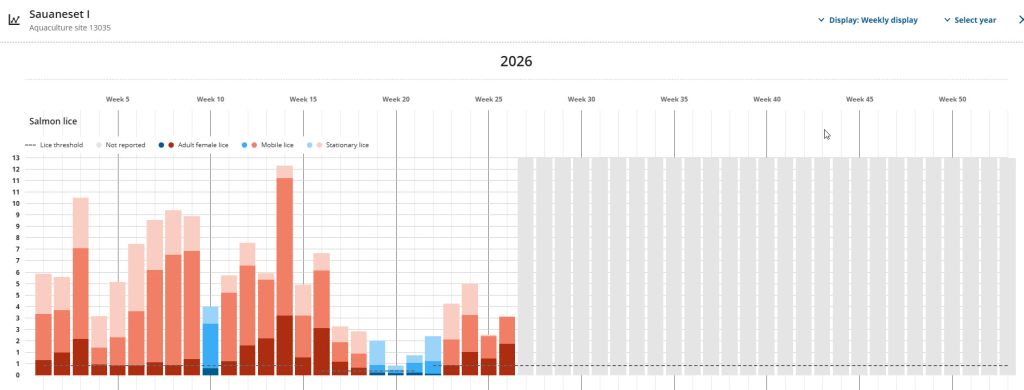
What is most interesting is that IMR’s own farm that is attached to Austevoll Research Station had been pumping out lice for most of the year until week 27 when it looks like the site was harvested.
Now over a week after IMR issued their lice report, they have put forward a suggestion as to why the lice levels are lower this year. They say that this could be due to an unusually cold summer in several of the production areas in southern Norway. For example, the temperature during week 30 in PO3 was almost three degrees below the average for the period 2012-2025. In PO4, the temperature was almost four degrees lower. I now look forward to reading a peer-reviewed paper which links lower lice levels to this year’s low temperatures.
According to AI, the Austevoll Research Station is located in PO3 which means water temperatures were lower this year around the research station, yet IMR still failed to prevent an explosion of lice in their fish pens. I am not quite sure why IMR cannot keep their lice levels under control when the industry is clearly making strenuous efforts to do so.
Iceland: I’ve been in Iceland this week to speak about sea lice at the Aqua Ice conference. As part of the event, the organisers kindly arranged a tour of southwest Iceland taking in the area of land-based salmon farm development, geothermal power generation and volcanic activity. This included short presentations from some of the new land-based farms, which all appear to be located along the same road in Olfus municipality. The mayor of Olfus told the participants that land-based salmon farming represented new value creation for the area. This he said, together with some other new initiatives, has revitalised the local town and the wider municipality. He says that these businesses represent the future of aquaculture and the local area. However, having heard representatives of some of the companies, I sadly do not share the same optimism expressed by the mayor. However, this is not a view that I have garnered from this one-day tour. A couple of years ago, I attended an event in London where some land-based companies came to present their vision for Icelandic aquaculture and, if I remember correctly, they were seeking both investment and potential marketing partners. The one point that I really remember was the insistence that land-based raised salmon from Iceland would receive a premium price. Yet, those speaking in Iceland last week were doubtful as to whether such a premium price could be obtained, a view I share with them. Salmon generally tastes of salmon whether raised at sea or in a tank. There may be some slight differences, but these are so small that consumers would have to eat significant amounts to become attuned to such differences. Consumers might say they are willing to pay a premium if they believe that one production method is better than another, but when it comes to paying more, they usually have a change of heart. I have never seen any evidence of premium pricing for the method of production, and very rarely for country of origin and then it doesn’t usually last. This view was confirmed after listening to these presentations in Olfus municipality. What is clear is that these farms can benefit from clean sea water, filtered through larva, which is raised to an ideal growing temperature by geothermal energy but after that, there is still a huge investment cost to build extremely large land-based farms consisting of multiple large concrete tanks. Most of these farms are under construction and still in their initial stages. Some have been growing smolts for some years and now are expanding into grow out too. There are some already producing harvest fish but not in large quantity. The main target markets will be China and the US, especially with favourable tariffs. The UK was in receipt of about 2% of production and certainly I have seen salmon in UK stores labelled as farmed in Iceland, but also labelled with multiple origins, typically Scotland, Norway or Iceland. Whether that salmon is land-based is not revealed.
Despite the benefits of clean warmed seawater, the farms have a massive capital investment. One of the farm representatives mentioned that total investment of their farm was around one billion euros. That seems an awful lot of money to recoup by just producing salmon.
Unfortunately, whilst the tour passed most of the land-based farms in the Olfus area, there was no opportunity to actually visit an operational unit. It was unclear whether this was because the farming companies did not want visitors within their farms or that time was limited. The tour did visit the construction site belonging to Thor Salmon where we could see the cast concrete bases of the new tanks. For me what was most interesting was that the company’s chief executive, who has been in the job for just over a year, mentioned that the farm was being built on a site that had been previously developed forty years ago. This was interesting because in 1988, I visited this farm, which at the time was also partly under construction but also had been partially stocked. I remember hearing the same benefits of this site back then, which was the use of pumped filtered sea water ensuring that the farm would be disease free and therefore not require the use of antibiotics. What happened to the farm is unclear, finance was mentioned last week but forty years ago, this was pioneering technology. It appears that at the time, that total package was just not viable. It remains to be seen whether the same ideas can currently pay now and in the long-term.
At present these salmon farms have another problem to contend with, and this is the issue of sludge, which builds up within the system. Currently, there is no process in place to deal with it. They cannot use it as fertiliser, and they cannot just dump it. There is an EU funded project looking at using the sludge in anaerobic digestion for conversion to biogas but the resulting waste must still be converted to some other form before it can be used. The alternative is to just use the available heat to dry the sludge into a usable fertiliser. However, the researcher involved in the biogas project highlighted that the chemical profile of dried sludge did not match up to that of imported fertilisers so further work needed to be done. What he did say was the amount of sludge that could be generated if the predicted production was met would equate to eight 40-foot containers a day.
The tour also visited a second power plant that had created a resource park around it, in which aquaculture was being encouraged. One salmon farm was already being developed but other species were being encouraged too. One farm was aiming to produce abalone which was expected to fetch up to $250/kg in Japan. Their representative explained that the conditions were idea for abalone, but he still needed to raise more finance to go into production. Another company was producing flatfish, based on methods developed elsewhere but without the benefits of heat and cheap electricity. The company representative said that they had been trialling other species too but had decided to focus on flatfish instead. Whether the market for these fish justifies increased production is another question.
Icy regulation: The Aqua Ice conference in Reykjavik was opened by the Fisheries Minister who spoke about regulation of Icelandic aquaculture. Salmon Business wrote about some of the discussion that was reported in Icelandic newspaper Visir. The main point was that the planned bill to regulate aquaculture in Iceland has been postponed and is now unlikely to be considered in this parliamentary session. This left planned changes for both sea and land-based salmon farming unresolved. The paper suggests that the reason that it will now not be considered is because other matters have a higher priority, but equally a message I heard was that there was no consensus amongst the industry as to what form the regulation might take. There was also no agreement on a unified strategy between politicians either.
Although it was not raised, I wonder how much influence that the angling sector has in the development of aquaculture policy. Certainly, Iceland is a hotbed of anti-salmon farming rhetoric with organisations like North Atlantic Salmon Fund claiming that salmon farming is responsible for the decline of wild salmon. This is in part one of the reasons why land-based farming has suddenly become so popular in Iceland but clearly, it is still not a certainty that such farms will be viable in the long-term. This leaves sea-based farming as a target and there is pressure on politicians to ban it whilst at the same time, local mayors and politicians are arguing that they are the lifeblood of some remote communities. With so many mixed messages, it is not surprising that a consensus on how regulation should look cannot be reached.