
Bits and pieces 1: Last week, the Scottish Government published the results of an acoustic tracking study looking at migration routes and behaviour of Atlantic salmon and sea trout. The specific target of this study was the area around operational wind turbine arrays in the Moray Firth, which was conducted by the Zoological Society of London over two years, 2023 and 2024.
The study found that a total of 33 post-salmon smolts (19%) entered the wind turbine zone and spent typically 36 minutes amongst the turbines with one resident for 5 hours. A small number of fish stayed for up to 2 days in the vicinity of the turbine zone but not in it.
Around 40% of sea trout spent a week stayed within the vicinity of the turbine zone re-entering the detection zone multiple times up to four months after the first detection.
The report says that there was no evidence of marine predation near to the turbines or in the wider study area. Although the conclusions were somewhat vague, it seems that neither Atlantic salmon nor sea trout suffered negative effects by migrating through wind turbines at sea.
What is of much more interest than these findings is that a report has been published for a tracking study that ran from 2023 to 2024 (although the detection arrays remained in position until March 2025). By comparison, the final report of the West Coast Tracking project which ran from 2021 to 2023 has still to be published. How can one tracking study that began at the same time that a second study ended have published the final report whilst the other has still to see the light of day and I suspect never will. This is because the one of the main aims of the project was to show that migrating smolts were impacted by the presence of salmon farms located on their route. In fact, the Atlantic Salmon Trust state on their website that the evidence generated by the project will:
“Help inform on going adaption of the SEPA Sea Lice Risk Assessment Framework”.
I am sure that had there been strong evidence from this project implicating the salmon farming industry in the decline of wild salmon, the Atlantic Salmon Trust would have been shouting the results with the loudest possible voice, yet I have heard nothing. Could this be because they have nothing worthwhile to say? In which case better to remain quiet than say anything.
Bits and pieces 2: The Scottish Government also just published the minutes of the Wild Salmon Strategy Implementation Plan Delivery Group meeting of 13th May 2026. Readers of reLAKSation will be pleased to note that the proposed logo was to be recirculated amongst members for any final comments.
Much of the meeting was taken up by a presentation from Scottish Canals who gave a summary of fish migration optioneering studies and discussion. As the Scottish Government have never recorded salmon catches from canals, this seems just another distraction from the central issue of stopping the decline of wild salmon. Such distractions seem to be a feature of these meetings as I have yet to see a firm proposal to do something positive to help stocks recover. The meeting also discussed wind farm applications, which are yet another distraction given the publication of the tracking study. The wild fish sector is very good at blaming everyone and anyone about the declines, but I see nothing in these minutes about the impacts of angling on wild salmon stocks.
I also note from the minutes that the Science and Evidence Board work on beavers and large wood additions remain active but is being progressed at a slower place. This is because the Chair of the SEC was busy with other Scottish Government work. I am sure wild salmon will understand the delay. Regardless, wild salmon have been in decline since the early 1970s, and beavers were first re-introduced to Scotland in 2009 so any work on beavers is really going to help! I will comment on the large wood introductions in the next section.
The minutes also refer to the failure of the Scottish Government to submit their conservation report to NASCO in April, and they now have a new deadline in November. Having seen reports submitted in previous years, it seems difficult to comprehend why there is a delay at all.
Finally, the minutes report that there was an unsuccessful procurement round in January to commission a socio-economic study and now there is consideration that FMS might lead this work. This again brings into question as to whether the aim is to safeguard wild salmon or wild salmon fisheries. Of course, if there is no salmon, there is no fishing and jobs will be lost and local economies will suffer. It doesn’t take yet another survey to understand this but whilst there is little effort to understand why wild salmon are in decline and then address the matter. This surely must be the focus of this group but nothing they have done since their inception has convinced me that wild salmon are the priority.
Bits & Pieces 3: The fishing reports published in Trout and Salmon magazine always produce some interesting comments. This time they come from one of the ghillies working on the River Spey. I know that Scottish Government scientists do not like anecdotal evidence, but such evidence from the riverbank does contribute to our overall knowledge.
The October issue reports that catches have been poor again this season, but the Scottish Government is happy to allow the river to remain as a category 1 unlike their neighbour the River Dee which is now category 2. The report says that it goes to show how poor catches have become when one of the big four rivers has fallen to category 2.
The fishing report continues that woody structures and tree planting may not be the saviours that they are trumpeted up to be. However, it points out that the problems are just not in Scotland with someone getting lucky in the lottery to fish the Norwegian river Alta for three days and caught just one salmon and two sea trout.
Finally, the report mentions the results of the juvenile survey which suggests that fry numbers have been good this year but the ghillie author of the report wonders whether this might be a false high as water levels have been low this year leading potentially to fish crowding in a much smaller area than if there was more water. Of course, such local knowledge may not have been taken into consideration by the Scottish Government scientists analysing the data whilst sitting in their laboratory.
Bits and pieces 4: By coincidence, the Scottish Government has also published an updated version of the National Electrofishing Programme for Scotland (NEPS) It seems that in August, the report was updated with the addition of the reference to alleged genetic introgression. The template had been updated in June this year but the last update for information was in June 2025 when the NEPS report for 2023 was added. It’s good to see that the Scottish Government scientists are using the latest information in their attempt to help wild salmon. We are coming to the end of the 2026 fishing season and juvenile data for 2024 and2025 has yet to be published.
If this was the commercial sector, the scientists would in my opinion be spoken to very strongly. There does not appear to be any accountability, so it is not surprising that wild salmon are in crisis.
Bits and pieces 5: It was sad to read that the author of the Tweedbeats blog has decided to discontinue his weekly musings. It seems that there has been an ongoing battle within the Tweed Commission with attempts to undermine the Chief Commissioner for reasons not shared. Tweedbeats says that there is more to life than this aggravation and it is no wonder that disillusion has set in and the last thig that he wants to do is to continue writing about the river he loves and its fish.
The picture often given is harmony within the ranks of the angling fraternity, but this is far from true. Over the years I have heard stories of many anglers who think that the rules don’t apply to them. It can be a very nasty place as the salmon farming sector know only too well.
I recently wrote about Ken Reid, who attended the last Delivery Group meeting, and his online fishing club. I wrote that two members of the salmon farming sector were excluded from the social media. I have since heard that they are not the only ones and that active members of the wild fish sector have also been excluded for highlighting factual inaccuracies about salmon farming that appear on the Salmon Fishing Club social media. It comes as no surprise that anyone making a comment that is not a direct attack on salmon farming is seen as a turncoat who should be excluded.
It seems very sad that some (probably most) sections of the angling fraternity do not want to engage in a proper discussion about the alleged impacts of salmon farming. Instead, it is guilt by association. As I have indicated before now, clearly the angling sector blame salmon farming for the lack of wild salmon for them to catch and kill and nothing will persuade them otherwise. I would have thought anyone who really cares about the future of wild salmon would be willing to leave no stone unturned in their attempt to find out what is happening to wild salmon.
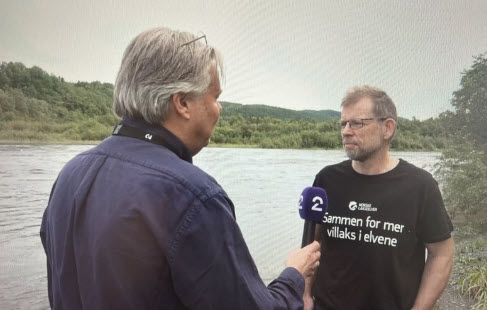
Bits & Pieces 6: I was interested in a commentary from Sjømat Norge that appeared on Linked In concerning catches of salmon and sea trout from the Stjørdal river in mid-Norway. Norwegian TV2 was present when Sp leader Trygve Salsvold Vedum visited the river and heard how bad the fishing was this year. A representative from Norske Lakseelver was also present and told the reporter that there were almost no salmon in the river. They added that it is very sad as there should have been at least one bite once a day but now a week can go by without catching a fish.
The Linked In commentary said that it was unfortunate that the reporter didn’t take the time to fact check the story because he would have found that what he was told by Norske Lakseelver was simply not true as the data on Elveguiden.no clearly shows.
During the 2026 season a total of 2,310 salmon and 517 sea trout were caught form the river, which represents the best salmon catch since 2017 and the fourth best year in the last twenty-five years. The commentary says how is it possible that so many fish have been caught when according to Norsk Lakseelver the fish are not biting.
Interestingly just eight fish alleged to be salmon of farmed origin were included in the catch.
The data doesn’t identify how many of the salmon that were caught were killed but last year about 35% of salmon caught were killed, which if at the same level equates to about 800 salmon killed from the Stjørdal river in 2026. There is a still from the TV report on Linked In which shows the head of Norske Lakseelever wearing a T-shirt with the words ‘Sammen for mer villaks in elvene’ which translates into ‘Together for more wild salmon in the rivers’. Perhaps the way to keep more salmon in the river is to stop killing them for sport rather than continuing to blame salmon farming for the lack of fish. Yet the Stjørdal river might indicate that in parts of Norway at least, salmon numbers have turned the corner.
Bits and pieces 7: Wild Fish (Conservation) say that they exist to reverse the decline in wild fish populations. Their main fund-raising activity is currently underway which is the Wild Fish auction consisting of 152 lots, the majority of which are for fishing on a variety of UK rivers. The star lot is a day’s fishing for two with Nick Measham, CEO of Wild Fish on an exclusive beat with lunch included. At the time of writing the highest bid of £250 falls well short of the £800 guide price.
It does seem odd that over 100 opportunities are being offered to torment wild fish and possibly stress them to death as a way of protecting wild fish populations but then Wild Fish are not that honest and fail to admit that they are the representative organisation for salmon & trout anglers and not a conservation charity. This is one of the reasons that they remain hidden away, preferring to speak only to those who know less than they do about the issues their promote. They won’t talk to the salmon farming industry because they know their claims against salmon farming will be countered with real evidence and not some unsubstantiated rhetoric.
Meanwhile, the Atlantic Salmon Trust will be launching their auction in October.