
Desperation: A couple of years ago, the angler’s representative organisation Wild Fish (formerly Salmon & Trout Conservation and Salmon & Trout Association) published a report that every farm in Scotland was pumping out around 2 billion sea lice larvae every week. In their crusade to have salmon farms removed from the Scottish west coast in their mistaken belief that this will bring back wild salmon to Scottish rivers, they have commissioned yet another model indicating sea lice dispersal from 16 salmon farms in the vicinity of the Isle of Skye.
They say that they have commissioned a couple of expert modellers, who clearly may be experts at modelling, but equally appear to have little understanding of parasitology to produce their new model, the results of which appear in a new report, which is available from the Wild Fish website.
The report – Modelling of Sea Lice Dispersion from Salmon Farms and Post-Smolt Exposure in the South Skye–Torridon Region, West Coast Scotland by Dr Tom Scanlon and Dr Matt Stickland of MTS-CFD Limited – runs to 53 pages but all that anyone needs to know about the report can be found in one of the various images of the model showing sea lice dispersal.
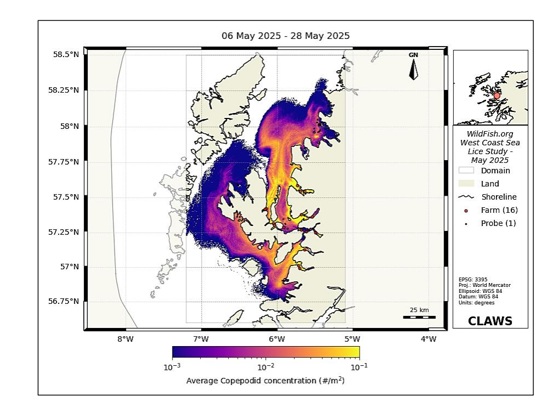
The image shows the concentration of infective sea lice larvae as they spread away from the farms with higher concentrations show in yellow with dilution in red through to blue, which is the lowest concentration. It is only when the scale is considered that more questions that usual arise. The scale is from 10—1 to 10-3 lice per m2. Thus, even in the most concentrated areas, just one louse is to be found in a square metre. However, lice, if they are present, do not remain as two dimensional but rather as three so the measure should be per cubic metre. The yellow area equates to one louse in 10 cubic metres of water whilst the blue area is one louse in a thousand cubic metres. Whichever way this is portrayed, it is extremely difficult to understand how such concentrations of lice larvae can represent any risk to wild fish.
Of course, this is not a problem for Wild Fish, who will ignore any inconveniences in their narrative to continue their crusade against the salmon farming industry. Now having funded the modellers to produce their evidence, it would complete the story if they funded some independent environmental company to sample various locations within the model and confirm that the lice they predict are actually present in the water column. I will be waiting with some anticipation.
Five factors: An extended article concerning the transformation of the salmon industry in Norway in relation to sea lice and written by a group of academics was published recently by Intrafish. They say that five things must happen if the industry is to successfully transform in the coming years. According to this group, society expects that lice pressure on wild salmon will be reduced whilst at the same time farmed salmon will be spared the damaging treatments that are currently required to maintain low lice levels on salmon farms.
Whilst this group suggest some reasonable proposals, I am not sure I agree with their view, and this is simply because they have responded to some established expectations, whilst I would take this a step further and question these preconceived expectations. For example, I would question whether society expects lice pressure on wild salmon would be reduced. Instead, a small, very vocal section of society, the angling fraternity, do expect this but at the same time, they hide the fact that they have a much bigger impact on wild salmon than salmon farming from the rest of society. Rather than have an expectation of sea lice pressure reduction, the basic question should be asked whether sea lice associated with salmon farming does actually have a negative impact on wild salmon at all. The scientific community say that there is an impact, but this is based on the results of the models that they themselves have constructed. They consistently fail to provide clear proof that wild salmon populations are impacted by sea lice in real life. It is just conjecture. The biggest problem is that the scientific community refuse to discuss whether wild salmon are impacted or not, which seems an unnecessary obstruction to the development of one of Norway’s key sectors.
Meanwhile, the authors of the article say that the societal expectation will not change in the coming years and thus restructuring will be also necessary. Again, this is a preconceived idea and still one that is unproven. The concept that farmed fish should be separated from wild fish was put forward long ago, but not by those with experience of salmon farming but by the wild fish sector. It is they who first promoted that salmon farms should be transformed into closed containment, with the view that the sea lice cycle will be prevented. What they fail to recognise is that closed containment, whether on land or sea comes with its own set of problems, not least the expense. Just last week, one of Norway’s major proponents of closed farming was forced to announce that one of the Watermoon units had failed leading to massive mortality. The positive spin on this story was that no fish escaped!
The authors of the article say that if salmon production is to be maintained then it will require extensive investment in technologies that effectively separate salmon and lice. They say that this could cost over one hundred billion kroner.
This view appears to echo the views of the angling fraternity, but it is misplaced. Firstly, because removing salmon farms (or separating them out) will not prevent lice infestation in wild fish. This is because there is a natural infestation which has always existed but was never noticed because there was no association to someone to blame. We have already seen from British Columbia that closing farms does not prevent high lice infestations. Secondly, there are other solutions to reducing lice on farm sea lice (that will be of more benefit to the farmer than wild salmon) and that is the development of vaccines and in feed lice inhibitors. Most of this innovation appears to be taking place in Chile as their scientists seem more enlightened than those in Norway.
In recent weeks, Fish Farming Expert has reported that a new vaccine based on functional domains of vitellogenin has reduced lice infestation by up to 53%. Another prototype vaccine using ipath recombinant formulation cut lice infestation by 73%. In addition, an in-feed treatment based on camelid derived nanobodies has been developed and is currently undergoing efficacy trials. A second in-feed treatment is also under trial and has demonstrated high efficacy of more than 99% on all states of lice. With such developments underway, why would any farming company invest millions on new cage technology which may lead to other unforeseen problems when vaccines and in-feed treatments are not that far away?
The article says that five factors will determine how quickly this transformation of the salmon farming industry will take place. These are:
- Lice counting on farms.
The authors say that for any new system to work sea lice on salmon farms must be counted reliably and that this cannot be done today, regardless of what method is used. They say that this is especially true of the ultra-low levels demanded by government regulation. However, we should be asking why we need to determine lice levels to such a low level anyway. There is no evidence that maintaining lice levels on farms benefits wild fish at all. Clearly automated counting could be better than manual counting, simply for practical reasons, but new data I have seen and can’t discuss at the moment would suggest that farm lice counts are highly over-estimated. It is the narrative that needs to change and this will never happen whilst the scientific community refuse to discuss the science that they prefer to ignore.
- Lice induced mortality in wild salmon.
The article say that the acceptable impact of less than 10% lice induced mortality appears to be poorly justified. The problem is exacerbated because it is difficult to estimate the relationship between lice infestation on farms and wild salmon mortality. I would go further and suggest that so far no-one has actually proved that sea lice are responsible for the mortality in wild fish. It is simply conjecture based on the idea that salmon farming has expanded at exactly the same time wild fish numbers have declined. This is simply a coincidence but because the models which are built on the concept that sea lice kill wild salmon, the models must be right and wild fish are dying in droves due to sea lice. Sadly, the models have never been validated which is just a minor inconvenience to the narrative.
- Technologies that distinguish lice from salmon.
The article says that serval production technologies have the potential to significantly reduce lice levels, closed, semi-closed and submersible facilities. However, the authors are not the ones having to pay for these proposed technologies which come with no guarantees that wild salmon numbers will recover if used.
- Binding cooperation in aquaculture.
There is some sense in local companies working together to stock fish at the same time and leave farms fallow at the same time but how practical this would be when so many farming companies operate in the same locality is unclear.
- Management with capacity and predictability.
The authors say that whichever regulatory model is chosen, it must be properly managed especially in relation to change. However, I would suggest that whichever is chosen must be based on truth and not the narrative of blame that drives regulation today.
The authors raise some key questions but whether these five factors alone will help resolve the current problems of regulating the salmon industry is doubtful. What is needed is a proper debate as to whether sea lice on farmed fish actually are responsible for the current crisis affecting wild salmon populations as some sectors suggest.
Ostrich facts: A number of angling and conservation groups have written to Kyst to say that the farmers of western Norway should stop burying their heads in the sand like an ostrich and stop disputing the research and putting forward other explanations to why wild salmon are in decline.
I would argue that it is organisations such as Norwegian Salmon Rivers, Norwegian Hunters and Fishermen’s Association and Reddvillaksen who are the ones with their heads in the sand. They write that the knowledge about sea lice is well documented and solid. I would disagree and so it seems are the farms of western Norway. However instead of being willing to hear why farmers are concerned about the knowledge base, these groups simply dismiss farmers concerns, as do the scientific community and you have to ask why.
The answer is simple. In the case of the wild fish groups, they know that if salmon farming is not the problem, then they are the next in the firing line. Currently Norwegian cod and haddock is being subjected to reduced quotas because of a growing acceptance that stocks have been over-exploited. Wild salmon are no different, yet no-one seems to equate the two together.
In the case of the scientific community, there has been a wealth of funding available which has led to hundreds of scientific papers; however quantity does not mean quality. This together with the fact that the determination of the regulation is largely based on the work of those making the determination means that the scientific reputation is under threat. If the science is rejected, then so is the scientific reputation of those who wrote the science.
The groups write that for decades wild salmon have swum through fjords with enormous amounts of salmon lice larvae. In that is the case, then perhaps the groups should go and find these lice and provide them as evidence to the farmers because so far no one, including the scientists, have managed to show that wild fish actually swim through enormous numbers of lice because they cannot find them. The fact that the lice are not there does not stop the groups saying that as a consequence of swimming through these (non-existent) lice, there is a high mortality among the migrating young salmon in the spring. Again, there is no evidence that these fish are dying as these groups claim.
According to the groups, the Institute of Marine Research calculate the mortality at population level, and they say that this makes ‘shocking’ reading. Seemingly 48% of wild salmon smolts from Granvinsvåsdraget died of sea lice in 2025 and 50% of the small Eidefjord salmon died in the same year. Of course, these numbers are calculated based on modelling and are unproven.
I am in no way suggesting that wild salmon are not in crisis and that 1-3% of migrating smolts now return to their home rivers, but the claim that this is due to salmon farming is extremely weak. These wild fish groups are more than welcome to explain to me why I am wrong as are the scientists, but none are willing to do so from which readers of reLAKSation can draw their own conclusion.