
King’s river revisited: In the last issue of reLAKSation, I discussed the proposed conservation gradings for rivers in Scotland for 2027 and pointed out that one of the more newsworthy changes was the decision to downgrade the river Dee from Good to Moderate. Obviously, I was not the only one to think so as the Sunday Times published an article about the changing circumstances of the river Dee saying it is a worrying development for angling in Scotland, but probably not as worrying as it will be for the salmon that are now in catastrophic decline.
The newspaper contacted the Dee District Salmon Fishery Board, which it says looks after the river, but they refused to comment ahead of the publication of the finalised conservation gradings. I found this an interesting response. Either they agree that the river Dee is now in crisis and warrants the new grading or else disagree and plan to appeal during the associated public consultation. Whilst the Times says that the Fishery Board runs the river, the reality is that it is the representative organisation of the river proprietors, who have a vested interest in the fishing. Maintaining a Good conservation status is clearly good for business.
The newspaper also spoke to the Scotland director of the conservation charity Wild Fish (otherwise known as the representative organisation for salmon anglers but that role has been greenwashed out of the narrative, Nick Underdown told the newspaper that the figures expose a slow burn national crisis and should set alarm bells ringing. However, Mr Underdown is wrong. It was a slow burn between 1971 and 2011 but in more recent years it has become a major catastrophe, although it is hard to believe from the lack of action taken to try to halt the decline.
Mr Underdown added that this should be the moment for the Scottish Government to upgrade environmental protection on its list of political priorities as it no longer can sit on its hands. He ended by saying that the decline of the Dee should force a fundamental rethink of Scotland’s approach to restoring wild salmon. However, Mr Underdown remained silent on what action the Scottish Government should take. We all know that Wild Fish are a one trick pony when it comes to Scottish salmon. They believe that if the Government would close salmon farms, wild salmon will miraculously return to Scottish rivers. Whilst Mr Underdown is happy to talk to the media, his concern for wild salmon does not extend to talking to others about possible solutions.
The Scottish Government told the newspaper that the Scottish Wild Salmon Strategy and the accompanying implementation plan developed with stakeholders is guiding collaborative action to tackle a wide range of pressures facing wild Atlantic salmon, in which case we can be absolutely certain that wild salmon’s days in Scotland are numbered because the strategy offers wild salmon no hope because it simply doesn’t address the fundamental issues affecting this iconic fish.
However, that covers the much wider issues which will do little to protect the river Dee. The question is why the river Dee has lost its Good status and should it have been downgraded before now?
It’s really all about whether the scientists think that the river is producing sufficient eggs to meet the egg requirement which is calculated as the number of eggs for every square metre of wetted area of salmon habitat in the river, which for the river Dee is 3.11 eggs/m2. This is calculated from the rod catch, which is a very unreliable method as so many factors can influence how many fish are caught in a river ranging from angling effort to how much rain there was and whether all the fish caught have been declared.
From this catch, the numbers of returning salmon are calculated and then to how many are spawning females, from which is calculated the number of eggs. Thus, number of eggs is then compared to perceived egg requirement, which is expressed as a percentage.
The last dataset available was for 2025 which means that the 2027 gradings are based on 2025 and thus are already out of date. Reports from 2026 suggest that the catches will be even worse than 2025 so potentially even less females available to produce eggs.
For 2025, the river Dee had a 60.72% chance of achieving its egg requirement. This percentage falls within the Moderate grade, but this is not why the river has been graded as Moderate. The actual percentage used by Marine Directorate scientists was 76.8% or 3.2% below the threshold for a Good rating. How 60.72% turned into 76.8% is not a mystery. Marine Directorate scientists actually use an average of the last 5 years figures to determine the percentage that the egg requirement would be met. This is sheer nonsense. Why would achieving an egg count in 2027 depend on the percentage of achieving the egg count in 2021, 2022, 2023 and 2024 as well as the latest percentage for 2025? The catch of salmon from the Dee in 2021 has absolutely no bearing on the catch for 2025. The reality is that the grading for the Dee for 2027 is just 0.72% from the river being classed as Poor.
In 2023, the percentage of egg requirement being achieved was 66.73%. The river should have been downgraded then, but the 5-year averages took it above 80% and therefore the river retained its Good grading. The actual 5-year percentage can be seen in the following table.
| 2021 | 88.3% |
| 2022 | 87.2% |
| 2023 | 82.7% |
| 2024 | 82.1% |
| 2025 | 76.8% |
What does all this mean for the river Dee. The answer is absolutely nothing because it does nothing at all to protect river Dee salmon.
It is easy to forget the purpose of these gradings, which according to the Scottish Government are:
Good conservation status
At least 80% probability of meeting the CL. Exploitation is sustainable therefore no additional management action is currently required.
Moderate conservation status
Between 60-80% probability of meeting the CL. Management action is necessary to reduce exploitation: catch-and-release should be promoted strongly in the first instance.
Poor conservation status
Less than 60% probability of meeting the CL. Exploitation is unsustainable therefore management actions required to reduce exploitation for one year i.e. mandatory catch-and-release (all methods).
The downgrading of the river Dee means that catch and release should be promoted strongly but as the river Dee has had mandatory catch and release for over twenty years then what difference is that going to make? In fact, if the river had been downgraded to Poor, it still would make no difference at all. The reality is that prolonged catch and release on the river Dee has done nothing to stop the decline in fish stocks.
The big question is what action can be taken? The obvious action is to ban fishing, but I am not convinced that it would do anything to halt the decline now, except potentially slow it down. I think it is now all a bit too late because finding out what is driving the reduction in numbers is likely to be even harder now than it would have been ten years ago.
Meanwhile, the wild salmon strategy might also slow down the decline, but it is too slow and too piecemeal to probably have any real impact.
Yet, we cannot stand by and do nothing so some immediate measures would include to ban the killing of all salmon and sea trout. The fishing season should be reduced. Certainly, given the concerns over spring salmon, the fishing season should not begin until May and then close at the beginning of September. Any river with a small catch, the number to be determined, should be closed to fishing and as temperatures rise, all fishing should be banned when the water reaches 20oC.
As I have mentioned previously, an alternative method of fishing could be developed using a fly with a hook that breaks under pressure so the angler can have the pleasure of the bite without catching the fish.
Of course, if anyone has any other suggestions….
Minute by minute: Whilst the Dee District Salmon Fishery Board had refused to comment about the rivers new Moderate grading, I thought it would be interesting to see what they were saying amongst themselves. The DSFB meet four times a year, the last meeting taking place on 9th of July. However, the minutes of that meeting have still to be posted on their website The previous meeting was held on the 26th of March, and the minutes of the meeting are somewhat enlightening.
Alan Wells of Fisheries Management Scotland, of which the DSFB are members, attended the meeting to explain the work of his organisation. Amongst the questions Dr Wells was asked, were questions about the salmon farming industry, despite the river being over 200 km from the nearest salmon farm.
The initial question was prompted by posting on social media by an angler named Ronnie Fraser, something I have been aware of for several months. Seemingly Mr Fraser had discovered AI and used it to develop a theory which he has widely promoted but is not borne out by the facts. Simply put, Mr Fraser claims that the collapse of salmon catches from 2010 coincides with the increased resistance of sea lice to the anti-sea lice treatment Slice causing it to lose its efficacy. This has led to the millions of gravid female lice surviving in both the Northern Isles and Norway releasing billions of live larvae into the sea 24/7. These lice larvae are swept in huge plumes by currents and winds straight into the migration corridor of east coast smolts. As it only tales 5-10 larvae to kill a migrating post smolt and the water columns is so saturated with larvae, the majority of smolts are unable to bypass the lethal gauntlet.
Mr Fraser says that the industry claims that wild salmon are starving at sea due to climate change but all the fish he has caught have been in excellent physical condition showing that the industry are covering up what is happening.
Over a number of months Mr Fraser has produced several graphs showing how changing Slice efficacy has resulted in the collapse of wild salmon from a range of east coast rivers. The following graph is his interpretation of what has happened on the river Dee.
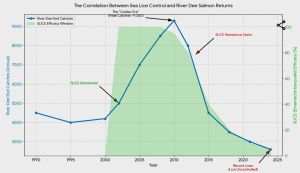
The graph looks convincing with salmon catches increasing up to 2010 and then as sea lice become resistance to SLICE, the catches have collapsed. Sadly, many anglers have been taken in by this nonsense, as it clearly appears, have the members of the Dee DSFB, a group who should know better because they have access to a much longer dataset than that used by Mr Fraser.
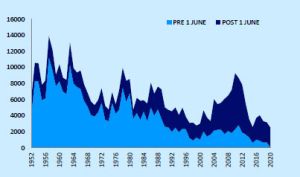
It is possible to see that the peak catch used in Mr Fraser’s graph is a peak that appears in a much longer period of decline that stretches back to the mid-1960s. In Mr Fraser’s narrative, sea lice must have been responsible for the declines from the 1960s onwards, even though there was no salmon being farmed then. The decline was halted with the introduction of Slice but began again when the efficacy of the treatment declined.
There are clear deficiencies in his narrative and even Dr Wells admitted to the DSFB that he has concerns about the analysis. He also suggested that the industry’s approach to sea lice treatment is aimed at ensuring Slice remains viable. Dr Wells also said that the modelling used by Mr Fraser to suggest that the North Sea was a sea lice soup was flawed with work from Norway indicating that the modelled sea lice concentration would have to be 7-8 times higher to have any effect. As already known, the Scottish Coastal Observatory data recorded off Stonehaven just south of the Dee shows levels of sea lice larvae that are hardly detectable and equally are unlikely to be salmon lice.
Dr Wells concluded that sea lice from salmon farms should not be given a high priority for the river Dee although it is interesting that Dr Wells did not say it should be of no consequence, given the other pressures facing the river.
Finally, Dr Wells was asked if FMS would like to see a moratorium on new salmon farm developments and he replied that that he would rather focus on ensuring sea lice are properly regulated on existing farms. He also said that a moratorium would likely be challenged by the industry and this would delay progress on the sea lice regulation.
The fact that the members of the Dee DSFB asked questions about Mr Fraser’s work and even salmon farming illustrates the lack of real knowledge about salmon farming. Most people in the wild fish sector just listen to misinformation spread by the more vocal members of Wild Fish and the Atlantic Salmon Trust and accept it as fact. Yet, at the same time, they are not interested in hearing the truth. My own experience of FMS is that they to are not interested in the facts. They just want the salmon industry to comply with their demands even thought they are based on misinformation and untruths.
It is not surprising that wild salmon are in crisis when those managing the rivers seem most interested in issues which don’t affect them. The question for the Dee DSFB is what are they going to do to halt the decline of salmon in their river?
Finally: Another point from the minutes was that Dr Wells was asked about working with the government. He said that the government are looking are looking at the pictures of salmon being held out of the water as the evidence says this damages the fish. Dr Wells said that there is a need for good fish handling to be demonstrated by the sector.
It is unbelievable that this is even being discussed by a DSFB. I would have thought that the DSFB would be fully aware of the damage caused to fish by poor handling and not forgetting the inevitable mortality caused by catch and release.
Catch and release across Scotland probably causes more harm to wild fish than any sea lice infestation.