
Dear Cabinet Secretary: I am writing this open letter to inform you as Cabinet Secretary for Rural Affairs that the section of the Marine Directorate overseeing the management and science of both wild and farmed salmon is well and truly broken.
Salmon and recreational fisheries recently sent out an email advising of the proposed conservation statuses for the 2027 fishing season and asking for any views by 4th September. However, submitting a response is a total waste of time because the whole conservation process, which was introduced in 2015 has done absolutely nothing to stop the ongoing decline of wild salmon stocks.
I was talking to a well-informed angler who tells me that catches this year have been really poor with the top beats now fishing at the same level as the mediocre ones used to whilst the mediocre beats are now not worth fishing, and this is a grade 1 river. No doubt we can expect the 2026 fishing season to be no better than 2025 or even worse. The big question is when are the Marine Directorate going to take action to protect wild salmon instead of pandering to the demands of the angling fraternity?
Twenty-one stocks have been downgraded for 2027 and eleven of these are now considered so poor that they have become mandatory catch and release. I am not sure why the Marine Directorate need to go through this assessment process every year as the situation for wild salmon is so critical that all fishing should be mandatory catch and release. This is despite the fact that catch and release does nothing to slow down the decline of this noble fish but at least it might send the right message to anglers that these fish are worthy of protection.
It is difficult to judge which of all the changes for 2027 merit the headline news, but I suspect that it should be the river Dee, which has been downgraded from good to moderate. This is the first of the big four rivers to lose its good status, yet this is of no surprise because the river has been in decline for many years despite mandatory catch and release being enforced locally. The Dee is even more newsworthy because of its Royal connections, yet despite this association, the river is in crisis.
After the Dee, the most significant change is the downgrading of the river North Esk to moderate. This is of interest because the Marine Directorate operate a field station at the mouth of the North Esk and therefore is probably the most studied river in Scotland. According to the local fishery board, the Marine Directorate identified the Nort Esk as the most productive salmon river in Scotland yard for yard. Clearly, this is no longer the case.
Finally, the third major change worth mentioning is that three stocks have been judged to have improved and thus no longer merit mandatory catch and release. Interestingly, all three salmon stocks are located in the heart of the salmon farming zone; an area which anglers claim represents death to wild salmon. It is worth highlighting one of these stocks to illustrate how nonsensical the whole conservation grading system continues to be.
Barr Water is about ten miles long and enters the sea midway down the west coast of the Kintyre peninsula. Since the 1950s, some of the flow has been diverted to the Glen Lussa hydroelectric scheme but that information is now many years old. In fact, there is very little up to date information about the river or its fishing.
The Marine Directorate assessment has shown that since 2021, catches of salmon from the Barr Water are 10, 25, 4, 7 and 10 fish in 2025. The fact that Marine Directorate scientists have considered upgrading this river so that it is no longer catch and release beggars’ belief. Common sense would suggest that with such small catches, the river should be closed to fishing, along with many other Scottish rivers that produce so few fish.
According to the Marine Directorate, there are now 22 (12.7%) that are assessed as good (grade 1) for 2027. A further 28 (16.2%) rivers are considered to be moderate (grade 2) and 123 (71.1%) are rated as poor (grade 3). Five years ago, the numbers were 37 (21.4%), 35 (20.2%) and 101 (58.4%) respectively. It can be seen that the stocks have clearly deteriorated in such a short time.
However, this method of assessment using 173 different stocks is rather arbitrary as it is simply a reflection of anglers demands rather than a true scientific assessment. As I have pointed out in every previous year, how can Marine Directorate say that river Lealt (4,000m2) can be considered as one stock and the river Tweed (16,187,000m2) as another. The smallest 116 stocks (of 173) still do not cover the same area as the river Tweed. They are simply not comparable. In 2015, the assessment was based on the 101 established fishery districts and whilst they too were not of similar sizes, they were established entities. However, as many anglers complained that their river should of a different grade to the fishery district, Marine Directorate acquiesced and created another 70 plus assessment areas. As already highlighted, some of these additional areas produce such a small catch, they hardly merit a separate assessment. Sadly, Marine Directorate scientists are not interested in changing their ways, so we are stuck with this nonsensical assessment process.
By comparison, if the assessment was based on area covered, the current proposals would change that ‘Good’ areas would account for 42.5% as compared to 127%, ‘Moderate’ would be 16.6% as compared to 16.2% and ‘Poor’ would be 40.9% against 71.1%.
However, all this is meaningless as it does nothing to help protect wild salmon from further declines. The latest proposals still allow salmon from 50 stocks to be killed for sport subject to local rules. The question should not whether fish should be caught and released, which we know can result in 12% mortality, but whether rivers should be closed to fishing altogether. The angling sector say that jobs will be lost and local economies will be affected but I am sure the same arguments were advanced when the coalmines, shipyards, steel plants were all closed. There becomes a time when the business can no longer be considered viable.
Meanwhile, the Scottish Government has a wild salmon strategy which is also as pointless and has done nothing to stop the declines. This is because it is aimed at protecting the fisheries interests, not the fish.
Some of the Marine Directorate scientists have been in their job for up to 30 years. They cannot avoid the fact that the state of salmon stocks has become critical under their watch. The question is why and the answer is simple. They have again pandered to the angling sectors misguided claims that salmon farming is a key factor in the decline of wild salmon. Consequently, they have been working for over twenty years on the alleged impacts of sea lice on wild salmon despite any hard evidence that wild salmon declines are the fault of the salmon farming sector.
In their FW0050 project review, the Marine Directorate proudly state:
“The Sea Lice Risk Assessment Framework was developed by SEPA after considerable consultation with stakeholders with implementation beginning in 2024 SEPA regulatory framework for aquaculture. This framework used model development and validation developed under FW0050 to support spatial management. SEPA went on to develop its own model using information from FW0050 and related projects.”
Their actions have saddled one of Scotland’s key earners with a regulation that is not only draconian but also will not save a single wild salmon. This is simply to satisfy the demands of the angling sector, who are still actively killing the same wild salmon for sport, albeit in much less numbers than they used to.
So, Cabinet Secretary, if you want Scotland to have a healthy wild salmon population and also a thriving business sector then you really need to sort out the Marine Directorate because they currently seem intent on killing off both salmon farming and wild salmon.
Question from Norway: In the last issue of reLAKSation I discussed the new report form the Marine Directorate describing ten years of project FW0050 concerning the alleged impacts of sea lice on wild fish.
I was particularly interested in one of the sections regarding a twenty-year study of sea lice on sea trout in Loch Shieldaig which has this year been published as a paper in ICES Journal of Marine Science. The report I discussed last week includes the following reference to the study which I have included in full as it is so short:
“6.1 Effects of sea lice infestation pressure on a sea trout population
To examine the impact of sea lice on sea trout, the MD collected data at a permanent fish trap set up on the Shieldaig river. The study was initiated in 1999, and continued through FW0050 until 2020. To supplement low numbers of wild fish the river was stocked with hatchery-reared fish, marked by the removal of the adipose fin. The study recorded the size of sea trout leaving the river, and the numbers and size of the fish returning. Sea lice infestation pressure was estimated by examining lice levels on sea trout electro-fished in the short stretch of river below the trap toward the sea. From the analysis of the data, it was concluded that the marine growth of sea trout was adversely affected by sea lice. As the infestation pressure increased, so, the growth rate of the returning fish decreased. Wild fish had a greater return rate than the hatchery reared fish at all levels of infestation pressure. There was strong evidence of an effect of infestation pressure on the return rates of hatchery fish, but this effect was not significant at the 0.05 significance level for the wild fish (Morris et al. 2026).”
In addition, I have been prompted to write about this study as it has just been reviewed in the Norwegian Aquablogg, but more about that later.
The online version of the paper includes a supplementary section with data and other information, and it was this supplementary information that caught my interest first.
The main paper describes the study area as follows:
Study area
Loch Torridon is a three-basin fjordic sea loch system located in Wester Ross on the west coast of Scotland. The loch is 20 km long with the basins being separated from each other by narrows (Fig. 1). The basins are called Loch Torridon that widens and connects to the open sea to the west, Upper Loch Torridon to the east, and between these lies Loch Shieldaig. The river Shieldaig enters this loch at its southernmost point and is 4 km in length.
Their figure 1 is shown below.
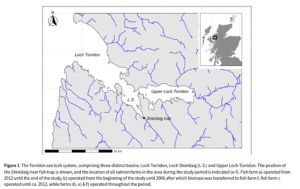
In case the typeface is too small to read. L S is Loch Shieldaig and the trap used in the study is marked at the southern end near the beginning of the Sheildaig river.
The supplementary information includes a photograph taken downstream of the trap.
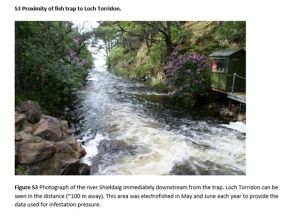
The text states S3 Proximity of the fish trap to Loch Torridon and Figure S3 Photograph of the river Shieldaig immediately downstream from the trap. Loch Torridon can be seen in the distance (~100 m away). However, by my estimation, what is visible is Loch Shieldaig with Loch Torridon being at least 6.5 km away.
Which brings me to the recent Aquablogg commentary which is titled: Are Scottishlice researchers worse than Norwegian ones? https://www.aquablogg.no/er-skotske-luseforskere-verre-enn-de-norske/
This Norwegian commentary suggests that the supplementary information tells a different story to the main paper. They have analysed the data supplied in the supplementary information and suggest that it doesn’t support the claims made in the paper. For example, the paper claims that the infection pressure from the farm varies in accordance with a two year cycle – the theory is that bigger fish in the second year have more lice, however I have looked at this theory across a number of lice infestations around Scotland and would say that whilst there is evidence of a two year cycle, there are plenty of examples where the two year cycle does not hold true. The paper suggests that when biomass on farms is high, the wild fish sampled had more lice. However, high lice counts did not reduce the number of wild sea trout, something that the paper acknowledges.
Whilst Aquablogg focuses on one part of the paper, I would like to consider a different aspect of the study and that is sea lice infestation of sea trout. The paper states that:
The annual metric of infestation pressure used in this study was constructed from sea trout electrofishing data collected from the lower reaches of the river Shieldaig. During the twenty-year study a habitat of approximately 1100m2 was fished from above the high watermark to the fish trap. The frequency of fishing was typically fortnightly in the early years of the study becoming weekly later on.
I have highlighted this because Marine Directorate have funded wild fish scientists working with the Salmon Fishery Boards to conduct regular sampling of sea trout for sea lice larvae at up to fifty different sites along Scotland’s west coast. The usual method of sampling is by seine net. The one key loch system that the fishery trusts have not sampled is Loch Torridon, despite the Marine Directorate’s focus on the area or maybe because of it.
Electrofishing for sea trout in the first 100 metres of the river seems to be a strange way to collect scientific data about sea lice. In his 2012 report Taranger says that sampling should be carried out well away from river mouths. That is not to say that Taranger is correct or not, but it is a suggestion that river mouths may not be the best place for sampling to take place, not least because the salinity is not at full strength.
The reason for this method of sampling is because the project was also involved tagging sea trout as they left the river and seeing how many returned. However, the two may not be necessarily connected.
Between 1999 and 2019, the researchers caught a total of 870 sea trout with the annual catch ranging from just 12 fish to 126. Interestingly, the sea lice sampling programme has a protocol which states a minimum of 30 fish should be caught and when this is applied to the river Shieldaig catch, insufficient fish to meet the protocol are caught in half the years. Whether this makes the data invalid is unclear, but it does bring into question the accuracy of any conclusions.
The table from the supplementary data list the catch in two columns. The first is the percentage of fish with one or more louse, whilst the second is whether the fish have 13 mobile lice, again expressed as a percentage.
When looking at the data, it does seem that the lice counts are higher in the second year, but the variation is so large that it is difficult to see how any conclusions can ne drawn. For example, between 2004 and 2007, the actual number of fish with any lice are 2, 0, 3 and then 55. In 2007, the number of infested fish was much higher but then so was the number of fish sampled, nearly double the previous year.
The second data set was of fish with 13 mobile lice or more. The paper states that:
Previous studies on sea trout have used a critical level of 13 mobile lice per fish as this level is considered to have the potential to cause fish physiological harm and they attribute this to a paper by Alan Wells from 2006. The problem is that the Wells paper considered not just sea lice infestation but also an abrupt sea water entry. Whilst some Norwegian laboratory studies, which rarely reflect parasitic infestation in the wild take several days to acclimatise the fish from freshwater to full strength sea water, Wells did three hours and inevitably stressed the fish making them more susceptible to infestation. Over the twenty years 349 fish were recorded as having lice infestation of 13 mobile lice and above, all of which made it back to the river. The paper makes no mention that if the fish were in a poor state of health or not.
This may be a peer-reviewed paper but as Aquablogg states:
“What kind of research is this?
The only thing this article shows is that peer review in the ICES Journal of Marine Science is broken, and that internal controls at Marine Science Scotland are being overridden by the desire to gather evidence against the convicted defendant. All the authors are employees of MSS. One of the authors, John Armstrong, holds the title of Chair of the Science and Evidence Board in support of Scotland’s Wild Salmon Strategy.”
Sadly, this is the type of science that Marine Directorate scientists say shows salmon farming is damaging stocks of wild salmonids when it actually shows nothing of the sort.