
Not us: The Norwegian Hunters and Fishermen’s Association (NJFF) has been quick to respond to the news from the Norwegian Environment Agency that they are to close three rivers to fishing from 1st August. These are the Gaula, the Orkla and the Verdalselva and have been assessed as having too few fish to meet the spawning targets. NJFF have said that it is important to emphasise that it is not angling that has created the wild salmon crisis and thus closing these rivers to angling will not save wild salmon. However, the only evidence that NJFF can provide to demonstrate that angling is not the cause of, or a major contributor towards, the wild salmon crisis is to mention that the rivers around Hardangerfjord have been closed to fishing for twenty years without stocks recovering at all. They are just certain that it is nothing to do with them. Clearly, Norwegian anglers have paid little attention to what has happened to other fish populations. In 1992, the Grand Banks cod fishery collapsed. It has taken nearly twenty-five years for stocks to recover sufficiently for limited fishing to resume.
It is interesting that the NJFF can deny any involvement in the crisis without producing any evidence and expect everyone to believe them, yet when the salmon industry does provide evidence to show they are not responsible, there are many from the wild salmon sector that accuse the industry of using the tobacco industry playbook to spread misinformation and deflect attention away from salmon farms.
NJFF say that it is right that the Environment Agency should close rivers when there is insufficient spawning stock, especially as there are so few alternatives. However, they say that the work for wild salmon cannot be limited to questions about fishing times, maximum targets and quotas. They say that if the trend is to be reversed, then measures must be directed at the reasons why fewer and fewer salmon are returning from the sea.
What is so puzzling is whilst NJFF say that wild salmon are exposed to many pressures over several decades, such as regulation of water courses, pollution climate change and changes to the marine environment as well as aquaculture, they are not interested in exploring how these factors have impacted wild salmon and what needs to change. This is because NJFF consider there is only one issue that needs to be addressed and that is salmon farming. This is because the Scientific Committee for Salmon Management (VRL) have declared sea lice to be the greatest threat to wild salmon. VRL are so convinced that sea lice are the greatest threat they refuse to even discuss the issue.
Surely, if they are all so concerned about wild salmon, why are they so unwilling to talk? This is even more so because Norwegian Salmon Rivers (Norske Lakseelver) appear to disagree with NJFF saying that the Environment Agency should not have overridden the management decisions of local river managers who had already amended fishing times on Norwegian rivers. They say that whilst it is clear that there is a critical situation for wild salmon, it is tragic that anglers are suffering for things which are beyond their control – salmon farming. Whilst I am sure it is tragic for anglers; it is even more so for the wild salmon they continue to catch and kill for sport. We are all expected to feel sorry for the poor anglers, especially those who are so quick to point the finger at salmon farming, yet refuse to engage in any discussion about the problems.
Like NJFF, Norske Lakseelver, refuse to consider any other reason why wild salmon are in crisis other than salmon farming yet more than 100 comments about their Facebook posting make illuminating reading.
Not unexpectedly, most comments refer to the need to impose greater restrictions on the salmon farming industry. Of course, most of those who make such comments have never heard the other side of the story, so they simply repeat the mantra of the wild fish organisations. In the rare instance that someone suggests that there may be more to the wild salmon crisis than salmon farming, those responding seem to resort to personal attacks which is about par for the course. Others say that if rivers are to be closed than salmon farms should be closed too.
By comparison, one commentator wrote that five years ago IMR wrote a report saying that wild salmon smolts migrate down the fjords so quickly that lice are not a problem. He added that is it not strange that smolts from Trøndelag rivers have passed through the world’s largest salmon farming region for nearly 50 years, so why has it taken until now for salmon stocks to collapse.
Other commentators focus on other issues than salmon farming. One says that it is good that the Environment Agency has intervened because the local management think far too much about the income and far too little about the salmon.
Another comment says that the salmon should be allowed to spawn rather than be terrorised by those with fishing gear whilst another says that the rivers should never have opened and should have been closed to fishing for the next five years.
Meanwhile, catch and release is deemed to be sadistic with anglers being accused of torturing animals for their own pleasure as being disgusting. Another commentator suggests a bigger issue is ‘Catch and Freeze’ which he says is something organisations like Norske Lakseelver are clearly aware of but do nothing about. Apparently, many salmon are caught from Trøndelag rivers but are not reported and instead are headed for the freezer.
Finally, a post mentioned that the current crisis for wild salmon is nothing new. More than 100 years ago, there were so few wild salmon in the Trøndelag rivers that there was a concerted effort by local people to do something about it. The first salmon hatcheries were established in Norway in the 1850s by local landowners and fishermen to help restock rivers with young fry. This continued for about 50 years after which it was decided that releasing tiny fry produced no measurable increase in adult salmon returns. In 1888, the Storting passed a law to help protect and restore depleted wild salmon stocks. This legislation was enhanced in 1891 to reduce fishing time and annual closed seasons.
I think that I am right in saying that salmon farming was not an issue in the second half of the 1800s, yet wild salmon stocks were suffering sufficiently to consider the use of hatcheries and for the Storting to pass specific protection legislation.
I know I sound like a broken record, but surely the way forward is to openly discuss the issues rather than allow the views of those with vested interests to dictate what needs to be done to ensure wild salmon return to heathy numbers.
Fishing reports: Trout and Salmon magazine might have a new editor, but the content remains the same with the usual attacks on the salmon farming industry. The latest issue includes two references to salmon farming in the fishing report section. First, Malcolm Newbould, a ghillie on the River Spey writes that ‘I again return to my old complaint that the salmon farms, which are rapidly expanding in the Northern Isles, are a major concern. Even if numbers of sea lice in the North Sea are not rising, the smolts still must navigate past Orkney and Shetland.’
It’s interesting that the editor is happy to print the views on salmon farms from an east coast ghillie but will not include an article on wild salmon declines from someone with a scientific background but who is connected to the salmon farm industry.
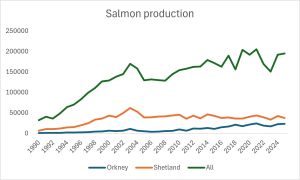
Mr Newbould is concerned about the expansion of salmon farms in the Northern Isles, but the official Scottish Government survey of salmon farms does not support his view. The following graph shows the increase in production for Orkney, Shetland and all of Scotland. The growth of production from 1990 hardly suggests any significant change especially as from 1970 salmon catches across the east coast rivers continued to grow until they peaked in 2010. During this time, salmon farming was present in the Northern Isles and presumably the east coast river smolts were still migrating north past the islands, especially Orkney, yet there were no apparent negative impacts. It was only in more recent times, that groups like Wild Fish amended their narrative to include Orkney and Shetland as impacting east coast rivers, despite not a shred of evidence to support their claim.
As to sea lice larvae in the North Sea, Wild Fish claim larvae are spread south from the island farms, yet the Scottish Coastal Observatory monitoring station off Stonehaven has reported very few individuals from the parasite group – the Observatory cannot identify specific species but can identify which family they belong.
The second report comes from Andrew Graham Steart, formerly of Wild Fish, who wrote about the river Ewe that ‘there was further encouraging news in late June this time on the sea trout front. Several fish in the 2lb class were landed. They were immaculate with no lice or fin damage and superbly well-conditioned.’
He continues that ‘there can be little doubt that the closure of the highly contentious salmon farm in Loch Ewe in November 2020 is enabling sea trout to thrive and grow without incurring fatal lice infestations (as well as enabling salmon smolts to reach the Minch unscathed). The slowish but steady recovery has manifested over the last few years. The implications of this recovery will not be welcomed by the salmon farming industry and its cheerleaders who will no doubt be reaching for their well-worn copy of the tobacco industry playbook before trotting out the usual denial and obfuscation.’
I am not sure why Mr Graham Stewart would think that anyone from the salmon farming industry would not welcome a recovery of sea trout in Loch Ewe. Many people connected to salmon farming came to the industry because of their love of fishing for salmon and sea trout. They are just as distressed about the decline in wild fish numbers as Mr Graham Stewart and his angling fraternity. In addition, Mr Graham Stewart suggests that people like me will be reaching for our well-worn tobacco industry playbook however, whilst I have an extensive library of books about salmon, the tobacco industry playbook is not one that I have, well-worn or not. Perhaps Mr Graham Stewart might like to lend me his copy as he seems very familiar with its content.
I would rather discuss the recovery of Loch Ewe/Maree sea trout because the official Scottish Government catch data does not support his claim of recovery.
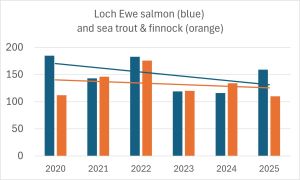
Of course, Mr Graham Stewart may have different information about the recovery, but he has not shared it. He also mentions that salmon are reaching the Minch unscathed, but Loch Ewe salmon catches increased from when the salmon farm arrived in Loch Ewe until 2010 when catches across all of Scotland collapsed, which had nothing to do with salmon farming.
The Loch Maree sea trout fishery was famous back to Victorian times. The following image often appears in discussions about Loch Maree.
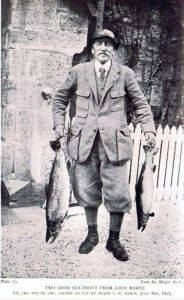
This is Major Baker with two Loch Maree sea trout one of which was 13.5 lbs and the other 6.5 lbs caught on July 8th, 1927. This image suggests that Loch Maree was full of large sea trout and it may well have been, as other pictures of the time show good catches too. However, I suspect that such large fish are the exception not the typical fish caught.
Mr Graham Stewart refers to good fish caught this year of about 2lbs weight. Using the official catch data for each decade from the 1950s to 2020s., the average weight of sea trout from the Loch Ewe system was as follows:
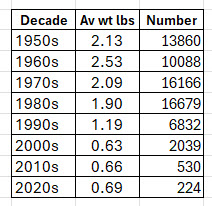
It was really only in the 1990s that the average weight dropped below the 2lb average weight
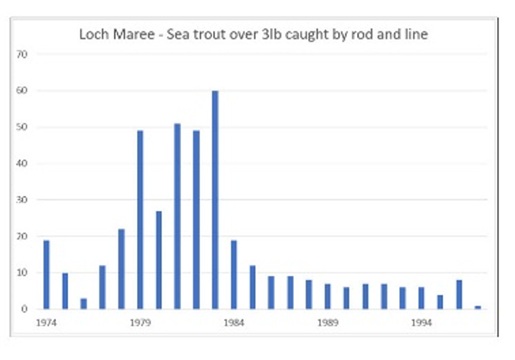
It is impossible to determine the range of sizes of sea trout from the official catch but some years ago, someone went through the Loch Maree Hotel catch record and produced the following graph:
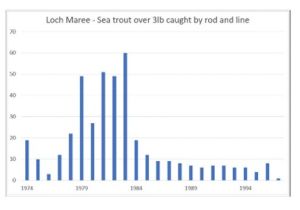
It seems that larger trout disappeared around 1984, three years before the salmon farm arrived in loch Ewe. This ties in with the removal of the three-mile fishing limit and the collapse of the fishery.
The other source of fish weights is the paper by Butler & Walker who charted the collapse in 2006. They compared the average weights from 1971 to 1980 and 1992 to 2001. The average weight in the first period was 1.19 lb falling to 0.75 lb in the second period. During the first period, the maximum size of fish caught was 11.15 lb and 4.41lb during the second period. Catching a fish of over 4 lbs after the collapse was quite an achievement because according to the angling fraternity, all the fish had been lost.
Whilst looking at the average weight calculated by Butler & Walker, I noticed that the number of fish used for the two groups was surprising. For the 1971-1980 group, the number of fish used in their sample was just 3,305. This compared with 7,094 in the sample from 1992-2001. I might have expected that fewer fish would have been used to calculate the average weight after the collapse but seemingly not.
Using the official catch data, the 1971-1980 sample was 16,555 fish and this fell to 6,323 between 1992 and 2001. The average weight of these sample groups were 2lbs and 1.16 lb respectively, which is higher than the weights calculated by Butler and Walker.
Mr Graham Stewart might be pleased with fish of weight 2lbs caught recently from the river Ewe but these need to be considered against the whole catch, not highlighted as good specimens. At the same time, it is clear that the fishing effort is nowhere near the levels found before the collapse, as illustrated by the catch numbers shown in the table above. Catches cannot really be considered as comparable.
It is still early days to decide whether Loch Ewe sea trout are on the road to recovery but if they are, then they would be bucking the trend from across all of Scotland.