
Head in the sand: In Scotland, most of the wild fish organisations will say in public that salmon farming is only one of the many pressures affecting wild salmon stocks, but what they say elsewhere tells a very different story. For example, the Atlantic Salmon Trust (AST) website has a section titled Position Papers. This states:
As we evaluate the impact of known pressures on wild salmon, and consider an associated ‘stressor analysis’, in 2025 the Trust began to publish updated position papers. These papers will be added to this page through 2026 and reviewed annually in response to further scientific evidence, and policy and regulatory changes.
We are now over halfway through July 2026, and the AST have so far only posted just one position paper. This is from December 2025 and is of course, their position paper on open pen salmon farming.
I recently happened on a social media post from the AST in which they were commenting on their attendance at an international angling event. Their post says:
However, the event sought not to dwell on the many negative problems facing the species, but to create a platform to offer positive solutions with which we can all move forward.
This included sharing
how to successfully raise public awareness against unsustainable open pen salmon farming practices.
If this is what they think of as positive, then I can only wonder what they think is negative.
Meanwhile, Fisheries Management Scotland are keen to be seen to be working with the salmon farming sector as long as it is on their terms. They want to promote stronger regulation to protect wild salmon yet their fishing season, depending on the river, runs from 11th January to 30th November and despite catches being the lowest ever, catch and release remains voluntary on many rivers.
The FMS website states that part of their work is Industry Engagement in which they engage with industries such as aquaculture to promote best practices, reduce environmental pressures and deliver shared solution for wild salmon conservation. I have been part of the aquaculture sector for longer than I care to remember but FMS refuse to engage with me. This is because they don’t want to hear what I have to say, which is that salmon farming is not the reason why wild salmon are in crisis and their crusade to impose stronger sea lice regulation will not do anything to help reverse the crisis.
Other industries they mention under industry engagement are agriculture, hydropower and forestry yet it is only aquaculture that merits employing an Aquaculture Interactions Manager. The current incumbent is their third since the role was created and is as reluctant to talk to me as the other two. The current holder of the post gets a small mention in the FMS annual review but doesn’t merit a place in the ‘Meet the Team’ section of the FMS website. It is as if the role is undercover.
As in several other previous years, I have offered to talk about sea lice at the FMS annual conference, but yet again I very much doubt my name will appear on the programme.
However, the views of these two organisations about salmon farming are nothing compared to Wild Fish, the salmon and trout angler’s organisation, who firmly believe that the only way to protect wild salmon is to put an end to all salmon farming whether in the sea or on land. Wild Fish, whether in their various previous incarnations of the Salmon & Trout Association or Salmon & Trout Conservation, have held the view that salmon farming is damaging to wild salmon for many years. They appear to be of the school of thought that salmon catches were good before salmon farming arrived in Scotland and have been in decline since, despite being unable to provide a shred of evidence to support their claims.
Wild Fish’s latest Scottish director is Nick Underdown and he was recently a guest on the Last Salmon podcast, hosted by activist angler and AST ambassador Jim Murray. The Last Salmon podcast has been funded to the tune of $12,000 by the Global Salmon Farm Resistance so there is no doubt as to the message the podcast wishes to put out.
In the latest podcast, Jim Murray had invited Mr Underdown to discuss the previous podcast in which Jim had invited the head of Mowi Scotland to hear the industry viewpoint. Talking about sea lice, Mr Underdown said ‘when all the science says that there is an impact, then there is a real impact.’ Sadly, Mr Underdown does not quantify what he means, and this is typical of those who criticise salmon farming. It seems enough to say that the ‘science’ says without any further explanation, and this is the real problem. There is a total unwillingness to discuss the science, and it doesn’t matter whether it is the Scottish director of Wild Fish, or any of the other wild fish organisation, Scottish Government scientists or SEPA, science is off the agenda unless it suits their purposes.
Mr Underdown added that the salmon farm industry has prevaricated on the sea lice issue for years which is one way of saying that his organisation refuses to engage in any discussion unless it is to say that the industry is closing itself down. I am not aware that the industry has prevaricated at all, instead they have been willing to openly discuss the issues as have I.
This would not be the first time I have written this, but I am ready to debate the issue of sea lice impacts with anyone from the wild fish sector including Mr Underdown. I would say it is a puzzle as to why none of them will take up my offer as they all claim to care about the protection of wild salmon, but the reality is that they don’t have the confidence to defend their claims about the impacts of salmon farming.
Asking the right questions!: In Norway, the Scientific Committee for Salmon Management (VRL) say that sea lice are the greatest threat to wild salmon as seen in VRL’s risk graph. Everyone seems to regard VRL as the experts so don’t question whether sea lice are the greatest threat to wild salmon or not. It is widely accepted that sea lice and hence salmon farmers are presented as the real villains in the decline of wild salmon.
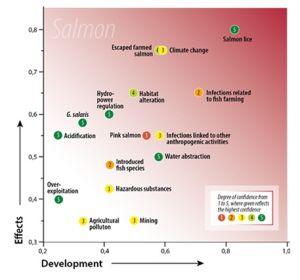
However, there is a problem and not just the one about whether VRL are right in regard to sea lice, but more importantly, VRL’s threat graph relates to anthropogenic i.e. man- made factors only. VRL do not include natural threats in their consideration of what represents the greatest threat to wild salmon.
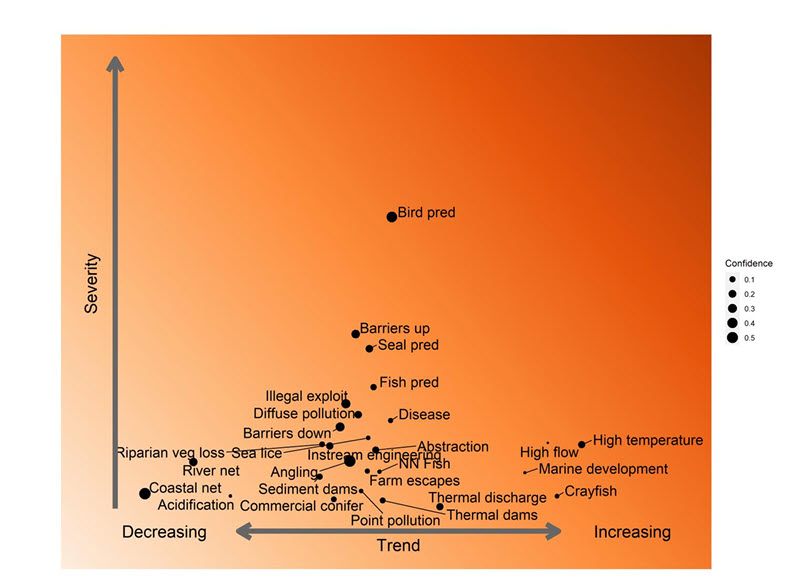
In 2021, Scottish Government scientists asked local fisheries managers to provide an assessment of the risk to wild salmon of 27 different threats. This was more of a subjective study than one which could be classed as scientific but regardless, the results as shown in the following figure, are very much of interest.
Unlike in Norway, the biggest threats mostly relate to predation, whether it be birds, seals or fish. The only other major threat comes from barriers that prevent upstream migration, something that doesn’t feature in the Norwegian threats. Interestingly, all these barriers were present when salmon populations were considered healthy and thus were never considered a problem. In the wider scheme of things, they still should not be a major issue but as highlighted, this assessment is more subjective than scientific.
Not so long ago, predation was never considered a major problem but in modern times, shooting birds and seals is not favourably viewed by the public at large, so the number of predators has been continually growing saucing an even greater impact on prey than in other times in living memory.
In Scotland, sea lice are not considered such an issue unless only the west coast river managers are consulted. In Scotland as a whole sea lice are rated at the same level of threat as downstream barriers, loss of vegetation, water abstraction and even angling and if perhaps, these river managers were prepared to hear a different view of sea lice, the level of threat might even be reduced further.
What is most interesting is that none of the threats listed either in Norway or Scotland would seem to be the reason why wild salmon are in decline. Something is happening to wild salmon across their range that has been happening for many years and none of the risk or threats highlighted can really be considered as driving the decline.
Now the state owned Norwegian Research Fund (FHF) is seeking to improve the state of knowledge about the current crisis in wild salmon with a NOK 6 million project to investigate the factors affecting survival of wild salmonids. The intention is to compile and assess all national and international knowledge on all the factors affecting wild salmon survival (or mortality) and to rank their importance.
Sadly, I think that when this project comes to an end, we will be none the wiser. This is because I think FHF are asking the wrong question. I don’t think that we really need to investigate all the pressures that affect wild salmon simply because many have changed over the years and therefore have not really influenced the long-term decline. I believe that something changed in the early 1970s and this is what we really need to understand. All the other pressures might chew away at the edges of the main driver but ultimately are not responsible. Equally, understanding the differences at local level are largely irrelevant in the wider scheme of things and simply deflect attention away from discovering the main cause. We have already suffered greatly from such deflection from the wild fish sector who have most to lose but yet are happy to ensure that the focus remains firmly on salmon farming in the mistaken belief that more stringent controls will lead to a return of healthy salmon populations, when clearly this will not happen.
What is surprising about this project is that Norway has a group of experts from a wide range of research institutions who make up the Scientific Council for Salmon Management (VRL). With such a group of experts, why is there the need for this new project. What does it say about VRL?
Last week, the Norwegian Environment Agency issued new restriction on salmon fishing due to low salmon numbers. The agency had commissioned the Norwegian Institute for Nature Research (NINA (who are represented in VRL) to assess fish counts and catches and they concluded that rivers in Trøndelag and Møre og Romsdal have catches well below those of this time last year. Consequently, six rivers in these areas have their fishing season reduced by 14 days.
The announcement of these closures concludes with the statement that:
According to the Scientific Council for Salmon Management’s status report on salmon stocks, the greatest threats to wild salmon are still linked to salmon farming, climate change and physical interventions in watercourses.
It is easy to see why with their focus on salmon farming, VRL have made little progress in understanding the reasons why salmon are in crisis. In my opinion they will say that the controls on salmon are not sufficient to protect wild salmon and this is why numbers continue to fall and it is only when the tightest controls are in place that wild fish declines may be slowed or even halted. Again, and in my opinion, they cannot comprehend that something other then salmon farming might be driving the declines. The problem is that they are not asking the right questions, so they are getting the wrong answers.
Finally, it was interesting to see one of the aims of the FHF project is to Identify knowledge gaps and uncertainties. This is the easy one as there is a massive knowledge gap and that is we have no idea why wild salmon are in crisis.