
Why?: The latest e-issue of Fish Farming Expert (No 2 26) (https://www.fishfarmingexpert.com/e-magazine) has a cover headed Pursuing the parasites – The search for the much-needed data about sea lice. This continues on page 10 with details of ‘The hunt for sea lice’. I am told that I am very good at writing long commentaries but even I would struggle to write four pages about hunting for something that isn’t actually there.
Anyone reading the four-page article will be none the wiser because there is no mention of any lice that have been found. As I already said, this is because they are not there.
However, before I receive comments saying that I am wrong. I do accept that sea lice larvae can be found in the seas but at very low concentrations. I also acknowledge that they can be found at depth and in some case where there is halocline, lice larvae can become trapped between the layers and form patches of still relatively low numbers.
This is simply a distraction from the main issue which says that fish swim through numerous lice and become infected. Surely, if lice are not present in large concentrations, then they cannot infect passing fish as predicted. In fact, I will go a stage further and say that the whole narrative about fish being infected by lice larvae released from farms is wrong because that is not how sea lice parasitise their hosts. Sadly, the established scientific community appear extremely reluctant to even discuss this view, let alone consider it and accept it.
SAMS scientist, Dr Helena Reinardy has in four pages written a poetic soliloquy about her life and sea lice but tells readers little and I suspect that is simply because there is very little to tell. I will just repeat one paragraph in which she talks about the team at SAMS which she describes elsewhere as a rabble. She writes:
“We combined our interdisciplinary perspectives on parasite biology, zooplankton ecology, physical oceanography and modelling to examine how sea lice larvae interact in a watery world. Six years of building, testing and mistake making, eureka moments and getting wet and cold and sunburned out on the water led to today. We were off again to hunt sea lice, fishing for the larval stages which are hidden among the vibrant and complex zooplankton world which itself is still almost totally mysterious to us.”
Perhaps after six years research and still not finding the lice larvae, it is time to think again, especially after admitting later in her commentary of the current lack of knowledge.
My understanding is that SAMS wants to become a centre of excellence for sea lice research. I have suggested that they should hold a mini conference to discuss some of the unanswered questions, such as why we can’t find the soup of lice that the wild fish sector insists exists. Wild Fish, the representative body for salmon and sea trout anglers published a report some time ago in which they said that every salmon farm in Scotland releases about two billion sea lice larvae into the seas every week. That makes about 400 million larvae dispersed along the west coast and with all the resources available it shouldn’t be too difficult to find them …. if they are there. Which they are not.
Embracing uncertainty: A side bar on the last page of the Fish Farming Expert article details the work so far. This includes 2021 – the SPILLS project (where they failed to find any lice larvae in the water) 2023 the SPILLS report published, 2024 the Sea Lice Risk Framework published and 2026 two papers mentioned. The second is by Sandy Murray of the Marine Directorate and considers the various methods of surveillance required for lice larvae. This is not yet in print.
The first paper is from the SAMS team with Dr Tim Szewczyk, an ecological modeller as lead author. It is the title of the paper that attracted my attention which is Embracing Uncertainty: Ensemble models of sea lice larval dispersal.
The ensemble modelling of which this paper is really about is just another way to suggest that the models actually work although as far as I can see, the paper makes no attempt to validate the ensemble model in the real world.
What interests me more was the idea that we should embrace the huge range of uncertainty that applies to the sea lice narrative rather than turn the uncertainty into certainty. Interestingly, although the paper is titled embracing uncertainty, the word embracing only appears once in the paper. ‘Ensemble modelling provides an alternative solution that embraces the variability among a set of plausible models.’ Yet, nothing in that sentence is sufficiently convincing to alter the view that models are just models and bear little resemblance to what happens in the real world.
Sea lice research has been undertaken for well over thirty years and it seem that there is more uncertainty within the scientific community than ever as to whether sea lice actually have an impact on wild salmon or not. The reason is that there seems to be a total belief in the modelling and outright dismissal of real-life evidence just because it doesn’t agree with the models.
For me the only thing I will embrace is certainty as I will leave the uncertainty to the modellers.
Arendalsuka: The week of August 10-14 is Arendalsuka, a festival where important conversations take place about society and how to build a stronger democracy. Over 2,200 events are taking place in the week with the main programme consisting of about seventy talks covering a wide range of subjects https://www.arendalsuka.no/program
Included in the programme are two events organised by the veterinary Institute which are being held at the Ankerplassen Pub. The first is titled – Sea Lice and mortality in wild fish. The knowledge base for regulating growth in aquaculture. The two main speakers are Eirik Biering and Knut Vollset of the Sea Lice Expert Group. Given that the Arendalsuka is about conservations and democracy, this event appears to be more of a lecture, especially as in my experience the Sea Lice Expert Group are not interested in conversations as evidenced by the fact that they refuse to discuss the existing science that clearly undermines their narrative about the negative impacts of salmon farming.
The second event is how to achieve a sustainable transition in the aquaculture industry, although it is unclear why there needs to be a sustainable transition at all, except at the suggestion of the scientific community who seem more interested in publishing peer reviewed science than trying to understand the salmon farming industry.
It is surprising that these events are being slipped into a wide-ranging programme in an area where salmon farming is hardly present. Given that representatives of other research institutions, such as Geir Lasse Taranger are involved, surely, these are topics that require much more extensive discussion than can take place over an hour in a local pub. Instead, why don’t these organisations partake in a proper discussion of the sea lice regulation as demanded by the Storting’s Aquaculture Committee. One might think that if they are happy enough to talk at Arendalsuka, they would be just as happy to talk in a more specialised meeting. This reminds me of the wild fish sector who are always happy to talk to people who know less than them but run a mile when faced with others who are able to engage in a proper debate.
Monitoring: Whilst the NALO monitoring programme was underway in Norway, the various fishery trusts have been pursuing their annual sampling as part of the flawed SEPA sea lice framework. It is acknowledged in Norway that the Traffic Light System hasn’t worked. We also know that even though the lice levels are low in PO3, IMR have declared the lice pressure to be high. The reality is that the sampling does not reflect any true impact of salmon farms on wild fish infestation unless the sampling takes place within a short distance of a farm. Within very short distances from a farm, it is possible that any lice infestation on wild fish may increase.
Unfortunately, neither in Scotland nor Norway, can those involved in sampling wild fish for lice can be viewed as impartial. In Norway, IMR are not just sampling but they are involved in the assessment, the science and control of the narrative. In Scotland, the fisheries trusts are the ‘science’ arm of the angler’s organisations, which are demanding increased regulation on salmon farms, whilst overseeing the wild salmon fisheries. It is a puzzle why those paying for sampling cannot employ people whose job is just to sample without making any pronouncement on the alleged impacts.
Lochaber Fisheries Trust has posted on social media that their sea trout sea lice monitoring programme is now in full swing, with five surveys completed across Loch Linnhe and Loch Sunart by late June.
They say that sea lice levels have increased slightly in Loch Linnhe but remain generally low. In contrast, we are seeing very high infestation levels in Loch Sunart. They have published an interactive wild fish lice map https://lochaberfisheriestrust-dev.github.io/current…/
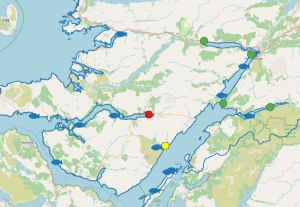
The interesting aspect to their sampling is that the sampling point is at the head of Loch Sunart near the mouth of the River Carnoch and the fishery trust has determined that 19 of the 26-sea trout sampled in that area will suffer100% mortality as calculated by the Taranger formula. However, whilst the fisheries trusts believe that the Taranger formula is akin to the gospel, the reality is that no-one has shown that fish with the lice above 0.3 lice /g causes fish to die. It is all conjecture based on flawed laboratory experiments and modelling. It doesn’t help that the only sampling point in Loch Sunart is at the head of the loch and has not been repeated much further down the loch. The nearest farm did have higher lice counts but just for a short time in January and still well within the government threshold.
I believe that the real problem is that the fishery trusts firmly believe that salmon farming is damaging to wild fish and thus everything is interpreted accordingly, The Lochaber Fishery Trust state in the post that ‘a substantial body of research has demonstrated that infection levels on wild fish are significantly increased by open-net pen salmon farming.’ They continue that ‘the Lochaber Fisheries Trust is committed to ensuring that sea lice levels—and the harm they cause to wild fish populations—are reduced through effective monitoring, research, management, and industry regulation’.
At the same time, Lochaber Fisheries Trust appear keen to promote the fishing in the area and not a mention of salmon farms and sea lice https://www.youtube.com/watch?v=4KpoI1_99-k
Meanwhile, the only other fishery trust to report their sea lice monitoring is West Ross and the results of their four samplings reported are that out of 78 fish sampled, 70 have lice counts that are green on the Taranger scale, one is yellow, two were orange and four were judged to be red. Thus 89% of the fish sampled were lice free.