
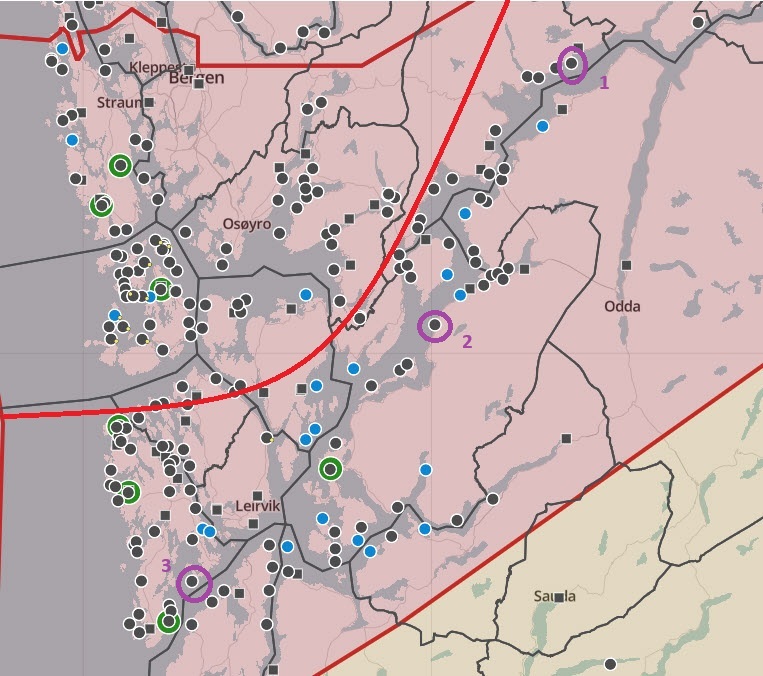
Where to start: Sea lice have been in the news with the Institute of Marine Research (IMR) publishing three separate reports. The first was the preliminary report of the NALO spring sampling programme with various indications of sea lice infestations in key production areas. The second report was IMR’s view of a new lice quota system for Norway with their advice on maintaining sea lice levels at sufficiently low levels to protect wild salmon. Meanwhile, the third report is IMR’s proposal to increase the number of production areas from the current 13 to 28, which IMR say will be easier to manage.
Unfortunately, there is so much here that is wrong that I don’t even know where to start. What I would say is that having looked at these reports, I believe that IMR have gone modelling mad. I have previously written of Erica Thompson’s book Escape from Model Land in which she highlights that it is too easy for researchers to become so drawn into models that they quickly lose sight of reality. The models become the reality and when the real reality doesn’t live up to expectation, then it is those to whom the models apply who will suffer and so it is with salmon farming.
Rather than dwell on the many flaws in the thought process, I would like to initially focus on one small section of the report providing advice on acceptable levels of sea lice releases. Section 2 part 1 is titled Salmon Lice. In three short paragraphs, IMR describe the process of egg production, where sea lice are found and what potential damage they can do. Over three paragraphs, IMR cite eight scientific papers, and it is this science on which I wish to focus. The first six papers have strong author links to IMR and clearly, IMR are never going to challenge the findings of these papers as it is their work. It is the last two papers I want to examine. They were not written by IMR researchers, but I am sure that I could question their papers in the same way.
The section 2.1 ends with the following words:
During the transition from sessile to mobile stage, virulence increases and mortality can occur in fish with a high prevalence of lice (Grimnes and Jakobsen 1996). Lice from farmed salmon in intensive farming areas have also shown increased virulence compared to lice from wild fish in areas with lower farming intensity (Ugelvick et.al. 2017).
Note – virulence is described as the negative effect on the hosts.
I am going to look at these papers because time after time the importance of peer-reviewed science is stressed almost as if it is the be-all and end-all of the science and nothing else will do. In my experience, researchers often look to just at the headline findings without delving deeper into what the work entailed. In addition, researchers might use statements from other papers about the paper being investigated, often adding to the loss of the relevance of the paper.
In this case, I have taken a deeper look at the paper by Grimnes and Jakobsen. This is a paper that is now thirty years old and one that has been widely cited in terms of sea lice infestation. The abstract states infection intensities above 30 sea lice can cause the death of post smolt salmon soon after the lice reach their preadult stage.
However, the interesting aspect of the paper is the methodology in which 360 hatchery raised smolts of around 40g weight were divided into eight tanks, four of which were artificially infested with sea lice. Each tank was reduced to 50 litres of water and then between 3,450 and 7,050 copepodid larvae were added and left for four hours with aeration but no water flow. This equates to a larval concentration of between 69,000 and 141,000 larvae per cubic metre. With natural larval concentrations of less than one per cubic metre in the wild, it is extremely difficult to comprehend how the experimental infestation relates to what happens in the wild.
The extremely high lice infestation meant that the average number of lice per fish was 85 on day 11. By day 25 when the first preadults began to appear, the infestation number was down to 72 lice and two-days later, it was down to 61 lice per fish. By the time adult stages started to appear the lice number was as low as 47 lice.
To put these lice infestations into context, the Scottish sea lice sampling programme from 1997 to 2019 sampled 21,627 fish and the percentage of these that carried over 30 preadults was just 1.8% (399 fish).
My interpretation of this work is that it has very little relevance to the type of infestation that IMR assume occurs on salmon farms. It is thirty years old and must be considered well past its sell by date.
The second paper is by Ugelvick and others. It is much more modern but should also be disregarded. My reasons for this are manifold but the first red flag is that the paper is part of a PhD thesis. I don’t believe that the future of one of the most important industries in Norway should be based on the findings of a doctoral thesis without at least a repeat of the experimental work. I am sure that the PhD candidate was more than capable, but the research is some of the first that he conducted. I am reminded that some new drivers display as Green P on their car after passing their driving test to show that although they have passed their test, caution should still be observed. I would have said the same of my own PhD research too.
However, my real concern is about the methodology. Like the previous work, fish were artificially infested, although in this case only 40 copepodids were added to every 10 litres of water. The results were based on samples of fish numbering between 13 and 15 and this is not a realistic sample size for a meaningful result. Yet the biggest concern was the data collection. The paper describes how when the lice on a fish had produced egg strings (from day 40 onwards), the fish were caught and anesthetised and all the lice were gently removed. Any damage to the fish was then recorded using a plastic film and a permanent marker after which the lice were returned to their original host. This process was repeated until after the lice had produced their fifth string of eggs. The host fish were then killed. I am not convinced that after such handling and manipulation that any results can be connected to what happens in the Norwegian fjords.
The problem is that these papers and others like them are used in the building of the narrative and the models. Inevitably, if the science is flawed then so will be the narrative and the resulting models.
Uncertainty: In the IMR report giving advice on acceptable levels of sea lice, the authors clearly state:
“The report also points out that there is considerable uncertainty associated with the calculations. Important sources of uncertainty are the quality of lice counts and fish number calculations in fish farms, variation in model assumptions (for example, tolerance limits for lice), geographical distribution of fish farms and natural variations between years. The results are also given as intervals, not absolute limits, to make it clear that the acceptable level of lice in fish farming will vary between years. For a high probability of achieving the environmental objective in all years, the lowest values within the interval should be aimed for.”
In other words and in my opinion IMR have not got a clue.
Regular readers of reLAKSation may remember that I have been looking at the weekly lice counts from farms in production areas 2 to 6. With a few minor scattered exceptions, farms have maintained sea lice levels well within the thresholds demanded on them. As I have mentioned, there is only one farm that should be considered a risk and that is the one run by the Institute of Marine Research. I previously suggested that I firmly believe lice pressure is low across all the production areas, but I said that I wouldn’t be surprised if others suggested differently and of course, I was right.
The IMR report – Sea lice infestation on wild salmon in spring 2026 states that:
PO 1 – no monitoring has taken place in 2026. The obvious question is why not.
PO2 – a low infection pressure on salmon smolts but for sea trout in the northern part of the fjord sea lice have probably had a moderate to high negative effect. The question is that IMR did the sampling, so why do they think that there is probably a high negative effect.
PO3 – Ultimately a high infection pressure on migrating smolt and sea lice have a probably moderate to high negative effect on both salmon and sea lice!
PO4 – Trawling indicates a generally high infection pressure on salmon but only a low to moderate effect on sea trout, which may be due to the relatively small number of fish sampled.
PO5 – Generally a low infection pressure on salmon and a low infection pressure on sea trout. This is despite the number of fish sampled in Vatnefjord been just five.
PO6 – Increasing infection pressure from moderate to high on salmon but high infection pressure on sea trout.
Sadly, the dataset will not be made available until towards the end of the year meaning that observers such as myself have to rely on the scraps of averaged data that IMR are prepared to share.
As I said, what is puzzling is where these high infection pressures originate because they are not coming from the farms. The obvious answer is that there is a natural wild lice pressure, but this is discounted by the scientific establishment because they firmly believe that it is farming that is the problem.
Perhaps research on wild lice is not as lucrative as that on farming which is why the natural lice population is never considered.
It seems that farmers still risk being penalised even if lice levels are maintained below the regulation threshold. It appears that even if the actual lice pressure is very low, IMR’s sampling can lead to a high assessment of infestation pressure.
It is possible that even if every farm was to maintain lice below the threshold, the models could indicate that the infection pressure remains high. Such an outcome is clearly part of the long list of uncertainties related to sea lice research. What is so puzzling is that not only IMR, but also the Sea Lice Expert Group, list so many uncertainties, yet none of these scientists consider that these uncertainties are worth discussing with the wider community who might be affected. The answer why is simple; the scientific sea lice establishment do not consider that their science can be wrong.
Meanwhile, IMR’s simplistic view of sea lice control, which mirrors the demands of the angling fraternity, is that the more salmon farming can be separated from wild fish, the better it will be for wild fish. Who are they kidding?
13 becomes 28: In their second report, IMR have proposed that the number of productions areas should be increased from 13 to 28. The cynic in me wonders whether expanding the production areas by 115% might help boost their income too. Could it be that the sea lice issue provides IMR with a real funding bonanza? Even the Scottish SEPA has jumped on the bandwagon paying. IMR £200,000 for advice which they could have got from Scotland for nothing.
The idea for increasing the number of production area comes from the characterisation of an optimal regulatory area. It seems that optimal regulatory areas are a concept that particularly apply to economic theory. Sadly, I am not sure that optimal regulatory areas can be applied to sea lice control.
According to IMR, an optimal regulatory area is characterised by two criteria.
- Homogeneity – the effect of sea lice on wild fish is the same regardless of where in the area the release of sea lice occurs.
- Independence -Discharges within the area do not affect wild fish outside the area.
However, they believe that they have the balance right between homogeneity and independence in their 28 new areas. For me, it makes no sense and I can illustrate this with looking at the new PO3A which covers all of the180 km of Hardangerfjord.
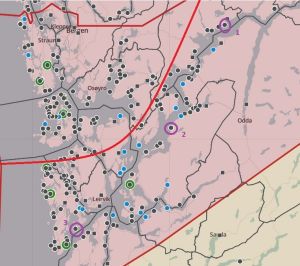
On the map PO3A is the lower area in red and I have highlighted three random farms at various points along the fjord. It is inconceivable that any wild fish would be exposed to the same effect from lice emanating from any of these three farms. For example IMR state elsewhere that sea lice larvae must find a host within 50 km so lice from one farm can never be homogenous in the Hardangerfjord. Of course, if the impact was measured mathematically as part of a model, then what would be considered common-sense would be ‘thrown of the window’.
The IMR report details the mathematical process that has led them to the discussion that Norway should have 28 separate production areas.
The following images show the mathematical approach however, if anyone wants to read the full version, then refer to https://www.hi.no/hi/nettrapporter/rapport-fra-havforskningen-2026-28#sec-3-2
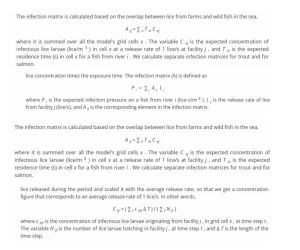
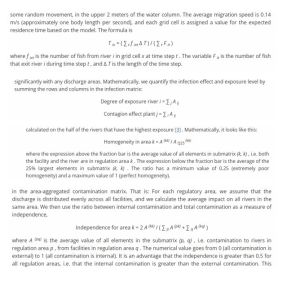
This all may make sense to the mathematical modellers who appear to have taken over the sea lice narrative, but the reality is that none of this bears any resemblance to the sea lice infestation that I have spent the last 15 years investigating. The message that this proposal brings is clear – there needs to be a new debate on sea lice and wild fish and if it doesn’t happen, I would be more than happy to challenge IMR to a public debate over the divide between models and reality.
Impartial?: This is not the first time I have questioned the impartiality of those employed to assess whether sea lice associated with salmon have an impact on wild salmon and sea trout stocks. Norsk Lakseelver (Norwegian Salmon Rivers) have posted a video along with The Norwegian Association of Hunters and Anglers (NJFF) about their nice little trip out with researchers from the Institute of Marine Research as they trawled for salmon smolts in Hardangerfjord as part of the NALO assessment programme. They have recorded their jaunt aboard the shrimp trawler ‘Fangst’ to promote their view that the greatest threat to wild salmon is salmon farming. The video can be viewed at https://www.youtube.com/watch?v=SKn6WvpX_Fc . For those who would like a translation then hovering over the start/stop bar provides a link to the transcript by clicking on ‘in this video’.

When the transcript appears, then clicking on it produces the link to translate to English.
Having watched this video, I can only wonder how many representatives from the salmon farming industry have had the opportunity to accompany researchers on their trawling voyages (or even to watch or participate in the sea trout monitoring programme) or is this a privilege only given to those who oppose salmon farming.
Although much of the commentary is from the visitors, it is surprising that IMR allow them to be filmed in a video that is factually and scientifically incorrect, but then as I have highlighted previously, IMR appear to have a very cosy relationship with the angling sector. The scientist in the video states clearly that sea lice are the greatest threat to wild salmon, which we know is untrue. She also agrees with Norsk Lakseelver that there are clouds of sea lice in the fjord, which we also know is untrue. Interestingly, the few salmon smolts sampled whilst NL and NJFF observed were all free of lice.
What was interesting is that all the smolts sampled were killed for later examination. Given the perilous state of wild salmon stocks, killing every smolt, even the healthy lice free smolts, would seem to be a step too far. It was also interesting to see, how the fish were killed because if the video had been shot on a salmon farm there would be an outcry about fish welfare. Salmon farmers have been dammed for much less.
This video is a clear illustration of why there needs to be a full national and international debate about sea lice, salmon farms and wild fish. Meanwhile, the salmon farming industry should be demanding that observers should accompany these trawling voyages to ensure the impartiality of the process.