
Breaking news: Intrafish has reported that whilst wild fish stocks remain low, salmon catches appear to have increased since the low of 2024. Kjell Rog Utne of the Institute of Marine Research (IMR) and the Scientific Committee for Salmon Management (VRL) now believes that the recent declines are not primarily farming related, although he says that sea lice undoubtedly contribute to increased mortality now that survival in the sea is so poor.
Of course, with sea survival so poor, it would seem responsible to ensure every fish possible returns to breed but in 2025, 40,760 salmon were killed by angler and another 22,740 by netsmen yet VRL do not consider this loss of fish to be a threat to the viability of wild salmon stocks unlike sea lice.
If not farming related, then one alternative theory put forward is that expanding stocks of mackerel have not only consumed salmon fry but also grazed on salmon’s food. However, mackerel stocks are now in decline so this may not explain the current problem for salmon. Intrafish asked Dr Utne that if not mackerel and not sea lice then what is causing the problem for wild salmon? He replied that they ‘don’t know for sure’. ‘We don’t know what eats wild salmon at sea. It could be whales or seals, but it is difficult to say anything for sure about what is happening in the northern seas, where wild salmon usually feed.’ Of course, there is nothing to say that wild salmon have gone missing because they have been eaten. There are plenty of other possible causes.
Perhaps, if Dr Utne and his colleagues had been reading reLAKSation, they might now have a better idea of other pressures affecting wild salmon, but the scientific community have generally been so focused on blaming salmon farming that they have shown no interest in finding out what is really causing the current crisis in wild salmon. At least, it seems that they are now more open minded to looking elsewhere besides blaming sea lice.
Wild Salmon Day: June 1st was International Wild Salmon Day where those showing an interest were asked to ‘raise the flag for wild salmon’. The organisers say that across the world, communities are restoring habitat and reconnecting rivers in ways that are already helping salmon recover. However, with 97% plus mortality in the sea, restoring freshwater habitat does not appear to be the solution.
To coincide with Wild Salmon Day, actor and activist Jim Murray launched the third series of his podcast The Last Salmon. This was a discussion between wild salmon enthusiasts from the UK, Iceland and Norway. Jim begins the podcast by saying that salmon anglers are now seen as salmon conservationists and then spends much of the podcast saying what can we do to encourage change to help wild salmon. For example, they say that in the UK, best catch and release practice is often ignored as taking a picture is often the priority to the detriment of the fish. In Norway, the problem is that catch and release is largely ignored as most anglers want to take home the fish they catch. It does seem from the discussion, that for many anglers catching the fish comes well before fish conservation. It really is all about the fishing.
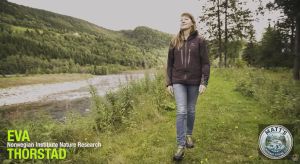
However, the most interesting aspect of the podcast came from Matt Hayes, a video and podcaster as well as an angler who owns fishing rights on the Gaula River in Norway. He mentioned that he had been speaking to leading scientist Eva Thorsatd from NINA (and VRL) on one of his videos. After some searching, I found the video where she appears twice. I found this really interesting because yet again here is a key member of a group, who appears to freely engage with a member of the angling fraternity, yet when a scientist like me tries to engage in discussion with her, there is just silence. The difference is that Matt comes from a sector that readily blames salmon farming for the decline in wild stocks whilst by comparison, I argue that the evidence shows that the scientific community such as VRL are unfairly blaming salmon farming. I have written in previous issues that Eva Thorstad’s VRL said in 2019, that sea lice associated with salmon farms killed an estimated 39,000 migrating salmon. What VRL do not mention is also in 2019, the angling fraternity caught and killed 83,179 adult wild salmon for their sport. All these fish were returning to their home rivers to breed but were prevented from doing so by their premature death. Common sense would suggest that the loss of 83,179 adult fish is a greater threat to the future of wild salmon than the loss of an estimated 39,000 young fish which VRL cannot even show died from sea lice infestation. It is not surprising that scientists like Eva Thorstad don’t want to talk to me.
By the time this commentary is published, we will have moved on from Wild Salmon Day. But it is important not to forget that Wild Salmon Day is celebrated alongside National Nail Polish Day, National Go Barefoot Day, National Heimlich Manoeuvre Day and most importantly National Hazelnut Cake Day. In case, they don’t seem worthy of celebration, then Tuesday 2nd June was National Rocky Road Day celebrating the combination of chocolate ice cream, marshmallows and nuts all in one and if that was not enough June 2nd was National Rotisseries Chicken Day and please do not get too excited because when this commentary is published it is the start of International Clothesline Week. This is to salute the efficiency and cost saving of hanging your clothes out to dry.
Page 9: Trout & Salmon magazine, the leading voice of salmon & trout anglers in the UK, reported that salmon & sea trout catches were in 2025 the lowest in 73 years. The total salmon rod catch stood at 28,020 fish, down 41% on the 2024 figure of 47,618. At its peak in 2010, the total rod catch was 111,405 fish. According to the report, the Marine Directorate noted that river flows across much of Scotland were low to extremely low and probably contributed to the reduction in catches.
A spokesman for the Scottish Gamekeepers Association Fishing Group said that ‘these statistics demonstrate exactly why there must be no delay in implementing the Wild Salmon Strategy, adding that it is vitally important we do not just study our way into a position that we can’t recover from. Action and difficult decisions will be necessary
This story appeared in the section of the magazine called ‘First Cast – What is happening in the world of game fishing’ and can be found at the bottom of page 9 of 114. One might have thought that the lowest catch on record would be headline news for salmon anglers but clearly not. This is not unexpected as in my experience the wild fish sector doesn’t like bad news because it might deter anglers from venturing out to fish. I suspect the main reason why we still do not have real-time reporting of catches is because it would identify beats where fish are absent and thus anglers might be tempted to move to rivers where fish are being caught. This would upset the river proprietors.
By comparison, the fishing reports section of Trout and Salmon devotes more space to Wester Ross, even though there are no fish catches to report. Instead, the space is devoted to a veiled attack on the salmon farming industry because as every angler believes, salmon farming is ultimately responsible for the current wild salmon crisis.
However, besides the apparent lack of concern about low catches, the most surprising aspect of this story is the comment from the SGA fishing group. They say that there must be no delay implementing the Scottish Government’s Wild Salmon Strategy. I had thought the strategy, which in my view will do nothing to help safeguard wild salmon, was already in place. After all, it was first announced at the beginning of 2022, some four years ago. The last meeting of the Implementation Plan delivery group took place on 19th March. Having read the minutes of that meeting, which are available on the Scottish Government website, I would say that the future of wild salmon in Scotland looks very bleak indeed. I can’t see anything they discussed will help safeguard the future of wild salmon at all.
NASCO: According to the minutes of the implementation delivery group, the Scottish Governments, Wild Salmon and Recreational Fisheries team (WSRF) were in the process of developing a first draft Conservation Commitment Report to submit to NSACO setting out the actions to address pressures facing wild salmon.
Interestingly, NASCO are getting together at the MacDonald Resort in Aviemore on June 2nd-5th for their 43rd Annual meeting. During the days before the meeting, all the Council documents are uploaded to the NASCO website including Conservation Commitment Reports from all the member nations. However, even at the start of the meeting, there was no sign of the CCR from Scotland although submissions from England, Wales and Northern Ireland are all available to read. Given that the meeting is taking place in Scotland, this doesn’t look particularly good. No doubt this omission will be blamed on the elections even though the team were engaged in writing it up before March 19th.
This year, salmon farming isn’t mentioned in the agenda because their then ongoing report about the evils of salmon farming was completed last year. The resulting papers are mentioned in NASCO’s 2026 newsletter, although the dire state of wild salmon stocks isn’t. This year pink salmon is the subject of their wrath. However, looking at the agenda, I cannot see any reference to the crisis affecting wild salmon across their North Atlantic range. Instead, the agenda reads like the out of touch intergovernmental organisation that it is. The first three parts of the agenda read 1. Opening the meeting, 2. Adoption of the agenda and 3. Financial and Administrative issues. No 5 is of more interest – NASCO’s High Level Acton Plan but any hope for wild salmon quickly fades after looking at the relevant document.
The ten-year action plan is guided by five objectives, the first of which states that NASCO will ensure that the best-evidence based information is compiled and accessible to address the critical challenges and threats to wild salmon. Sadly, NASCO have already shown this objective to have failed. Their review of sea lice and escapes, which is mentioned in the latest issues of NASCO news, was compiled from highly selective evidence used to support the wild fish, negative narrative against salmon farming. This was confirmed by the fact that NASCO refused to let a representative of the International Salmon Farmers Association speak at a previous annual meeting. NASCO, are just another wild fish group, who support angling and criticise anything they think might undermine their ability to catch wild salmon for sport.
Objective 2 is to use the evidence from objective 1 to ensure guidance reflects best management practice, whilst objective 3 is to promote sustainable conservation and management practices. Objective 4 is to foster collaborative efforts and finally objective 5 is for NASCO to improve organisation practices and work in an efficient, effective, inclusive and transparent manner. What any of this has to do with protecting wild salmon is unclear.
The most interesting thing I learnt from the NASCO documents published in advance of their meeting was that ‘in general tipping is not expected in Scotland. However, it is common to leave a 10% gratuity in restaurants is you are happy with the service’. That will be useful for any delegates who wish to eat at the Rowan Tree Restaurant in Aviemore where they can select a main course of pan seared salmon with grilled asparagus, spiced strawberry salsa and strawberry vinaigrette served with coriander and lime wild rice. A bargain at £29 (plus £2.90 service) or the Cairngorm Hotel has a fillet of pan-fried Scottish salmon with mashed potato, seasonal vegetables with a creamy tarragon sauce for £26.