
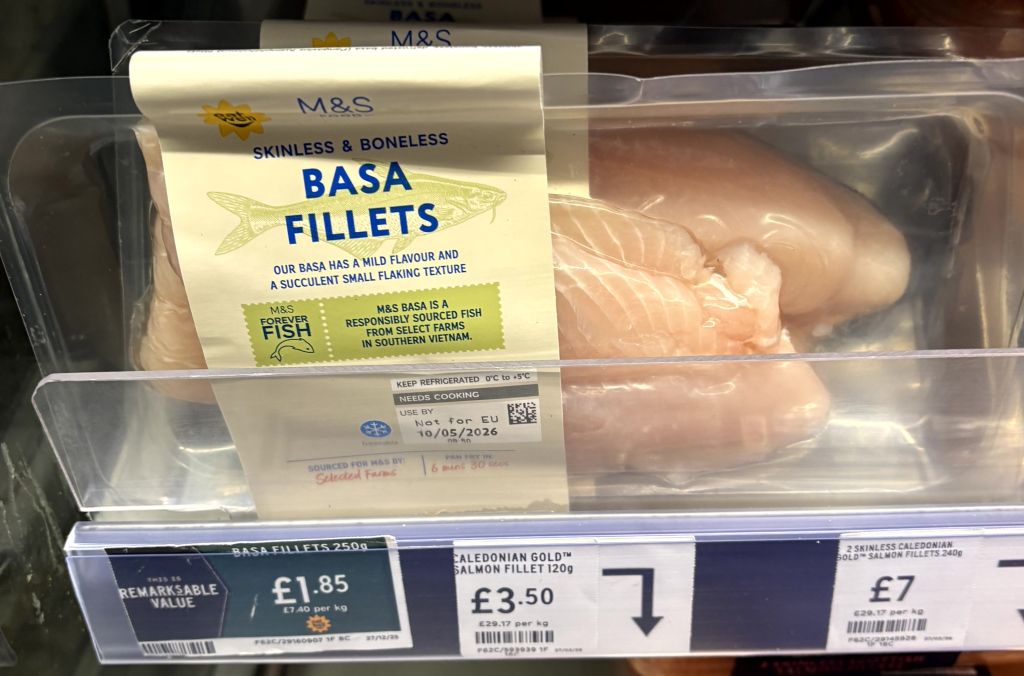
No surprise: Salmon Business report that the Norwegian Research Institution Nofima has published a report examining seafood consumption among the younger age groups of the public, typically aged 18 to 35.
The study found that what young adults say about their intentions of eating seafood are not matched by their actions. This is nothing new and applies equally to a wider selection of the public who have been saying the same thing for many years. They say that they would like to eat more fish and seafood but then don’t do anything about it.
Nofima also found that the main barriers to fish and seafood consumption are price, smell, bones, limited cooking confidence, time pressure and competition from other foods. Again, this is as it has always been with the claimed barriers to consumption remaining unchanged over many years.
Researchers at Nofima also found that claims of sustainability were less influential at the point of sale than price and taste with labels such as that from the Marine Stewardship Council being often overlooked in real shopping situations. Again, this is absolutely nothing new. My own research has shown that if such labels were removed from stores overnight, most consumers wouldn’t even notice.
Nofima say that price seems the main driver of consumption and that evidence from retail promotions in Norway during 2025 boosted sales of salmon and trout by about 250%. Consequently, Nofima have recommended that rather than run short-term promotions, stores should invest in more stable low-price concepts offering better value products over a longer period of time.
They also urge processors to develop bone-free products with milder odour profiles more suited to younger consumers.
In theory, the idea of lower priced fish, developed in to more accessible products is a good idea but one that is simply not going to happen, at least not until there is a major overhaul of the farming system. Since salmon companies began to be listed on the stock exchange, salmon prices were relatively low, and these low prices meant that salmon could be processed in a wider range of added value products which could be retailed at a price consumers were prepared to pay. The late 1990s and early 2000s were really exciting time for new product development, at least in the UK market. There was everything from salmon lasagne to marinated salmon fillets. From smoked salmon with sauce to salmon stir fry with rice. However, development of such novel products came abruptly to an end when salmon prices started to rise, and the higher raw material price made it uneconomic to convert into more convenient dishes. High prices have ensured that such developments are no longer viable and the range of novel products has fallen significantly, although some companies continue to offer new ideas, but they don’t seem as attractive to consumers as they once used to be.
One of the problems, at least in the UK market, is that fish products are always stocked in the fish section. This may seem blindingly obvious, but if consumers rarely buy fish, then equally, they rarely visit the fish section, meaning they miss potential fish products that might appeal to them. If they don’t see these products, they cannot buy them. The retail interface for fish has always been a problem and those promoting fish need to offer retailers a radical rethink if consumption patterns are to change.
I recently discussed the Harbour Salmon 4 breaded salmon fish fingers sold through Sainsburys. These 60g fingers sell for £14.58/kg. Most fish fingers weigh about 28g to 30g and branded versions cost £17.71/kg for cod. A cheaper version made from pollock sells for £11.79/kg because cod is just too expensive for many consumers, The same brand also produce a chunky finger weighing 60g selling for £10.42/kg. These used to be made from pollock, but the price of this cheaper fish has forced the company to substitute pollock with even cheaper pangasius to make this product.
Sadly, I have yet to be convinced the salmon fish fingers will succeed. They need to be displayed where more consumers see them than might do at the moment. Hoverer, online searches for fish fingers on the retail website may hopefully bring them to the attention of a wider range of shoppers. Only time will tell.
Protein: Intrafish reports that the Norwegian Seafood Council has called for industry collaboration to exploit the protein boom in the market. Bjørn-Erik Stabell of the Council’s UK office has said that protein rich diets are becoming an increasingly strong trend but, it is a trend that the seafood sector has largely ignored.
According to research compiled for the Seafood Council, one in five UK consumers follow a high protein diet whilst around three in five prioritise protein in their diet. How reliable this data is, is unclear because as is known, what people say and what people do can be two very different things.
The Seafood Council says fish and seafood is rich in protein and therefore well suited to be adapted to meet this trend, yet seafood has not exploited this trend. In an interview with Intrafish earlier this year, consultants McKinsey stressed the importance of ready to eat meals with clear protein labelling.
The supermarket Sainsburys stocks twenty-two protein ready meals, none of which include fish or seafood. Of the twenty-two, ten are own label and these are of most interest because they can be compared directly to the supermarket’s standard product. I have looked at two examples, the first of which is chicken katsu curry. The standard product is 400g and priced at £2.50. It has 29.3g of protein and chicken breast makes up 15% of the dish. By comparison, the ‘High Protein’ labelled version is priced at £3.75 for 400g and contains 33.6g of protein and is made up from 26% chicken breast. It contains less fat, saturates, sugars and salt. The protein in the standard product costs 8.5p/g whereas the protein dish protein cost 11.2p/g.
The second dish is Chicken Tikka Masala. The High Protein version costs the same as the previous product, £3.75 for 400g compared to £2.10 for 400g for the standard version. This has 24.6g protein and 13% chicken breast whilst the values of the High Protein version are 3.4g protein and 29% chicken breast. The protein costs for the two dishes are similar to the katsu dish.
A scan across other supermarkets reveals that there is at least one High Protein dish made with seafood and this is branded Hide and is a prawn and chicken paella. The 380g pack costs £5 (although other varieties without the prawns are priced the same). The protein is 29.1g and the dish contains 13% chicken ad 9% prawn. The price of the protein is 17.2p/g.
Unfortunately, there is a clear reason why these High Protein ranges do not include fish and that is as previously highlighted, the cost of the raw material is too high to make the finished dish competitive. High Protein dishes may be desirable, at least for the time being, but probably not at any price.
Rogue fish: BBC News reports that there are some rogue fish and chip shops operating in the Northwest of England. Their crime has been to pass off pangasius catfish as ‘traditional fish and chips’. However, the news report, which has been picked up by a number of other media outlets, fails to ascertain whether the ‘rogue’ chippies have been describing their offering as cod or haddock and chips or just fish and chips. Clearly there is a difference.
The BBC investigation was prompted by the owner of a Liverpool chip shop complaining about the dishonest practice, He said that it is putting chip shops like his at a disadvantage. The BBC visited five chippies in Liverpool and five in Manchester. Of these three listed the fish as cod, four listed it as haddock and the remaining three just as fish and chips. The three selling unspecified fish said they were selling white fish.
The investigators sent samples for DNA sampling with Professor Stefano Mariani at Liverpool John Moores University. I have written about him some years ago when he made claims that consumers were being misled over the fish they bought. The results of the tests were that three of the samples were pangasius, which corresponded to the three chippies selling unspecified fish. Professor Mariani said that he had not seen such a high use of catfish but then, chippies have not been under such financial pressure as they are today.
Professor Mariani was asked whether customers could tell the difference between cod and pangasius, He replied that it is very difficult for a member of the public that is not a trained biologist to identify one fillet from another. I would suggest otherwise. Pangasius do not have big flakes of flesh seen in cod.
The BBC say that catfish is safe to eat. It is unclear why they need to say that when it is widely available in many formats from every supermarket, including Marks & Spencer and Waitrose. Andrew Crook president of the National Federation of Fish Friers also said it does not represent a health risk, and it is just that consumers need to be properly informed of what they are being sold. He added that it is fine to eat and there’s nothing wrong with it but when you go to get fish and chips most people expect a marine species such as cod not a farmed freshwater fish.
This is such a fuss over nothing. Supermarkets sell packs labelled breaded white fish and it only the small print on the back that mentions the species. At the cheaper end of the market, there are products that simply say minced white fish.
The reality is that the current economic climate means that chip shops need to watch their costs and if cod is too expensive then why not sell cheaper alternatives as long as they are not described incorrectly.
The question is whether there would be a story if the fish were locally caught saithe, whiting or ling? I doubt it.
I suspect that those chippies selling pangasius are more of a mixed food outlet where fish and chips is just another dish on the menu along with other different types of foods than a dedicated fish and chip shop where fish is the main offering.
However, in the final reckoning, we should be grateful that the public are simply eating fish and not eating pizza, curry, or tacos