
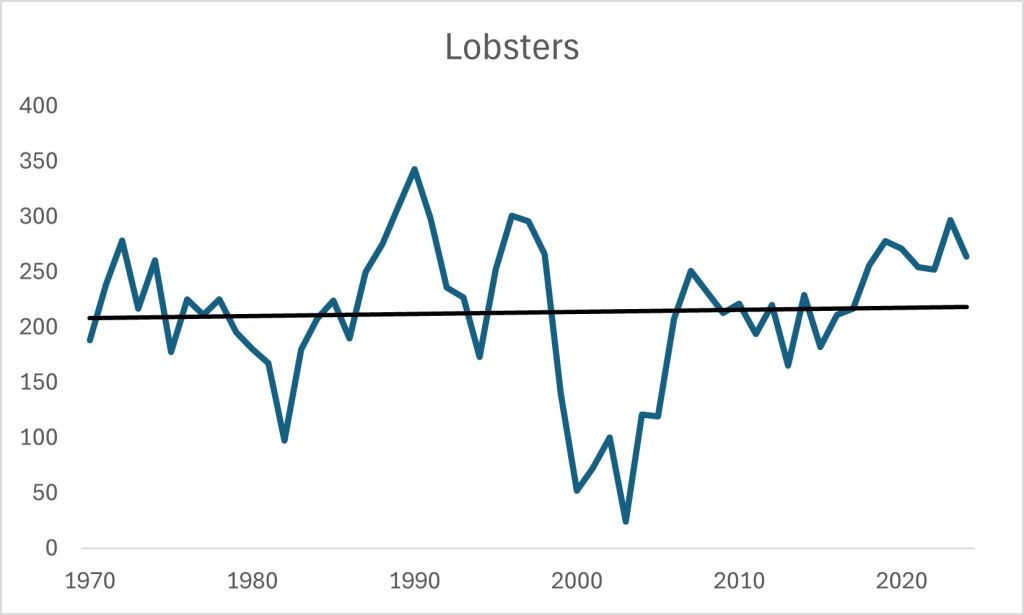
CSA science again: Although it was not my intention to discuss the CSA sea lice report in every issue, the next paper cited in the report merits discussion. In his report, the CSA indicated that Pert et. al (2014) had identified infection pressure on sentinel fish correlated with lice counts from nearby salmon farms. He goes on to say a similar relationship was identified using plankton sampling by Penston & Davies (2009) and that the lice counts on farms correlated with the numbers of sea lice copepodids in the surrounding waters.
The paper includes a section about local wild salmon populations because clearly wild fish also contribute to the sea lice load. Penston refers to the river Balgy and says that the size of the local salmon and sea trout population can be estimated from the rod catch and the population numbers are listed in a table. However, what jumps out of the paper is that Penston then continues:
‘It was assumed that the same number of sea trout and salmon also returned annually to the river Torridon.’
How Penston and Davies can make this assumption is beyond belief. It is only necessary to reference the Scottish Government’s annual catch data from 1952 onwards to see that no such assumptions can be made.
For salmon catches between 2002 and 2006, the period covered by the paper, the total catch from the Balgy according to Penston was 160 fish. The number according to the Scottish Government data was 151 fish. For the Torridon, Penston said the catch was also 160 fish whilst the Scottish Government data highlights that just 14 fish were caught from the river.
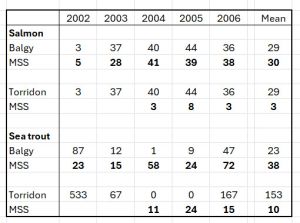
For sea trout Penston gives catches of 156 from the Balgy (which includes sea trout from the river Shieldaig as it is located in the Balgy fishery district) and 767 from the river Torridon. The Scottish Government figures for sea trout caught from the two rivers are 192 and 50 respectively.
As both Penston and Davies worked for Marine Scotland, it is unclear why they relied on external sources for their data when they had access to the Scottish Government statistics. Why do I believe that is this relevant here? The answer is that Penston estimated the number of gravid lice in Loch Torridon based on the number of farmed salmon and the lice count on them and the number of wild salmonids and the lice on them. The total number of salmonids estimated by Pentson was 1,243 fish whilst the official Scottish Government data puts the number at just 407 fish.
However, Penston does not only assume how many fish are entering some rivers, but there is also an assumption how many lice are infecting wild fish based on numbers recorded in other papers. The numbers are 16.9 lice and 7.9 gravid females for salmon and 3 and 0.14 for sea trout. The numbers of total lice for salmon were based on returning 1SW and MSW fish, but Penston ascribes the same numbers to all the salmon on farms, which is simply unrealistic. The number for gravid females comes from a paper by James Butler who actually takes the figures from a paper by Chris Todd. In this, net caught salmon typically had an average of 15.7 females per fish leaving Butler to assume that 50% were gravis equating to 7.9 per fish. How this can be adjudged by Penston to be a figure that can be used to assess lice in Torridon is a puzzle.
In the case of sea trout, Butler initially modelled the numbers of lice on the fish but then said that these modelled numbers were corroborated by the counts of sea lice sampled by the West Coast Fishery’s Trusts using data from 1998 to 2000 but later records that the 0.14 ovigerious females originate from counts in June 2000. From that data, 20 lice were recorded by 139 fish which does give a value of 0.14.
The use of these figures for lice infestation together with the assumption of the number of fish actually in the wild suggests that the lice numbers are highly overestimated by Penston bringing into doubt that there is a correlation between the number of lice on farms and those in surrounding waters.
The study also involved trawling for sea lice at three locations in the Torridon system, however, I have been unable to access the results, so I have to rely on the limited information provided by the paper. Some of the data actually comes from two other papers published by the author in 2008. These give the numbers of lice found but they are not related to density. What Penston does say is that the overall average density of copepodid in the sea lochs was just 0.14 larvae /m3. That is extremely low and hardly represents a high lice pressure on wild fish.
The next papers referred to by the CSA are from Middlemas (2010 and 2013), which are papers I have questioned in several previous commentaries stretching back over a few years. I already know that they do not support the claims made in the Scottish Government’s summary of sea lice science so am confident that the inclusion of them in the CSA report does not help in the claim that the science underpinning the SEPA framework is defensible because it is not.
Who would have thought: In 2016, I attended a workshop in Copenhagen organised by the International Council for Exploration of the Sea (ICES) who had been asked by NASCO to review the impacts of sea lice and escapes on wild salmon. The long executive summary of the final report includes the statement that ‘the long-term consequences of introgression across river stocks can be expected to lead to reduced productivity and decreased resilience to future impacts such as climate change i.e. less fish and more fragile stocks.’ I attended the meeting without really knowing what to expect but what I found was generally a group of scientists who were firmly of the belief that sea lice and escapes were highly damaging to wild salmon populations and no matter what was discussed, they were not about to change their minds.
Ten years on, one of the scientists at the forefront of work on introgression, who was present at the workshop has just co-authored a new paper that has analysed 885 migrating smolts and 7.275 returning adults from the Etne river in Norway. The wild fish population associated with the Etne river was reported to have been introgressed by between 25-30% of farmed salmon genetic material after extensive escapes between 1989 and 2012 showing one of the highest ad-mixed rates documented.
The new paper confirms other recent findings that the wild salmon population did not suffer any impact from the high level of introgression. They conclude that populations with lower rates of introgression would also show no loss of fitness during their marine phase.
The paper suggests that the reason that there has been no detectable impact form these so call domesticated genes is due to natural selection purging mal-adapted individuals before they transfer to sea.
I can only wonder why it has taken scientists so long to work out that Darwinian evolution was all about the survival of the fittest and this even applies to salmon populations.
I also wonder how long it will be before scientists finally admit that their claims about sea lice also need a major rethink
Closed again: An article in the Daily Telegraph says that our salmon could soon be farmed on land but that a project to raise 5000 tonnes of fish is fuelling an ethical debate.
The article says that salmon farming in its traditional form using pens at sea is increasingly understood to be an ecological disaster citing the example that chemicals used to treat fish leach into the ocean and kill lobsters. It continues that the farms are breeding grounds for salmon lice which latch onto and kill wild fish. Escaped farmed salmon interbreed with endangered wild Atlantic stocks diluting bloodlines, producing offspring that don’t recognise migratory roots (sic).
Yet without salmon farming it is a struggle to see how we can keep eating the fish in the quantities we do, but at the eleventh hour a possible solution has leapt out of the water. This solution is proposed for Grimsby where a 40,000 square metre salmon farm is planned. The article says that the project provides a neat solution to salmon farming’s current ecological woes. It would give the lobsters a reprieve and it is the same story of lice and wild salmon.
As regular readers of reLAKSation should now know, the story of sea lice and wild salmon is simply baseless. It is just that those who promote this story are not prepared to see the evidence and thus admit they could be wrong. The story of lobsters is also highly overstated. I have plotted the landings of lobsters at four west coast ports, Stornoway, Ullapool, Mallaig and Oban since 1970 and the graph tells its own story. Other than a period in early 2000s, lobster landings have been relatively stable overt fifty years.
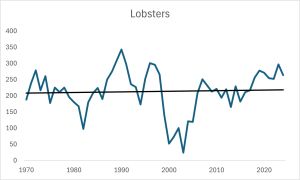
Although there is a dip in the early 2000s, this cannot be attributed to salmon farming. What is surprising from the analysis is how much the Scottish Government’s fisheries reports have chopped and changed over the years. There is very little consistency in the way the landings are reported and in the early 2000s there were some clear gaps in the data.
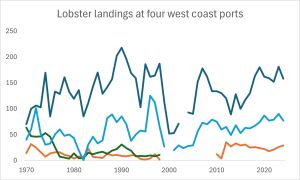
In one case, there is a gap of ten years and when the reports restart, the numbers are much the same as before the gap. Another factor could be that whilst four west coast ports were initially selected because that was all that were listed, in more recent times, a further two ports were included in the data. In much the same way, data for crabs was also changed, initially from edible crabs but this was later divided into brown, red, green and velvet crabs, making full analysis more difficult. For the purposes of this commentary, it is sufficient to know that landings of all crustacea including crabs and langoustine have not shown any impact from the growth of the salmon farming industry.
If we want lobsters to have a reprieve, then that is an issue for fishermen to address. Meanwhile, this is another reason why land-based farming is far from being a solution, mainly because it is a solution to a problem that doesn’t exist.
Wrong angle: Two stories highlight why we should not rely on the views of anglers to mould policy. BBC News reports on the High Court case brought by 4,500 people who claim that chicken producers Avara Foods and Welsh Water are responsible for environmental pollution allowing the river Wye to turn green and become smelly and slimy in the summer. Both parties say that case is misguided.
However, what caught my eye were the comments of the local ghillie who said that salmon in the river are said to be in a critical condition with just a few thousand migrating up the Wye each year.
The ghillie said he has signed up to the claim but thinks that the main issue as to why the number of salmon caught has fallen dramatically in recent years, in 2024 the catch was 153 fish, mostly caught near the river mouth, is that the green algae has made them harder to find and catch.
The annual reports from the Environment Agency make it clear that wild salmon are declining across all of England often to critical levels, Against this background the idea that there are plenty of salmon in the Wye and the only reason why they are not caught is because anglers can’t see their activity in the river and therefore cannot target them makes no sense.
If the Wye is judged to be polluted as a result of intensive chicken farming, then it certainly doesn’t help wild salmon but that is not the reason there are so few in the river.
The second story appeared in the Herald newspaper. Apparently, there is real outrage from the angling sector after Fife based David Lowrie fishmongers posted a video saying that they had ‘Wild Scottish Salmon just in’ and that it was ‘straight off the Tweed’.
The Herald asked how is this possible as commercial fishing for salmon is prohibited. They answer their own question by saying that net fishing of salmon in inland estuaries is only allowed in river with good or moderate conservation status and as the Tweed falls in this category, salmon fishing is permitted.
Anyone looking at the latest provisional catch data for 2025 will see that in 2025, 913 salmon were caught by net which is slightly down on the 2024 figure of 935 fish. Netting in the Tweed had been allowed after coastal netting was banned, primarily because administrators forgot to include river net fishing in the legislation banning coastal fisheries. This is nothing new.
What is different now is that some of the fish caught have found their way to a Scottish fishmonger who publicised the fact. Previously fish have typically been sent to London and sold through Harrods or top end smoke houses. I suspect that the cache of wild salmon is slowly disappearing because there are so few and these are sold at ridiculously high prices. At the same time. farmed salmon offers the same eating at a much lower price.
It is a bit late to be outraged. The time to do that was when net river fishing was not included in the legislation not when a fishmonger has advertised the fish for sale. Yet again, anglers seem to have no idea of what is happening around them. All they care about is having enough fish to catch and if there isn’t enough then to blame anyone and everyone.