
Who is kidding who: A regular reader of reLAKSation recently reminded me about catch and release by sending me a weekly fishing report from one of Scotland’s major rivers. This is something that I do look at from time to time when I have the time to do so. However, it seems opportune to discuss catch and release as I consider other stories about the wild fish sector.
In January 2025, Fisheries Management Scotland updated its guide to best practice for catch and release. There is an on-line booklet available at https://fms.scot/catch-and-release/
It begins ‘UK anglers are leaders in conservation’. This is followed by the statement ‘if we follow catch and release guidance 100% survival rate of caught fish can be achieved.’ Although the booklet runs to six pages, the two main key points are:
Keep hands off – wherever possible avoid handling the fish directly to prevent infection, With the right tools in most cases, it is easy to unhook without touching the fish.
Keep it under – Fish have a better chance of survival when they stay submerged throughout the release.
I would suggest that is all extremely clear. Keep the fish in the net in the water, unhook without touching the fish, photograph and then release from the net.
This message is repeated by one of the members of Fisheries Management Scotland, the Spey Fishery Board on their website:
“We recommend that all salmon and trout caught are landed in a rubberised net, are kept in the water whilst being photographed and are quickly and carefully released so that it can go on to spawn. “
Again, that seems remarkably clear and so my correspondent thought. This is the link to the Spey Fishery Boards’ fishing report of week commencing 30th March 2026 was sent to me – https://riverspey.org/fishing-reports/week-commencing-30th-march-2026/
I have not reposted the photos here as I am unsure of copyright, but I have counted twenty-eight pictures of salmon caught from various beats on the river Spey from 30th March. Eleven of them show the anglers holding the fish in two hands above the water, mostly well above the water. Another eight photos, have the anglers holding the fish when sitting or standing on the riverbank. There are six photos of the fish being held by the tail and laid out along the water’s edge with the fish just in the water. Finally, there are three fish that are held but most of the fish remains in the water. Not one of the fish is being treated in line with best practice and with a typical 12% mortality rate for catch and release, it would be expected that 3 or 4 of those fish photographed will not survive and others may not go on to successfully spawn.
In recent years and in light of criticism, many anglers no longer post pictures of their catch, which doesn’t mean that bad practice is reduced, it is just hidden. But then much about the angling sector is hidden away out of view.
This latest fishing report is one of many posted on the Spey Fishery Board website. It does seem if the members of Fisheries Management Scotland appear to endorse bad practice what hope is there for the future of Scottish salmon?
Spring in the air: I have also been sent the Atlantic Salmon Federation’s newsletter ‘Rivernotes’ (https://www.asf.ca/rivernotes-april-9-2026/). The Canadian organisation based in New Brunswick has interestingly included a piece updating news of the season for catching threatened spring salmon in Scotland. This is written by retired ASF vice president Andrew Goode, who is pictured with a salmon held in a net still in the water.
He writes that the spring 2026 season has started noticeably stronger in Scotland than in recent years with both the Dee and Tay rivers reporting catches well above the five-year average. Other rivers such as the Tweed, Spey and the Northern rivers were all reporting better catches than last year when low water levels were a widespread problem. He continues that fishing the early season maintains a certain reverence for anglers especially as these salmon are considered to be the finest fighting fish of the season.
It interesting that an overview of the 2026 fishing season comes from Canada and not Scotland where everyone remains relatively tight lipped. After all, we are still waiting for the Scottish Government to publish the confirmed catch data for 2025, so any news of the 2026 catch is usually many months away. Meanwhile, we have plenty of pictures from the Spey Fishery Board to look at.
No cash: Fish Farming Expert reports that the Atlantic Canada Fish Farmers Association (ACFFA) have written to the Canadian Prime Minister to urge him to ensure that none of the money earmarked for wild fish conservation in Canada (£44 million) goes to the Atlantic Salmon Federation. This is because the ASF is a foreign funded activist organisation that has repeatedly engaged in campaigns designed to misrepresent, undermine, and ultimately dismantle Atlantic Canada’s salmon farming sector whilst providing negligible outcomes for genuine conservation. The ACFFA continue that their activities are strategic, coordinated efforts to demarket farmed salmon and erode public trust in a vital Canadian food producing industry. The organisation has also requested a formal review of ASF’s charitable designation based on it acting as a conduit for foreign entities and deceptive marketing practices.
I cannot say that I have had much interaction with the Atlantic Salmon Federation, but they did send at least four people to London a year last January to attend the Wild Salmon Connections conference. If I remember correctly, one of them participated in the discussion about the impacts of salmon farming and the views expressed bordered more towards activist. This was the session about salmon farming for which all questions from the audience had to be submitted in advance, unlike for the rest of the meeting where questions could be asked in real time. Of course, that is typical of the issue of farmed salmon, because organisations like ASF are not willing to respond to questions for which they have no answer.
For us on this side of the Atlantic, the activities of the ASF sound all too familiar with groups like Wild Fish and their Off the Table campaign and the lack of any real attempt to conserve wild salmon because of their belief that if salmon farms are removed all will be well.
In conversation (or is it conservation): The Fishmongers Company have posted a video titled ‘In Conversation’ which is a conversation with Mark Bilsby of the Atlantic Salmon Trust (https://www.youtube.com/watch?v=PC9OS2XlLUw).
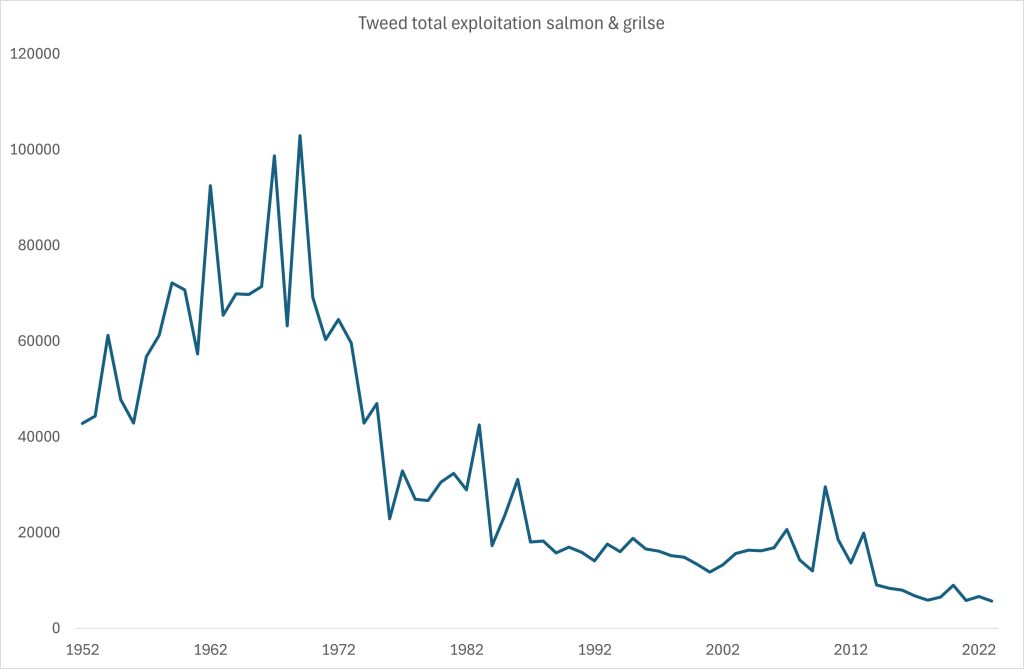
The tone was set from the outset with the focus on angling. It was pointed out that 2025 was the worst catch on record with 28,000 fish, yet in 2010, the river Tweed alone caught over 20,000 fish and since then there has been a series of ever poorer catches. However, the problem is not one that developed since peak catch in 2010. The problem has been evident for many more years than that, it is just that the wild fish organisations and river managers have been more focused on the fact that the angling fraternity have been recipients of healthy salmon catches that do not reflect the true position of wild salmon stocks. This can be seen from the graph of catches from the fishery board:
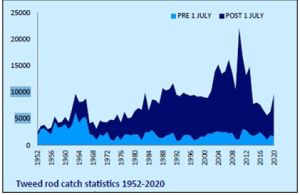
Compared with overall exploitation
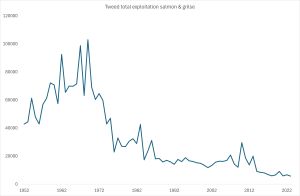
Catches were clearly in decline from the late 1960s, and the river Tweed was not alone in heading towards crisis.
Mark Bilsby was asked what was going wrong for salmon and he responded by saying that ‘There’s a lot less fish coming back to our shores. And there you have it – the problem in a nutshell – there’s fewer fish coming back from their marine migration. The question should be what we are doing about it and frankly, the rest of interview was simply waffle. The belief is that if river catchments can be made the best they can be so the maximum number of smolts can leave the river so that some will return. The problem as was outlined in 2017 by the King is that in the 1980s one in four fish returned but now it is one in twenty (2017). Nine years on it is not even that so for every 100 smolts leaving a river, we are lucky if just one makes it back. In 2017, the King said we don’t know why and we still don’t know why. Climate change is now highlighted as a cause with rivers warming to excessive temperature but that is not why fish did not return in the 1970s, 80s, and 90s and even the 2000s.
Mr Bilsby was asked about the ‘vexed’ subject of salmon farming, which is very much on the agenda. What sort of work are you doing in this area? He answered that “in terms of open pen salmon farming, the science aspects of problems with parasitic sea lice or escapes are pretty well documented. The science is pretty much settled in this area, so it becomes a question of management and managing the manageable, so we need good regulation of fish farms in the short term. In the long term we need to look at how we can really separate wild from farmed salmon because it’s an issue of scale because within one salmon pen there is probably the same population of salmon in there than there is in the whole wild population so we need to separate them and that can be done by closed containment on land or at sea and its one of those transitions that we have to go through. Wild salmon are classified as endangered and this is a manageable impact, and we need to manage it. We need to regulate it”.
I met Mr Bilsby once. I had arranged to meet the then new AST research director, (since sacked) and he turned up too, in my opinion, to ensure that she didn’t speak out of turn. Mr Bilsby wasn’t interested in discussing the science. He just said that he had seen sea lice on fish on the west coast for himself and that was all he needed to know. I hope Mr Bilsby watches the video for himself because he could apply the same comments to angling. Wild salmon are endangered and thus perhaps we should separate them from the sport of angling by closing all rivers to fishing. Angling is manageable and perhaps it should too be managed. Currently, there is little management except catch and release which the data clearly shows does not work. Scottish Government have been recording catch and release since 1994 and it has slowly increased to its current level in the 90% range yet as the video points out, salmon catches in 2025 were the worst ever on record.
The Atlantic Salmon Trust doesn’t talk much about angling, yet its annual charity auction offers fishing lot after fishing lot including one offered by the charity’s patron, His Majesty the King.
Mr Bilsby ends the interview by saying that people care about wild salmon. It seems to me that they care more about angling than saving wild salmon. If they really cared, they would be looking beyond those factors that they consider manageable to look to find out what is really behind the decline of wild salmon. One thing is certain, separating wild and farmed salmon will not save wild fish from local extinction.