
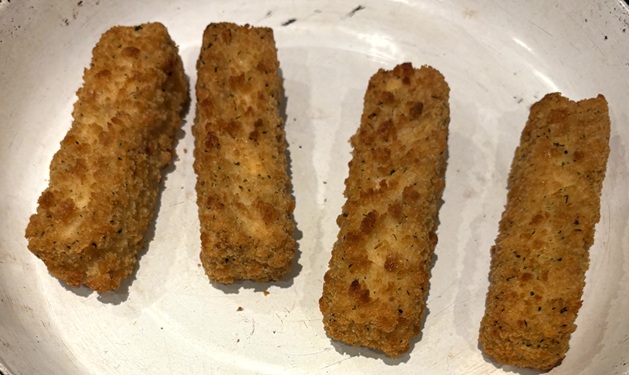

Tasty fingers: Many years ago, I upset the Scottish salmon farming industry by suggesting that if we needed to put salmon into fish fingers in order to expand and diversify the market for salmon, then that is what we should do. At the time, the industry was promoting whole Scottish salmon as a premium product and the idea of salmon fish fingers seemed a step too far.
Sometime later, a chance meeting with someone working for the Bluecrest fish processing company led to the opportunity to make some samples of a fish finger made from imported pink salmon. Pacific pink salmon were used in the se samples because the fish was available as a frozen block which was suited to cutting up into finger shapes.
The samples actually promoted some interest but the move to Atlantic salmon was at the time considered too difficult because of manufacturing issues. Yet, the idea of a salmon fish finger was not dismissed and eventually, Young’s who owned Bluecrest launched a salmon fish finger of their own. This was still made from pink salmon. Sadly, after a couple of years, the product was withdrawn. I suspect that this was a missed opportunity because it could have been promoted as an omega-3 fish finger, something Young’s did eventually do using Alaskan pollock, a fish with a much lower omega-3 profile.
In March 2026, salmon fish fingers returned to retail with the launch of Harbour Salmon Co’s 4 breaded salmon fish fingers into Sainsbury’s. The 240g pack sells for £3.50. Although the pack is sold through a Scottish address, the fingers are actually manufactured in the Netherlands using salmon farmed in either Ireland, Norway or Scotland. The appearance of this product in store provided an opportunity to undertake a taste test, once a regular feature of reLAKSation.


The salmon fingers are easy to cook in an oven or an air fryer. They cook well, look good and make really good eating and hopefully, these fingers will become a regular fixture on the supermarket shelves. There is one tiny criticism and that is that one of the listed ingredients is lemon oil. Lemon is served widely with fish as it provides a touch of acidity that balances the natural richness of the fish. However, in these salon fingers, the lemon is just a little too strong, affecting the balance of flavours preventing the salmon from shining through. Of course, taste is subjective and what is strong to one might be hardly noticeable to another. These salmon fish fingers remain a good buy.
White fish: Whilst the current unrest in the Middle East is certainly not helping, there has been a dramatic price rise in white fish prices at retail since before last Christmas. This has included not just cod and haddock but somewhat surprisingly, sea bass and sea bream. I say surprisingly, because whilst cod and haddock are wild caught and subject to declining catches, sea bass is farmed and should in theory be more predictable as to supply and hence price too. That is the theory anyway.
Regardless of the cause, the change in price is marked and even though salmon is considered as expensive, it is even more competitive now. In one retailer, cod has risen from £21/kg to nearly £28/kg whilst sea bass has gone from £25/kg to £33/kg. Currently, salmon fillets in the same store can be bought for around £18/kg.
However, this Easter, the best price on salmon can be found in the discount stores with £7.49/kg on whole salmon and £11.24/kg for salmon fillet (800g) The cheapest mainstream store offer is £12.00/kg for a whole salmon side.
And chips: According to the BBC news website, the owner of an award-winning fish and chip shop has said that the traditional fish and chip shop will die if they don’t change and do things differently. This is because the price of cod and haddock has risen so sharply that they have had to increase the cost to the public from £8.50 a year ago to £12.50 a portion. He believes that this is just too high for his regular customers. Consequently, he has been trying to get his customers to try cheaper species such as Norwegian pollock, which he says he can sell at £10.50 and make a reasonable profit. However, some of his customers are resistant to change, who still want cod and haddock even though he would have to charge £17 a portion to still make a profit. Others have been happy to try the cheaper alternatives.
Meanwhile, one of the suppliers to fish and chips shops argues that customers will still want cod and haddock and is sceptical that offering cheaper alternatives is a solution. He told the BBC that the public just love their cod and haddock and in the long-term, they will just have to pay the price.
Andrew Crook of the National Federation of Fish Friers said a growing number of fish and chip ships were now offering alternative species, such as hake from South Africa, hoki from New Zealand and farmed species such as tilapia.
Yet, whilst it is understandable that limited supplies of cod and haddock mean prices have risen, the international flavour of the alternatives is puzzling. After all, UK waters are rich in alternative species which are almost never considered by British consumers. As well as coley, ling and whiting could be utilised by fish and chips and whilst some industry commentators think that British consumers will not consider anything else but cod, the evidence would suggest otherwise.
Several years ago, environmental groups warned that North Sea cod stocks were in danger of collapse and that consumers should avoid the fish at all costs. In response, the major frozen fish manufacturers switched much of their coated fish offerings from cod to Alaskan pollock. This was sold simply as breaded or battered fish fillets and as it was priced competitively, the public were happy to adopt the changes. Alaskan pollock was also widely used in fish fingers which were promoted as omega-3 fish fingers because they had a slightly higher omega 3 fatty acid content than the more traditional fish species although the difference was relatively small.
After some years, without the same environmental group pressure and with cod now coming from Norway and Iceland, the frozen sector moved back to cod and haddock but leaving a significant share of the market to Alaska pollock because it is still cheaper than cod and haddock.
Why fish and chip shops are slow to use locally caught alternatives remains a mystery. I suspect that most chippies simply don’t have the experience of promoting alternatives so simply don’t bother.
Weight loss jabs: Interestingly, Andrew Crook of the NFFF has been in the news again within a short time. He told the BBC that since Covid, sales of fish and chips are down by a third. This he attributes to a number of issues including the rising cost of living which Mr Crook says has meant the public are buying fewer portions of fish and chips. He says that because portions tend to be generous in size, families are sharing one portion between two or even three people, which begs the question why chippies don’t offer smaller more affordable portions. However, he also says that another reason fewer portions are being sold is the increasing use of weight loss drugs.
I just wonder whether these drugs and jabs are simply an excuse for the failure of the fish and chip sector to adapt to a changing market and consumer needs. A local outlet of a fish and chip shop chain came to my attention when trying to feed a six-year-old who wanted fish and chips. The kid’s menu consists of chicken nuggets, fish fingers or fish bites but not a small portion of fish. The only way to give the child a piece of fish is to buy a full price portion of fish, which shows a lack of thought.
In this competitive world of so many choices of food, fish and chips now needs to stand out from the rest and I’m not convinced it does.