

Where do I start?: I wrote a note to the organiser of the meeting to launch the 16th IMR Risk Report asking whether it would be possible for her to ask a question on my behalf. The answer was no, as they were prioritizing questions from the audience. IMR had previously sent out a notification that all space was taken for people to attend. I watched the event live and even the prioritised audience did not get to ask a question. There was a panel discussion, however it was led by Research Director Geir Lasse Taranger, meaning that the single IMR researcher on the panel managed to avoid any awkward questions.
In their response to the International Committee, the Sea Lice Group said that they organise an annual meeting where they explain and describe their latest assessments of lice impacts, which are then discussed. These annual meetings are not as well advertised as those of the Risk Report, which in my opinion, is probably how the Sea Lice Group also avoids being asked awkward questions.
The subject of these meetings is one of Norway’s most important industries – salmon farming – yet they are held as if the industry doesn’t matter. IMR invited a token representative of the industry to be part of their panel but otherwise what transpired was simply a lecture on the main points of a report that anyone can read for themselves at their leisure.
This Risk Report has the potential to cause untold damage to an important part of Norway’s economy, let alone for jobs and local communities, so such a meeting should not be restricted to some poky meeting room with a total capacity of 54 people but instead held in a sufficiently large venue to allow anyone who wants to attend to do so. In January, I spoke at a meeting in a hotel in Bergen with an audience of around 400 people. There is no excuse for restricting numbers and more importantly, those who do attend should be able to ask questions in a Q&A session that is not deliberately limited in time.
This year’s Risk Report requires that questions should be asked because it highlights the absolute weaknesses of IMR’s knowledge of salmon farming, sea lice and wild fish. I suspect that we have reached the 16th edition of this report simply because IMR have avoided being asked uncomfortable questions. I remember seeing a commentary in one Norwegian newspaper where scientists from IMR had said that they should not be questioned by lay people who might question their scientific credibility. I would not consider myself to be a lay person in this respect, but IMR are still adept at avoiding answering any of my questions.
I would certainly have asked a question about one graph that was presented during the launch. I have taken a screen grab as shown:
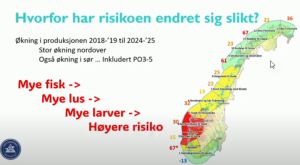
The question posed in the slide is ‘here is why the risk has changed?’. The answer is
‘More fish leads to More Lice leads to More Larvae leads to Higher Risk’.
This is the quality of an answer I might expect from a high school student than someone from a major research institution. It just shows a complete lack of understanding of salmon farming, sea lice and sea lice ecology. This view is simply far too simplistic.
The reason for the slide saying ‘more fish’ is because as IMR announced on the 11th, that salmon production had increased by 182,000 tonnes which according to Intrafish came as a surprise to the report’s lead author Ellen Sofie Grefsrud. This is the largest annual growth in Norwegian salmon farming during the period 1980 to 2025. Ellen Sofie Grefsrud added that they at IMR have discussed the causality, but they don’t have a clear answer as to why or how production has increased so much. This growth has occurred despite the measures imposed by the Traffic Light System. We often hear that the scientists at IMR are the experts but clearly their expertise is left wanting as they cannot explain why production has increased. Even if they didn’t initially understand the reasons for the extra 182,000 tonnes, they are scientists who should have enquiring minds and sought to seek an answer before publishing the Risk Report.
In her introduction, Ellen Sofie Grefrsud said that the main challenges in 2025 remain as sea lice, animal welfare and escapes. Yet clearly, they can’t be such a challenge if production has increased by an amount, which is nearly equivalent to the total output from Scotland. Although, they don’t appear to understand how production has increased by so much whilst under the Traffic Light regulations, IMR do recognise that farmers have managed to attain this growth, whilst keeping within the restrictions of the regulation.
The increased growth has been observed in all the production areas except PO1 in the south of the country, but what surprised IMR scientists most was that the most growth was seen in the areas where production capacity was expected to be controlled by the Traffic Light regulations. Thus, growth was seen as follows
PO3 – 15%
PO4 – 30%
PO5 – 32%
IMR say that this growth is only noticed now because of the two-year production cycle but that still means that this growth is just a new thing. Simply, farmers have learnt to adapt to production under regulation with improved welfare, increased cooperation and reduced numbers of sea lice.
Yet IMR, with their clear lack of knowledge of farming operations, suggest that sea lice numbers have not fallen and this is because of the increased production. However, clearly all this extra production was not in the sea all at the same time so the extra production cannot be used to explain why production has not matched the threat to wild salmon as predicted by their models. Of course, there is a very simple explanation and that is that the models are just wrong, something IMR will not accept. At the same time, we know the sampling that IMR undertake to assess the threat does not reflect the actual spread of lice amongst wild fish. This is not helped by the fact that the number of wild fish sampled for lice has fallen each year. In 2018, they sampled 4,722 fish whilst in 2024, it was 2,286 and 2,354 in 2025. With the number divided between 13 production areas and serval sites, the number of fish caught from a particular site can be less than 100 fish.
IMR maintain that more fish in the sea together with warming water increases the threat to wild fish from sea lice. They remain stuck with the mantra that the greatest threat to wild fish is from sea lice, despite growing evidence to the contrary.
I suspect that IMR are encouraged in this view by their seemingly close association with the angling fraternity. Regular readers of reLAKSation may remember that last year I referred to a video from a representative of one of the angling organisations in which he said he was a regular visitor to IMR. The video showed him chatting to one of the researchers, someone I have tried to engage in discussion but is reluctant to do so.
Meanwhile, Thorfinn Evensen, Secretary General of Norwegian Salmon Rivers (Norske Lakseelver) was one of four panellists at the launch of the Risk Report. The others being a representative from the salmon industry, the head of the Ministry of Fisheries and a representative from Mattilsynet (The Norwegian Food Safety Authority). Why Mr Evensen was present is unclear although this is not his first appearance at this event. It is well-known that the angling fraternity blame salmon farming for the lack of wild salmon that they wish to catch and kill, but his presence at the launch of the Risk Report would only ensure further criticism of the industry and we were not to be disappointed.
iLAKS reported on the comments he made during the panel discussion, and this began with him saying that it is disturbing that the Traffic Light System which was supposed to help us has not done so. I though the purpose of the Traffic Light System was to protect wild salmon (from sea lice infestation) not to help the anglers have more fish to catch. He added that the fact that the Traffic Light System is not working was an ‘a-ha experience’ for the anglers. Mr Evensen said that Norske Lakseelver is committed to wild salmon and sea trout in Norwegian rivers – although it is unclear whether he means committed to protecting them or committed to catching them – and as salmon production is increasing, the current situation requires action and that action is urgent ‘if we are to take care of wild fish’.
So how much do Norske Lakseelver care for wild fish? Fortunately, we don’t have to reply on models for an answer as the data is readily available from Statistics Norway. Since the introduction of the Traffic Light System aimed at protecting wild fish, anglers have caught and killed 698,466 salmon of average weight 3.5 kg and 295,727 sea trout average weight 1.08 kg. That is just under a million fish that were returning to their home river to breed and propagate the next generation of wild fish but were prevented from doing so because of their premature demise.
Statistics Norway started to record this data in 1993, and from then until now, anglers have caught and killed 3,390,692 wild salmon with an average weight of 3.25 kg and 1,790567 sea trout of average weight 1.04 kg. This makes a total of 5,181,259 wild salmon and sea trout that have suffered a premature death and the anglers now wonder why there are so few left. If this is caring for wild fish, then I can only wonder what the situation would be if they didn’t care.
Interestingly, I think I know what explanation Norsk Lakseelver might offer in response to this widespread devastation of wild fish stocks because following the publication of the Risk Report, they were very active on Facebook. One comment in response to their feed was that ‘there is a lot of talk from Norsk Lakseelver about taking care of wild salmon yet salmon fishing is allowed in our rivers for fish that are heading upstream to spawn’.
In response Norsk Lakseelver wrote ‘As with all hunting and fishing, no more should be caught than the individual stocks can withstand. Over 160 rivers are closed and the vast number of rivers that remain open have so far enough spawning fish left after the fishing season closes but that is because the harvest is lower than it should have been. The quota for each angler is small.’ Norske Lakseelver end by saying that being able to harvest at least 80% of the normal harvestable surplus is part of the quality standard for wild salmon.
In response, the person posting the original comment replied: ‘Wild salmon in Norway are in decline and are considered endangered in many water courses, Nevertheless, sport fishing is permitted in several rivers precisely where the salmon come to spawn the next generation. Although wild salmon are an important part of Norwegian natural heritage, in practice they are treated as a recreational asset. This shows that nature conservation does not always come first when it collides with tradition, economy and human entertainment.’
I couldn’t have put it better.
It is also worth remembering that in 2024, the number of wild salmon caught and killed was 30,137 whereas in 2025, the number rose to 40,670, although to be fair the number of caught and released fish rose from 14,751 fish in 2024 to 26,394 last year.
Mr Evensen also spoke at the Risk Report panel saying that he supports a polluter pays scheme, so given that his sector has killed so many wild fish how much are they going to pay to help wild stocks recover? Of course, he does not see salmon angling as a threat to wild salmon as they see it as the right of anglers to carry out their sport.
Instead, he wants salmon farms to pay, but does he really expect the industry to pay fines based on estimated mortality based on a model that has not yet been validated. The problem is that there is not a shred of evidence that salmon farming is responsible for the decline in wild salmon numbers other than on the say so of people like Mr Evensen and on the inherently flawed models constructed by the scientific community.
If Mr Evensen wants the salmon farming industry to suffer stricter penalties, then he should be willing to sit down with the industry and with the scientific community to determine what we know and what we don’t know rather than basing regulation on some half-baked theory.
Meanwhile, IMR say that a number of farmers in PO3 and PO4 have taken advantage of exceptional growth which helps explain why the Traffic Light System has not had the positive effect on wild salmon that was initially expected. They add that this increase in production has come regardless of the environmental status of the production area in which they are located.
Yet it seems that angling is allowed to continue regardless of the environmental status of the locality. Since the Traffic Lights System was introduced, anglers in Vestland have caught and killed 42,559 wild salmon and 19,039 sea trout. If wild fish stocks are considered at risk in areas where the red light is applied, then surely, all fishing should be banned in the area exactly because of the poor environmental status. What is the point of protecting wild fish for allegedly damaging sea lice infestation if anglers are simply going to catch and kill the adult fish in nearby rivers. It makes no sense.
What is interesting is the Risk Report makes no attempt to quantify how many wild salmon have actually died from sea lice infestation. Surely, this is something we need to know otherwise the future of the industry is based on modelled output and as we already know the models bear little resemblance as to what is happening in the actual environment.
As I suggested in the last issue of reLAKSation, until the scientific community are properly challenged on their science, the biggest risk to salmon farming and wild fish comes from the scientists themselves.