
Eat more fish: According to the Grocer magazine, British consumers want to eat more British fish. A new study from the University of East Anglia suggests that around 40% of consumers were willing to experiment with fish they have never previously tried. The study points out that sardines and anchovies were once staples of traditional coastal diets, although I cannot say that anchovies were ever on the fishmongers’ slabs that I have ever seen. Herring and spats were more likely to be seen but increasingly not. The study says that concerns about taste and bones often stand in the way, but despite this, curiosity is strong and many consumers say that they would be willing to try these lesser-known species especially if they are fresh, locally sourced and reasonably priced. The research found that 58% of respondents had never tried sprats, 28% had never tried anchovy, 23% had never tried herring and 12% had never tried sardines.
Yet clearly this curiosity that the study has found amongst consumers has never manifested itself with actual purchases of these fish. This might be because most fishmongers don’t offer them for sale, because hardly anyone bothers to buy them. In fact, as the study shows, 84% of adults eat fish with most buying the big five and the likelihood is that this consumption is dominated by canned tuna and frozen and coated white fish. When it comes to fresh fish, salmon remains the star of the show.
The study also found that consumers would be prepared to pay a £4 premium per portion for fresh local fish. This is where what consumers say and what consumers do, appears to influence the study because there is no evidence that consumers would pay a premium at all, unless it is because they shop at M&S or Waitrose rather than Aldi and Lidl. However, such shoppers pay a premium for the whole range of shopping when they make such a choice and not just fish.
The study concludes that a shift towards more diversified fish consumption would support national fisheries, food system resilience and help reach nutritional targets especially in younger and lower income families. They recommend introducing British fish into school meals, helping children develop healthy habits early and give families confidence to diversify their diets. They also recommend that if retailers increased shelf space and highlighted simple recipe ideas, people would be more likely to try species like sardines and anchovies. Finally, they recommended the introduction of a proposed ’Pyramid Fish ’sustainability label which they say consumers found easy to understand.
Whilst consumers might find it easy to understand a sustainability label (but probably wouldn’t bring about increased purchases) I fail to understand why researchers from UEA’s Centre for Social and Economic Research in the Global Environment felt that the fish sector needed yet another survey about UK fish consumption habits, which revealed nothing new.
The simple truth is that UK consumers choose to buy salmon in fresh and chilled form because it is easy to prepare, tastes good and is value for money. They also buy frozen coated white fish so they can eat fish and chips at home more cheaply than by visiting their fish and chip shop. At the same time, they choose to buy canned tuna because it is cheap, convenient and is versatile to be used in anything from sandwiches to tuna pasta. Finally, consumers choose warmwater prawns because they are easy to cook and offer a more substantial meal than the north Atlantic shrimp.
The reason why consumers avoid the many species that could be widely available is because various surveys tell them that this is what they ought to be eating and they are presented as fish when really what consumers want now is ‘the fish’ offered in a format that aligns with the food that they currently eat.
Many years ago, I upset a section of the industry by saying that we should be producing not what we think the consumers wants but what the consumer actual wants. This current message is very much in the same vein. We shouldn’t be telling consumers what to eat but rather finding ways to adapt what we have to offer into formats with which the consumer is familiar. Sadly, we rarely try to do this and consequently consumers remain loyal to the Big Five and we are besieged with ever more surveys telling the industry what consumers say they want, when they really don’t.
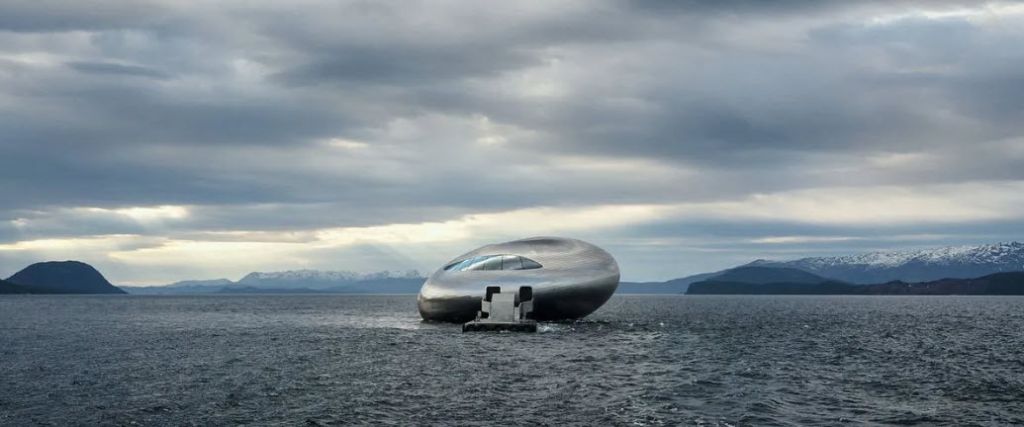
Shuteye: According to Fish Farming Expert, Salmon Eye chairman, Sondre Eide announced at the start of the year that the Michelin-starred Iris restaurant at the Salmon Eye visitor centre at Rosendal in the Hardangerfjord had been temporarily closed and the thirteen staff had been laid off. Mr Eide said that the closure was not permanent and he remained proud of the Salmon Eye and the Iris restaurant and that there were plans to strategically develop the concept to achieve ambitious goals.
The concept of the Salmon Eye was developed by Sondre Eide and was opened in 2023. It weighs 1256 tonnes with a diameter of 25 metres, and an area of over 1,000 square metres divided over four levels, one of which is underwater. His vision was to set the standard for the future of aquaculture. Mr Eide has also developed a closed containment farm.

The restaurant could accommodate 24 diners who were ferried to the restaurant by electric boats and then served an 18-course dinner whilst looking out at the panoramic views over the fjord and the mountains. In May 2024, the restaurant was awarded a Michelin star. In October that year Aslak Berg editor of iLAKS reported about his experience of eating at Iris. (https://ilaks.no/en-apenbaring-for-sansene-i-hardangerfjordens-solvperle/ – which can be easily translated).
Despite international recognition of the food, the restaurant has been running at a loss for years (sic). Mr Eide says that it takes time for new concepts to bed in.
In my opinion, it was not the concept that was wrong but the simply the pricing. One of my pleasures in life is to eat at one-star Michelin restaurants, especially those offering the best value, so even allowing for the view and the unique setting of the one-star Iris restaurant, I would baulk at paying the equivalent of £392 for the experience of eating at Iris.
The £392 cost also needs to be considered against the price of eating at Maaemo in Oslo, a three-star Michelin restaurant which cost £458 per person. In London, the three-star seven-course menu at Core costs £255. The tasting menu at three-star Alain Ducasse is £285 and £300 at Restaurant Gordon Ramsey.
Of course, Norway is more expensive than the UK and an average price of all the one-star menus is £200. Iris was charging nearly double that. The menu at Iris might be longer than some with 18 courses, but it is the price that visitors consider.
For comparison. Casa Fofo in London has a seven-course tasting menu for £73 and Behind, which is a real favourite, has a six-course lunch menu for £64 per person and a 10-course evening menu for £125.
It could be argued that Iris provided a unique experience beyond the food and therefore justified a higher price however, there is another one Michelin starred restaurant in Norway offering a unique experience which Is the restaurant ‘Under’ in Lindesnes. This is a restaurant that is half under the sea offering a view into the underwater world. The menu is £196 for dinner (10 to 12 courses) or £132 for lunch (5-6 courses).
Could it be that those involved with the Salmon Eye were simply out of touch with the reality of fine dining today with both cost and the menu. 10-12 course is a lot of food even with small plates, 18 courses is simply over the top so it’s not surprising that Iris has now gone under.
Erling Braut Haaland: One of the presentations at the recent Aqkva conference concerned market development and international initiatives for Norwegian seafood during which the Haaland effect was highlighted.
The website Godfisk.no features the Manchester City football star and says that he has always loved fish and seafood. He is known for his healthy diet and tries to eat as much natural food as possible. He said that Seafood has been part of my diet while I was growing up and still has a natural place in my life to ensure that his body is ‘fit for fight’.
The Seafood Council clearly believe that Haaland is a role model to encourage the public to eat more fish and seafood. However, the Seafood Council must have been extremely disappointed when Haaland and his Manchester City team arrived in Norway just five days later to play football minnows Bodo Glimt.
Unfortunately for the Seafood Council, the poster boy for Norwegian seafood and his teammates were simply outclassed and lost by 3 goals to one.
In an interview on TNT TV afterwards, Haaland said that Bodo played some incredible football and their win was deserved. He continued that ‘I don’t have answers and I take full responsibility for not being able to score the goals I should’ adding that I just apologise to every single Manchester City supporter and especially to those that travelled to Norway today because in the end it is embarrassing.’
I wonder whether after the game the Norwegian Seafood Council were also embarrassed that their star signing failed to produce the goods on his home soil.
Two days after the match, four of the Manchester stars including Haaland put out a statement saying that they would cover the costs of tickets for all 374 fans who had headed north to watch the match. This is estimated to cost them at least £10,000.
Maybe Erling Braut Haaland might also consider refunding the Seafood Council for his poor performance too.
Although not directly connected, towards the end of last year Haaland launched his own video channel on You Tube, the first offering was ‘Day in the life of pro footballer Erling Haaland’. In this he does talk about food, but the focus is very much on how he enjoys his steak,