
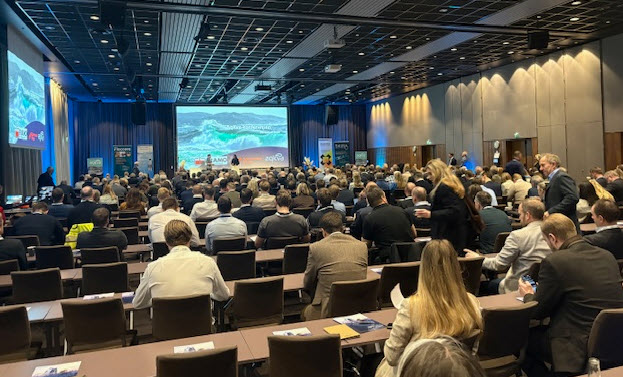
Talking point: I was in Norway last week as a speaker at the Aqkva conference, which was held in Bergen. The title of my presentation was ‘Are Sea Lice guilty as charged’. This covered three of the issues regular readers of reLAKSation will be familiar with: parallel declines across two Scottish coastlines, the absence of sea lice in the fjords and lochs and finally, the unique way sea lice are distributed amongst their hosts. It seemed to me that the 350 plus audience were riveted by the images I showed. Certainly, I received many positive comments from members of the audience throughout the day. I was also delighted that sitting in the front row was the Norwegian Minister of Fisheries who I hoped also found my presentation to be of interest.
Amongst the issues raised, I highlighted that the Scientific Committee for Salmon Management (VRL) had written in their 2025 review of salmon stocks that sea lice were the greatest threat to wild salmon stocks and that they indicated that in 2019, 39,000 fish were estimated to have died because of sea lice infestation. What VRL don’t mention is that also in 2019, netsmen and rod anglers caught and killed 129, 421 adult salmon as they returned to their home rivers to breed but failed to do so due to their premature deaths. I would suggest that the loss of 129,421 adult salmon is a greater threat to wild salmon stocks than the estimated and unproven deaths of 39,000 fish. I hope the Minister took note.
Previously, her office has responded to such questions with a stock answer that she relies on the expertise of the Sea Lice Expert Group. The problem, as I have previously highlighted the is this group and the wider scientific community seem extremely reluctant to discuss any aspect of sea lice infestation that does not agree with their own view. This means that there is very little discussion at any of the issues. It was therefore pleasing to be invited to the Aqkva conference to spread the message that there is evidence available that brings the whole issue of sea lice infestation into question. My thanks go to the organisers of the Aqkva conference who recognise the importance of this issue.
By comparison, the Norwegian Seafood Fund (FHF) have organised their annual two-day conference on sea lice on the 3rd and 4th of February in Trondheim. Their website talks about the conference as:
The Lice Conference is the most important professional gathering of the year on the topic of lice in the aquaculture industry. Through sharing new knowledge and experiences, we want to help find good solutions for the future. The conference starts with a status and situation description around the coast and ends with input and R&D challenges further.
Interestingly, whilst FHF say that they want to find good solutions for the future, they are apparently not keen for participants to hear that policies on sea lice have been moulded by flawed science and that by addressing the science they could bring good solutions for the future. For example, one of the presentations is titled ‘Closed facilities as part of lice strategy’ and the speaker is from Ovum, manufacturers of the Egg growing system. Yet, if it is shown that sea lice associated with salmon farms are not responsible for the decline of wild salmon then wild salmon no longer require the protection of closed systems.
The FHF conference begins with four presentations about the lice situation in four parts of Norway and there are three presentations from Inaq about the KOLUS project looking for coordination and collaboration of sea lice work and five presentations from researchers from the Institute of Marine Research, one of which asks whether sea lice can adapt to freshwater.
To my way of thinking, this question comes from those who fail to consider the natural lifecycle of sea lice before raising concerns that are not really concerns. I am sure that this might generate research funding for these scientists, but the reality paints a very different picture.
Salmon returning to their home rivers are likely or not to be carrying sea lice. As the fish transfer from sea to freshwater, these lice will inevitably drop off as the change to freshwater takes effect. However, some lice, mostly adults, will hang on for some time as evidenced by anglers catching sea liced fish 30 or so kilometres upstream. Anglers are usually delighted to report such catches are they represent a freshly run fish. Sea lice have been hanging on to their host whilst in freshwater probably for millennia but have never adapted to live in freshwater This is not surprising as after all they are sea lice.
In recent years, freshwater has been used to treat farmed salmon for sea lice. Inevitably, some lice will not succumb to treatment because as in the wild, some take longer for the effect to work. The question is whether these lice will become adapted to freshwater on repeated treatments. This is like saying that some lice will become resistant to a medicine even though it is not the same.
I assume that the presentation at the FHF conference will be based on one from Sea Lice 2025 in Chile. In the experiment, sea lice on fish were exposed to freshwater for two hours three times in a generation repeated over five generations, something that is unlikely to be ever repeated in the farming situation. The researchers found that copepods from the lice exposed to these treatments showed a preference for a lower salinity environment (14-24 ppt) than the control lice. Low salinity water is however not the same as freshwater and in nature sea lice experience the change from full strength sea water to low salinity as they enter river estuaries.
I can only wonder why members of the farming community attending this conference would prefer to hear this conjecture-based presentation rather than one which asks whether the salmon farming industry is being unfairly penalised because of a dependence on flawed science. Surely, the question of whether the Traffic Light System is fit for purpose should be a priority, especially since the Aquaculture Committee highlighted the issue. I get the impression that the difficult questions posed by the Traffic Light System are not those that some conference organisers really want to address.
The most interesting part of the FHF conference programme is the talk titled ‘What implications will the introduction of lice quotas have’. When I say it is interesting it is indeed sad that it seems that there is acceptance, at least by FHF organisers, that lice quotas will be introduced in Norway to replace the TLS even though lice quotas are based on the same flawed science that underpins the Traffic Light System.
Perhaps the organisers of FHF sea lice conference might like to send a mail to registered participants and ask whether they would prefer to hear about the possibility of freshwater adaption or why the Traffic Light System science is so flawed that it classifies PO3 red when it should be green?
Sadly, this situation is not unique to Norway as the Scottish authorities are equally reluctant to organise a public discussion on sea lice and wild fish, especially one that is not directly organised by the industry because the angling sector would argue that it is biased, although such meetings organised by the wild sector clearly are not!
I have always thought that the ideal organisation to arrange such a meeting would be the Sustainable Aquaculture Innovation Centre (SAIC) as they already organise workshops such as the one held at a MASTS meeting about measuring sea lice in the environment. SAIC were also supposed to organise the international Sea Lice 2024 conference in Glasgow but failed to do so. I have subsequently suggested that they organise a one-day meeting on sea lice science, but they continually claim to have no funds to do so, yet they manged to organise workshops on climate change and ocean clusters. It is not as if SAIC were not interested in sea lice, as I see that a representative of SAIC sat on the scientific committee for Sea Lice 2025!
SAMS has aspirations to be a centre for sea lice expertise yet is also reluctant to organise a sea lice conference or workshop.
In Scotland, SEPA are still trying to impose a sea lice regulatory framework, in a similar vein to the Norwegian Traffic Light System. The science which underpins both is flawed but there is no opportunity for any discussion, firstly because scientific community refuse to enter into any discussion and secondly because no-one is willing to organise a conference to discuss these controversial issues. If they are confident in their view of the science, what do they have to be scared about?
Experts!: On January 19th, the Sea Lice, Steering and Expert Groups (SG and EG) published a ten-page document as a response to the recommendations made by the International Evaluation Committee who issued their report in December 2021. Ignoring the content of their response, it is diabolical that the SG and EG have taken four years to respond and simply confirms that they believe their view of sea lice to be unassailable.
In their report they say that it has been incorrect to say that the SG and EG have taken little account of the committee’s recommendation because they had met with the committee and important changes have been made.
Certainly, if the latest EG report is compared to that of 2021, some chapters have been expanded to include more information but whether this information is actually helpful in determining the effectiveness, so the Traffic Light System is very much open to question. This is because the SG and EG are firmly plugged into a fixed narrative and are closed to other views. This is illustrated by the fact that one of the international committee’s recommendations concerned how submitted knowledge, especially reports and ‘grey’ literature are evaluated. Yet, the EG is only prepared to hear new knowledge and not knowledge that has previously been ignored.
However, in documenting the various sources of knowledge such as peer-reviewed, theses, reports and the like, EG say in their 2025 Expert Group report that the gathering of such knowledge will include ‘acquired knowledge possessed by members of the Expert Group’. This is of interest to me since IMR and others have been happy to dismiss the fifteen years of my acquired knowledge as irrelevant.
I was also interested to see that in the 2025 EG report, they say, in relation to peer-reviewed literature, that sea lice is a relatively small research field internationally, which it is. Unfortunately, this also means that the pool of expert reviewers is also very small and hence papers that are contrary to the supposed consensus are difficult to get through the peer-review process. I recently heard of a paper that took eight years to get through the peer-review process and when finally published it was ignored by the scientific establishment, as usually happens in such cases.
The International Committee recommended that further consideration should be given to composition of the EG. Unfortunately, this polite suggestion about consideration means that the EG and SG considered the idea and rejected it. They say that the EG consists of nine members with scientific expertise relevant to the annual assessments and that other expertise can be best included by collaboration with relevant experts. However, this means that EG can decide if they need to collaborate and who with, which would suggest that nothing much will change. The reality is that most of the members of the EG are also involved in research, of which all attempts to show that sea lice associated with salmon farms exert a negative impact on the wider environment, whether it be the sea bed or wild salmon. This means that there is no dissenting view in the group who questions whether any of their actions are appropriate or relevant. This is why the group should have a wider make-up as the International Committee recommended. As a starting point, the group should have representation from the industry. I am certain that there are people working in the industry who are qualified to doctorate level and can hold their own against this so-called scientific consensus.
I would suggest that other scientists who do not benefit directly from the research should also be included in the EG.
The International Committee also recommended better communication with stakeholders. The EG and SG say that annual information meetings is where the assessments are explained and the impact of sea lice is discussed. They say that there is also an opportunity to give short, registered lectures at these meetings. Having watched one of these meetings take place, I would suggest that they do not go far enough as evidenced by the restriction on short, registered lectures. Instead, the EG should hold a one- or two-day workshop where their evidence and new and old knowledge is openly discussed. Sea lice knowledge and experience is not part of some secret society where membership is exclusive. Impacts of sea lice are of major importance affecting one of Norway’s key sectors. Discussion of restrictions is of concern to all and should not be left to the views of a small scientific clique.
Interestingly, the International Committee suggest that there should be peer-reviewed studies of impacts of sea lice in situ at both individual and population level. Yet SG and EG say that this is not in their mandate. The EG point out that the Research Council has funded the Hit Lice project that will conduct such studies yet Hit Lice involves the same research institutions of which EG and SG members belong. They are all part of the same closed shop.
The International Committee also refer to the uncertainty of these assessments and recommend better communication. The EG and SG say this has been improved by the inclusion of probability distributions for each area. Yet, probability distributions do not convey uncertainty any better than previously. For example, they discuss the models but fail to mention that as yet no-one has found the larval sea lice in the fjords in the numbers or locations predicted by all the models. This is the greatest area of uncertainty but is ignored.
I was interested to see that when the International Committee suggest that more rivers should be used in the assessment, the SG and EG say this is not in their mandate, saying this is the responsibility of VRL, which not unsurprisingly is made up from those working for the same research organisations as the members of the EG and SG. It is all very incestuous.
The reality is that the TLS assessment is in the hands of a few researchers from selected research organisations, which are all involved in some aspect of sea lice research or another. The Aquaculture Committee has recommended that the TLS should be reviewed, and this should really include discussion of whether the science is right and whether those commissioned to make assessments come from a varied background. In my experience challenging anything the SG and EG say is extremely difficult. It should not be so. After all, if they are confident in their science and assessment process, they should have no concerns about facing alternative views.