
Happy Christmas: I would just like to wish all readers a very Merry Christmas and a Happy New Year and to thank you for your continued support. I will be back with more commentaries on Saturday 3rd January.
SEPA: According to Fish Farming Expert, The Scottish Environment Protection Agency (SEPA) has just launched a new consultation ‘Safeguarding Scotland’s Water Environment’ in which they highlight seven significant water management issues. These include agricultural runoff and the physical conditions of rivers. However, included in the list is ‘sea lice from marine farms.’ The consultation document states:
“Sea Lice from Marine Fish Farms
One of the other significant issues for wild fish populations is the assessment and management of the interaction between sea lice from marine fish farms and wild Atlantic salmon and sea trout. In sufficient concentrations, sea lice can have a significant adverse impact on these migratory species. We currently assess and manage the risk posed by sea lice to wild salmon and sea trout when determining applications for proposed new marine fish farms or to increase the permitted maximum biomass of fish held at existing fish farms.
We now need to focus on gathering additional information necessary to understand the effects of sea lice from existing marine fish farms on wild salmon and sea trout. We expect this will involve several years of data gathering. Where the evidence collected shows significant adverse impacts on wild salmon or sea trout, we will ensure appropriate and targeted action is taken to reduce pressure from sea lice as part of the RBMP programme of measures and so help improve the condition of wild salmon or sea trout.”
What this document appears to be saying is that SEPA have yet to understand the effects of sea lice from existing farms on wild salmon and sea trout. To gain this better understanding, they are planning several years of gathering data. However, I suspect that what they really mean is that they hope that the data collected in forthcoming years can be used to validate their model on which the Sea Lice Risk Framework is based. What they don’t say is what they will do if after several years, the real-life data doesn’t match the output from their model. I am relatively confident that it won’t because fifty years of existing data does not to support their model so there is no reason why this should change in the next few years.
Their announcement coincides with the beginning of the DPEA appeals hearing in which the salmon farming companies are challenging SEPA over changes to their licences. These appeals should have never happened, but SEPA have consistently refused to consider that wild salmon populations are not threatened by sea lice associated with salmon farms. This is because they are firmly stuck in Model Land where their model, rather than real life, reigns supreme.
Spey catch: The Spey Salmon Fisheries Board has issued the following news:
“The Spey Fishery Board is pleased to announce that the salmon rod catch for the River Spey in 2025 was 3,677, 99% of which were released. This is less than 2024’s catch of 5,344 (99% of which were released) but very similar to 2023’s 3,961 (97% of which were released). Conditions on the Spey in 2025 were immensely challenging to fishing through high water temperatures and prolonged significant water scarcity, more so than even 2023. As a result, we are immensely grateful to the efforts of all anglers, estates and ghillies who have participated in angling on the Spey this year.
Sea trout catches remain concerning. 2025 saw the capture of 953 sea trout, 95% of which were released. Although higher than the 562 of 2024 (94% of which were released), it is lower than the 1,118 caught in 2023 (90% released). The steady increase in sea trout release rates is greatly appreciated but it is unclear how much of this low catch was due to low stocks, under reporting of catches or a lack of angling effort targeting sea trout respectively.
We look forward to the 2026 season and hope to see you at the opening ceremony on the 11th of February.”
This raises a number of issues:
Salmon catches from the Spey are at an all-time low and the expectation is that this will be reflected across all of Scotland and yet, there is no real attempt by either Scottish Government or local river managers to understand what is causing this decline. Instead, their focus is on local rivers. Meanwhile, the Scottish Government has just published the results of their consultation on salmon conservation, and the outcome is that it is business as usual.
Clearly, it is important to understand the current situation of local stocks, and this is determined from the annual catch. Yet, the numbers provided by the Spey Salmon Fishery Board for 2023 and 2024 are not the same as the numbers in the official Scottish Government catch data. However, nobody in either Scottish Government or Fisheries Management Scotland appears to be concerned about such inaccuracies.
According to the Spey Fisheries Board, 3,507 salmon were landed in 2023, yet the official statistics record 3,961, which means a difference of 454 fish whilst the Board record 5,340 in 2024 which the official statistics recorded 5,344 fish.
There are also discrepancies over the sea trout catch with the Spey Board recording 1,118 fish in 2023 and 562 fish in 2024. The official statistics record 1,130 fish for 2023 and 636 fish for 2024.
The Spey Fishery Board say that they are unclear whether the low catch of sea trout is due to low stocks, under reporting or a lack of angling effort. One would hope that the fishery boards are constantly monitoring the activities on their rivers, but it seems not. It seems that as long as fishing can go ahead, then all is well.
Finally, the Spey Salmon Fishery Board published their catch data around the 9th of December, yet it will be May 2026 before the official catch data for Scotland is published. It is absolute nonsense that a new fishing season is allowed to begin before the state of fish stocks in 2025 are understood. After SIWG reported, the reporting system for salmon and trout was supposed to be updated, but after some initial investigatory work, the idea was dropped and instead the Scottish Government continue to rely on an archaic system that is no longer fit for purpose.
The situation seems no different over on the west coast. Andrew Graham Stewart, formerly of Wild Fish has penned another fishing report in Trout & Salmon magazine which covers the rivers of Wester Ross. He reports that despite light fishing, the local ghillie Ray Dingwall caught eleven fish which brought the total catch to 133 fish for the year. Mr Graham Stewart says that the consensus was that this year’s runs were an improvement on those of previous years. He says that last year just 899 salmon were caught bringing the 5-year average to 122 fish. According to the official record, the catch in 2024 was 116 fish not 99 as Mr Graham Stewart suggests. The five-year average last year was 149.2 and this has fallen to 138.8 fish if the 133 fish catch is correct. If all the years are considered since 1952 when records began, the average Ewe catch is just 191 fish, which suggests that the river Ewe salmon are not faring too badly despite many years of exposure to salmon farming.
Mr Graham Stewart also writes that there are positive signs regarding the system’s sea trout with good specimens landed from the River Ewe and Loch Maree up to 4lb. He says that the numbers landed (he does not say how many) reflect the lack of angling effort implying that stocks are improving. He also says that the fish caught are well fed and are devoid of damaged fins. The implication is that Loch Maree is on the road to recovery after the removal of the salmon farm from Loch Ewe. However, he ignores the overall trend that sea trout are in decline across all of Scotland, as illustrated by the numbers reported from the river Spey.
The reference to the damaged fins is a dig at the salmon farming sector who he blames for the declines of salmonid fish especially in relation to sea lice. He writes that the Wester Ross Fisheries Trust has sampled various marine locations across the region and highlights that high lice counts continue to be identified at Flowerdale by Gairloch. He adds that these can be correlated with the production cycle of salmon farms in Loch Torridon, which he says is now devoid of local sea trout. He also highlights high lice counts from the River Applecross which is 15km from farms on Isle of Skye.
Certainly, Wester Ross Fisheries Trust has focused on sea lice monitoring this year with twelve separate sampling events, although down from 20 in 2024. In total, they sampled 156 fish of which 36 were free of lice. Over the years, the Flowerdale site in Wester Ross has always produced numbers of fish with a higher lice infestation although the nearest farm is in Loch Torridon. Sadly, Wester Ross Fisheries Trust do not seem to have investigated any specific link between the two locations,
I am still waiting for the full sample of sea lice data for 2025 to be made available. FMS refuse to acknowledge my request for data and SEPA are treating it as an FOI. Meanwhile the Marine Directorate say such data is nothing to do with them. I find this all to be somewhat sad. I will comment on all sea lice monitoring when the data is published.
Atlantic Salmon Trust: The Atlantic Salmon Trust has published their 77- page Annual Review for 2025 which they have titled ‘Putting Wild Salmon First’. I was most interested in a paragraph from the report’s forward written by the CEO. In this Mark Bilsby wrote that there has been a sustained drop in marine survival over the last sixty years. He says that recent work by the AST and the Missing Salmon Alliance has linked this to a decline in marine zooplankton abundance along the salmon migration routes. He adds that alarmingly further reductions are predicted by 2040s.
Drawing a link between declining salmon stocks and changing zooplankton concentrations is nothing new. It is a subject that I have previously discussed in reLAKSation. I remember at the time, the wild fish sector showed no interest in that connection primarily because they are dismissive of anyone associated with the salmon farming sector that puts forward ideas about wild salmon declines. They claim that only they have any knowledge of anything to do with wild fish. This is why there is still no discussion about the impacts of seismic surveys on wild fish. This is because they didn’t think of it.
The annual review is filled with pages extolling all the wonderful things the AST are doing to help save wild salmon. Despite all their efforts, it seems that wild salmon stocks are in the worst state ever.
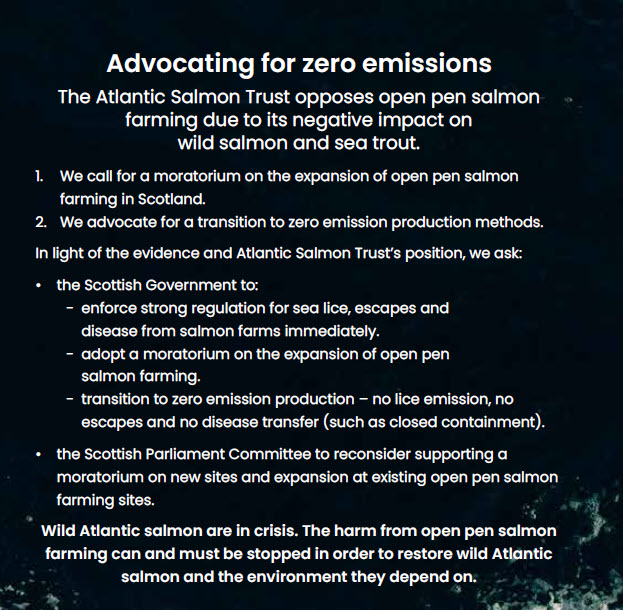
It is not until page 62 that the AST turn their attention to the issue of pressures on wild salmon. They say that this year the AST have started to publish updated position papers on the impact of known pressures. Not unexpectedly, the first position paper is on salmon farming. They say the science is clear and AST now advocate for zero emissions of sea lice and zero escapes. However, despite being clear about the science, no-one from the AST is prepared to discuss the science. This is because they have to justify their latest call for a moratorium on the expansion of farms and a transition to closed containment, which appears in the review.. The reason for this change is that the AST is clearly moving away from its science-led position to one which is activist-led. This is probably why their research director recently got sacked. As yet, they have no replacement probably because most scientists won’t like being directed by activist views.
What is interesting is that the reference to the changes to zooplankton which are critically important cover hardly a fraction of the space given over to salmon farming.
The AST have also recently announced that their auction has raised £97,000 but interestingly, I took a look on the last day of the auction and saw that quite a few of the lots on offer had not attracted any bid. This included some fishing lots. I suspect that even the most passionate angler is not willing to pay to fish a river where there is very little chance of catching a fish. I was also interested to see that the lots offering the opportunity to see behind the scenes at two of the AST’s key projects – the Deveron and the Dee also failed to raise a bid. Most interest seems to be directed at fishing rather than saving wild salmon.
Independent: On 10th December, Arianne Burgess MSP posed a question in Parliament to the Minister for Public Finance in Parliament concerning job creation. She highlighted that recent ‘independent’ research indicate that job numbers in salmon farm applications may be significantly overstated. Her point was that job creation claims should be verified before a new application is approved. Her constituents in the Highlands & Islands must be delighted that her priority is to undermine any attempt to create jobs in her region.
It is no secret that Ms Burgess is very much against salmon farming. She supports the Coastal Communities Network in their opposition to salmon farming as well as any other organisation that holds similar views. The independent research was carried out by Andrew Moxy of Pareto Consulting and Angela Tregar of the University of Edinburgh Business School and was commissioned by Wild Fish (formerly The Salmon & Trout Association) and the Sustainable Inshore Fisheries Trust, two organisations committed to the removal of salmon farming from Scottish waters. The report is titled ‘Assessing the Economic Impact of Salmon Framing in Skye and Lochalsh – An Exploratory Scoping Study. The highlights of the report claim that estimates of economic impacts of Scottish salmon exaggerate economic benefits by focusing on gross rather than net effects and disregarding counterfactuals. Given the motives of those who commissioned this study, this conclusion should come of no surprise. This report comes on the heels of another economic study conducted by Biggar Economics, which was quoted by the Minister in response to Ms Burgess’s question.
I suspect that Ms Burgess did not read all of the Wild Fish/SIFT report because it is only on reaching Appendix B – the discussion guide for the stakeholder interview when the reports motivation becomes clear. The anonymous telephone interviews were conducted with ‘selected stakeholders in Skye and Lochalsh with experience of negative impacts of Scottish aquaculture (particularly salmon farming)’. The interview prompts also show that the report has sought out to show a negative impact of salmon farming which we know is aimed at undermining the Scottish salmon farming industry.
Their report was published about the same time that Wild Fish have posted a video discussion about their ‘Off the Table’ campaign. Like their economic report, the panel discussion is made up with those who have a negative view of salmon farming. Wild Fish would never invite anyone from the salmon industry to discuss their claims because they aren’t interested in the truth.
The most interesting point from this video is that we get to hear from their new Scotland director Nick Underdown, formerly of Open Seas. In the video, Mr Underdown talks about the ‘Off the Table’ campaign saying that Wild Fish ‘does not want to be instigating the Off the Table campaign’. He continues ‘Our mission is the recovery of wild fish population in our water with all the ecological and cultural benefits they bring’ adding ‘we would prefer this problem did not exist’.
Sadly, Mr Underdown fails to recognise that the ‘problem’ does not exist except in Wild Fish’s perception. Wild Fish are not interested in hearing from the salmon industry or engaging in any discussion. They are convinced that salmon farming is to blame for the decline of wild salmon numbers and nothing will persuade them otherwise.
Mr Underdown says their mission is the recovery of wild salmon stocks but over the years Wild Fish, in whichever incarnation they presented themselves have done nothing to work towards the recovery of wild salmon in Scotland except to attack the salmon farming industry. Rather than wasting money on economic surveys that only an anti- salmon faming MSP has noticed and an ‘Off the Table’ campaign that tries to convince restaurants that don’t serve salmon not to serve salmon, Wild Fish might be better served by spending money directly on salmon recovery projects. It seems that Wild Fish are not that interested in saving wild salmon but rather their mission is the removal of salmon farms from Scottish waters, irrespective of what happens afterwards.