
IMR’s knowledge: The Havforskninginstituttet (HI- Institute for Marine Research) has issued a press release headlined ‘HI’s knowledge for the traffic light assessment’. One line stood out for me:
We observed a lot of lice on the smolt in the Hardangerfjord this spring, in other areas, it varies from moderate to low infestation says Ørjan Karlsen, project manager of sea lice at HI.
In July 2025, IMR submitted an interim report to Mattilsynet -the Food Safety Authority which, amongst lots of other data, described the catch of post smolts in the Hardangerfjord. The following is what they had to say then:
A total of 225 post-smolt salmon were caught in the Hardangerfjord in 2025. The catch was greatest in the first 2 weeks
In week 18, lice were found on 65% of the post smolt with an average intensity of 5 lice. The proportion with more than 0.1 lice per gram of body weight was at the same time 39%. The following week, prevalence increased to 89% and average intensity to 26 lice. The proportion with more than 0.1 lice per gram of body weight was at this time 80%. A reduction in both prevalence and average intensity was observed in the following week (20) at the same time as catches began to decrease. In week 21, only one post smolt salmon was caught by trawl in the Hardangerfjord (Table 4).
| Table 4. Results from trawling for post-smolt salmon in the Hardangerfjord system (PO 3). n shows the total number of individuals examined. Prevalence (Prev) is the proportion of infested fish expressed as a percentage, and the calculated 95% confidence interval is given in brackets. Intensity (Int) indicates how many lice the infested proportion has on average, with the calculated 95% confidence interval in brackets. % > 0.1 shows the proportion with more than 0.1 lice per gram of body weight with the calculated 95% confidence interval in brackets. | ||||||
| Fjord system | Week | n | Weight | Prevalence [95%CI] | Intensity [95%CI] | % >0.1 lice/g [95%CI] |
| Hardangerfjord | 18 | 136 | 20 (10.5-49) | 65 [57-73] | 5 [4-6] | 39 [31- 47] |
| 19 | 65 | 22 (12.5-48) | 89 [79-95] | 26 [21-31] | 80 [69-88] | |
| 20 | 23 | 21 (13-30) | 52 [33-71] | 5 [2-13] | 22 [10-42] | |
| 21 | 1 | 26 (26-26) | 100 [5-100] | 2 [2-2] | 0 [0-95] | |
Five months on, IMR have published their final report for 2025 for Mattiilsynet and it is interesting to see that the above table has changed. In week 18, the number of fish has been reduced from 136 to 134. In week 19, the 65 fish (they were already one down from the number in their spread sheet) is now down to 60 and week 20 now shows 22 fish instead of 23. It may be argued that questioning a difference of one fish is petty, but IMR are a science-based organisation and it might be expected that as such it is important to maintain accuracy.
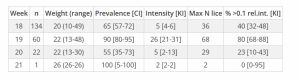
This means that the total fish in the sample of 226 listed in the spreadsheet is now just 217 fish, a loss of 9 fish. It seems that IMR have removed these fish because they are either over 50g, dead or did not fit into the genetic profile. I am led to believe that IMR also remove fish that have excessive scale loss but there is no clarification if they have done so this year,
Leaving aside the actual number of fish used in this analysis, the picture painted by IMR of sea lice infestation is extremely simplistic. They focus on a number of parameters including prevalence. This is the percentage of fish infested with sea lice but can be misleading as week 21 shows with 100% prevalence, the result from just one fish. Intensity is also used by IMR and this is the average number of parasites per host. However, intensity ignores the fish that have no sea lice.
IMR also use the number of lice per gram with the percentage greater than 0.1lice/g. This is the Taranger number which is used to estimate mortality as in the Traffic Lights. However, this is simply based on a model and IMR have yet to show that the estimated mortalities actually match those in the wild.
The problem with this analysis is the focus is only on fish carrying lice and tends to ignore those that are lice free. This is compounded by the fact that the sampling undertaken by IMR does not reflect the true spread of parasites amongst their hosts.
As can be seen, the above tables show the parameters based on the week number, yet I am unclear why IMR choose to report these results as such because week number is simply an arbitrary point in time. In 2025, the prevalence based on the total sample of 226 fish was 71% with an intensity of 12.4.
Regular readers of reLAKSation will know I like to look at samples and sampling, and this Hardangerfjord dataset is no different. In total, IMR sampled 226 salmon (although IMR say differently) with an average weight of 20.75g (10-52g).
The spread of lice amongst the 226-host fish is shown in the following graph.
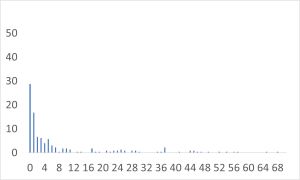
This is a typical aggregated distribution with the majority of fish carrying no or few lice. However, the percentage of lice free fish is rather low at just under 30%. It could be suggested that this is because the infestation is high as IMR have indicated or alternatively it could be because the sampling is so poor that the samples obtained do not reflect the true infestation pressure of sea lice in Hardangerfjord.
In total, sea lice infested post smolt salmon were caught in IMR’s trawl on seventeen separate days between 28th April and 22nd May 2025. Of these seventeen samplings one produced 122 fish, a second 27 fish whilst a third 16 fish. The remaining samplings collected between 1 and 10 fish with an average of just 4 fish. Only one of these samples exceeded the 100 fish sample recommended by Taranger (2012). Yet even these numbers do not paint the full picture as the 122 fish sampled were collected in six separate trawls with the most fish caught at one time being 67 in number.
IMR conducted 156 trawls between 28th April and 24th May each typically lasting 45 minutes. These covered an area of about 60 km long towards the southern end of the Hardangerfjord. Of these 156 trawls just 44 (28%) yielded a catch of post salmon smolts (although they caught lots of other fish too).
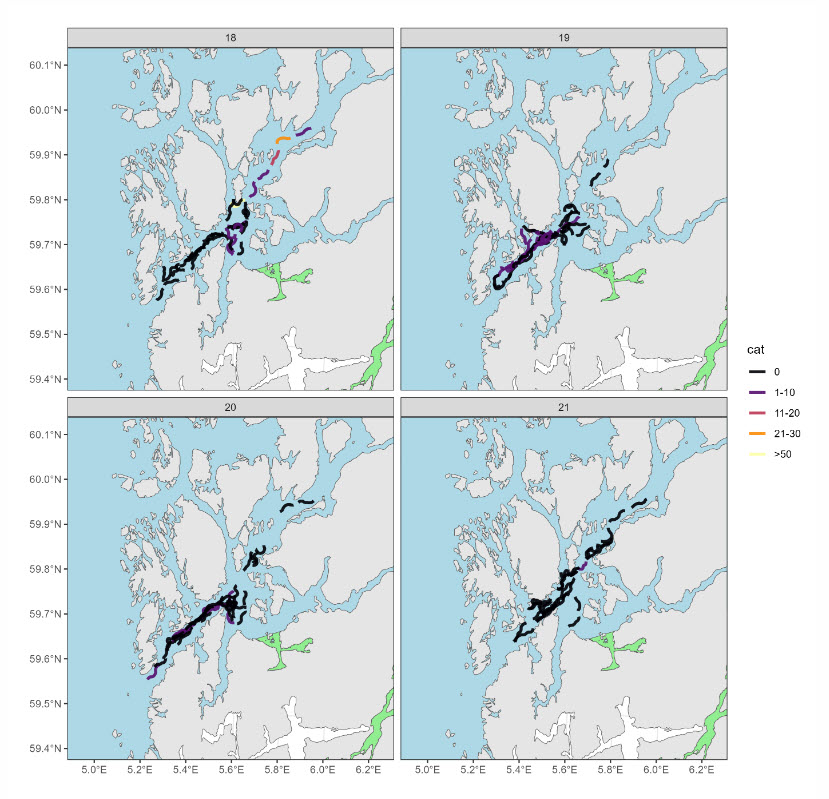
The 156 trawls do not seem to follow a specific pattern. This random nature means that they could be trawling in one area whilst post smolts are passing through another. My own view is that the trawls should be continuously repeated over one area towards the mouth of the fjord. The majority of fish were caught during trawls 17 to 22 whilst those fish with the highest lice counts were caught in trawls 45 to 55. The location of these trawls can be seen from the following diagram from the latest IMR report.
Interestingly, the few fish with high lice counts were caught in very small samples ranging from 1 to 9 fish. When all 44 trawls are considered, it can be seen that the majority of trawls caught very few fish. Fourteen of the trawls (32%) caught just one fish.
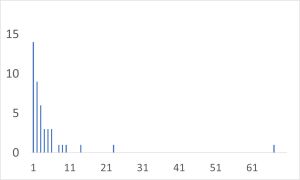
Taranger (2012) suggests samples need to be large and he cites 100 fish, but at the same time it is also known that small samples are not representative of parasite populations (Poulin (1988)).
The problem of sampling is compounded as fit healthy fish can evade the trawl better than those compromised by any infestation. This is equally apparent from the NALO sea lice data where the sampling is dominated by small samples.
Analysis of the largest sample taken from Hardangerfjord this year shows that a larger percentage of fish are lice free than in the total catch. The percentage of lice free fish rises from 28.7% in the total sample (blue) to 46,2% in the single sample of 67 fish (orange).
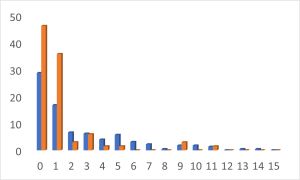
However, it should be noted that large samples do not necessarily provide a true reflection of parasite load. This is because this is the real world where so many different factors apply and every area is different. This is not a laboratory where sampling can be repeated with similar results every time. This is apparent by comparing the results from Hardangerfjorden with those from the Boknafjorden which is in PO 2 whilst Hardangerfjorden is in PO3.
In July, IMR described Boknaforden as having a moderate negative compared to Hardangerfjorden with a high negative effect on wild fish.
In July, IMR posted the following table for Boknafjorden:
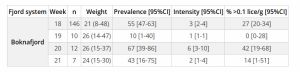
The spreadsheet of raw data list 178 fish whereas, IMR have only declared 175 in the above table. The spreadsheet has 11 fish listed for week 19 and 9 for week 21.
In the final report, the table is as follows:
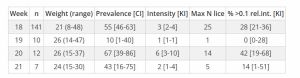
IMR have lost a further 5 fish from week 18 leaving a difference of eight fish from the fish listed on the spreadsheet.
In 2025, the spread of lice amongst the 178-host fish can be seen in the following image:
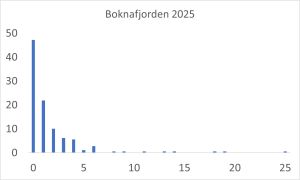
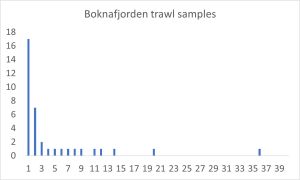
The 178 fish were caught in 37 different trawls (largest catch 36 fish) out of 213 trawls undertaken by IMR. Seventeen of the 37 trawls caught just one fish.
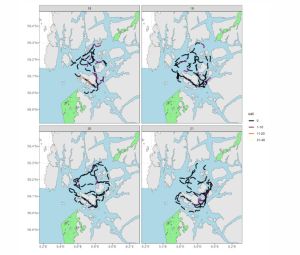
IMR have kindly provide the locations of the trawls in Boknafjorden.
On paper, it would seem that the wild salmon post smolts caught from Boknafjoden have a lower lice load than the fish caught form Hardangerfjord, despite relying on a smaller number of fish for the estimate of mortality.
What IMR appear to have ignored is the status of lice infestation in each of the fjords at the time the trawls were carried out. The two fjords are very different with Hardangerfjorden being 179 km long and home to 83 farming sites compared with 96 km for Boknafjorden with its 55 farming sites.
During the period of the trawls the number of farms exceeding the lice limit for each week is shown in the following table:
|
Week 18 |
Week 19 | Week 20 |
Week 21 |
|
| Hardangerfjorden |
2 |
1 | 2 | 6 |
| Boknafjorden | 3 | 4 | 4 |
7 |
Whilst IMR suggest that Boknafjord has a moderate negative infestation, the fjord has 9 out of 55 with lice infestations exceeding the level set by the regulation. That is equivalent to 16.3%. Meanwhile the Hardangerfjorden had 7 of its 83 farms with lice levels exceeding the set limits, which is equivalent to 8.4% or half that of Boknafjorden.
In their press release, HI state that the observations from the field work in these two fjords is matched by the work using models. They add that with such a long coastline, it is not possible to monitor with field work alone which is why they use models to show the spread of sea lice in both areas where field work is carried out but also in areas where it is not.
IMR have previously said that the models have been validated by the sentinel cage work, even though regular readers may remember that I showed that there was very little infestation pressure in HJardangerfjorden when the sentinel cages were deployed. This latest comparison of IMR field work with actual infestation pressure in two fjords suggests that the modelling does not fit the reality of life in the fjords.
Finally, it is worth looking at the view of the Expert Group to see what they add to this knowledge. Their report on the trawling in Hardangerfjorden states:
Trawl catch: In 2025, trawling was carried out in the period 28 April – 24 June, weeks 18–21. The largest catch was at the very beginning of the trawl period, week 18, with decreasing catch beyond the trawl period. Estimated mortality on migrating post-smolt salmon was moderate in weeks 18 and 20, high in week 21. Calculated as an average of all salmon caught, high sea lice-induced mortality is estimated in 2025, 36% [confidence interval: 30–42%). Estimated mortality calculated for fish from the various regions is high for both the inner and middle rivers, moderate for the outer ones. Overall, trawl data therefore indicate a categorization in high sea lice-induced mortality. The uncertainty is assessed as medium as the number of fish examined is relatively high, but the catch pattern indicates that trawling may have started somewhat late in relation to the migration.
What this suggests is that the good farmers of PO3 are to be penalised because IMR weren’t ready to sample migrating salmon post smolts when they started their run out to sea and thus the sampling of the fish by IMR is a true representation of salmon post smolts in Hardangerfjord this year. For comparison, the trawls in Sognefjorden collected just 13 fish whilst in Romsdalfjorden, the total haul was 9 fish!
In situ: The Sea Lice 2025 conference recently took place in Chile and sadly attendance was beyond my travel budget. However, there was very little about wild fish interactions in the programme, so I do not think I missed too much.
There was one paper that did attract my attention which was submitted by NORCE and IMR from Norway. The abstract, published by the conference organisers, describes how knowledge about sea lice infestation would be advanced by a novel trial undertaken by these researchers.
They had collected 1900 wild smolts which they held for a couple of days before exposing the fish to varying levels of lice infestation. The infested fish, which had been already tagged with a PITA tag, were then released to continue their migration to their northern feeding grounds. When the fish returned, they would be identified by the tag and the number of survivors analysed to see how many fish survived the varying levels of lice infestation. According to the abstract, the preliminary survival rates for Returning 1SW fish were to be reported at the conference.
As I was unable to attend, I contacted all four authors to request if they could provide some of the data revealed at the conference. Not one has replied.
I wonder how much of their reluctance to share their information could be due to some inherent weaknesses in the design of the trial. Firstly, wild salmon are in crisis and yet these researchers have removed 1900 smolts from a river that NASCO have deemed to be at moderate risk, although not from salmon farming, but from habitat interference and acidification. The loss of these 1900 fish for experimental purposes could potentially push the Nidelva towards a much higher level of risk.
What we do know about wild salmon is that 97-98% fail to return to their home rivers from their migration north to their feeding grounds. This is a recognised loss of fish across their whole range irrespective of whether salmon farms are present or not.
Applying this background loss to the fish used in this trial means that between 1843 and 1862 of these fish will die regardless of the treatment applied to these fish. This means that between just 38 and 57 fish may return. It could even be less because the stress of handling, tagging and infestation may result in early mortality before the fish even begin their long migration.
I have heard from a couple of people who attended the conference and both have different recollections of what was said but what was not heard was the preliminary results of the number of fish that returned. I have subsequently written to the authors to request the information promised in the conference abstract. As might be expected, in return there has bene total silence.
The question is whether a trial that will see such small numbers return has any value. I significantly doubt it. I suspect that the trial seemed like a good idea at the time but was never really thought through.
This is not the first time wild smolts have been used in experimental trials to prove the alleged negative impact of sea lice. Ten years ago, Scottish government scientists insisted that the findings of smolt release trials in Norway and Ireland were not applicable to what happened in Scottish rivers. They spent £600,000 on a trial in which they caught smolts from both a west and an east coast river and then treated half with an anti-sea lice agent before releasing the fish to continue their migration. Over two years (2015/6) a total of 3,231 smolts were caught from the west coast and a further 4012 fish from the east. Of these just two fish were recaptured in the west (one treated, one control) and 52 fish from the east (20 treated and 32 control fish), where there are no salmon farms. Needless to say, this trial was a complete disaster and did not show what the scientists had hoped to show. Natural mortality of about 95% then would mean that 161 fish would be expected to return to the west coast river and 200 to the river in the east. The actual numbers fell well short of this expectation. The final report suggested that there was too much uncertainty about return rates to have calculated meaningful estimates prior to beginning the trials. However, I remember when this project was first proposed, there was much doubt expressed as to the viability of this project, yet so determined were researchers to prove sea lice had a damaging impact on wild fish populations that the project went ahead regardless. I suspect that the same can be said about this current Norwegian research.