
Cartel: There are four Tesco supermarkets within easy reach of my home plus a couple of Tesco convenience stores, yet I choose to shop at none of them. That is my choice. Tesco offer a good range of products including prepacked fish, some of which can be bought in other stores and some which are unique to Tesco, yet I still choose not to shop in their stores.
In exactly the same way, Tesco can choose which products they want to buy to stock their shelves. That is their choice. No-one is forcing them to buy one range of products over another. For example, Tesco are currently not offering keta salmon, yet Sainsbury’s and Waitrose are. Clearly, Tesco have chosen not to stock this form of Pacific salmon. That is their choice.
Back in June, Tesco announced that it will only stock Scottish sourced fresh salmon in its Scottish stores (although at certain times of the year, they may need to top up its supplies with salmon sourced from outside Scotland. The decision to supply 100% Scottish salmon is their choice. No one is forcing Tesco to make these decisions.
It is thus surprising that Tesco have filed an anti-trust lawsuit at the London High Court against several Norwegian salmon farming companies claiming that they have colluded to inflate prices. Surely, if Tesco believed that salmon prices were too high, either due to collusion or not, no one forced them to buy the fish. That was their choice so to complain that companies colluded to inflate the price is simply nonsense.
In response, the salmon farming companies have argued that normal market factors explain the price fluctuations, but it is not just about the market but also the biology. Anyone who has been to a fish market will know that the price of fish can ultimately depend on the amount of fish landed on any specific day. In the same way, the amount of salmon coming to market can affect the price. The problem for Tesco is that salmon are cold blooded animals, and their growth is dependent on the surrounding water temperature. Unlike chickens for example, salmon farmers cannot predict exactly what day the fish will be read for market. A cold spell can delay fish reaching market size when required but critically, a cold spell will affect all salmon farmers in the same way. It’s possible that at certain times, there could be shortages of fish that means the price is pushed up beyond that which the buyers want to pay. With all companies in a similar position, those outside the industry might see this as a collusion.
However, there is another aspect of salmon farming that also might give retailers like Tesco cause to think that there is collusion and that is the regular pronouncements from the financial analysts. Ultimately, they are interested in company share prices rather than the needs of the consumer. In salmon farming terms, they still retain the simplistic formula that high salmon prices mean high share prices and vice versa. Unfortunately, high share price might be good for investors but not for consumers. I have written previously that I do wonder whether the industry is producing salmon for the investor or for the consumer. Maybe retailers like Tesco now think the same.
Consumer shift : Intrafish report that Aldi are seeing an increase in sales of ‘alternative’ and ‘unusual’ seafood as shoppers branch out from traditional staples. They say that they have seen rising sales of species such as basa, tuna, and mackerel as consumers look for adventurous choices.
I visit Aldi at least once a week and I cannot say that I am seeing any different trend as far as the fish offering is concerned. Of course, what Aldi do not say is whether this change is just about chilled fish or whether it includes ambient seafood such as canned fish too.
As Aldi is very much aiming its offerings at the budget conscious shopper it is not surprising that basa sales are steadily increasing. Aldi say that sales have increased by more than 50% over the past year. Currently basa is selling for £7.80//kg compared to cod at £17.96/kg, so less than half the price.
Aldi say that sales of mackerel and yellowfin tuna are also experiencing rising demand with sales up by 15% Most mackerel is sold as canned or smoked, often in a variety of flavours. Changing flavours could be one reason why mackerel has seen an increase but in the case of yellow fin tuna, the increase is easier to explain. Aldi only recently reintroduced yellowfin tuna to their stores. Currently it sells at £24.95/kg compared with £41.67/kg in Waitrose. Aldi is attracting more shoppers from top end retailers, and their tastes can travel with them hence the reappearance of yellowfin to Aldi shelves.
Aldi now have the second largest share of the seafood market behind Tesco. Their offering has always been traditional and limited in range. However, I suspect to attract more shoppers away from the other retailers, they now must widen their range of fish and seafood. They have only just added sockeye salmon, for example, to their range and it will be interesting to see how this fares in the longer term.
However, from my perspective Aldi still have a long way to go before suggesting consumers are looking for more unusual species. There is still a lot of salmon on their shelves.
MSC/ASC: A few weeks ago, I was asked to sit on a panel at the new UK Seafood Federation conference held at Fishmongers in London. I was sat next to George Clarke of the MSC and I could feel the atmosphere change when I suggested that most consumers would not notice if the MSC and ASC labels were removed from the supermarket shelves. His reply included the observation that the MSC blue tick appears on packs of MacDonalds fillet-o-fish. Again, I would argue that I doubt that anyone buying this fish product in MacDonalds is doing so because it is certified by the MSC.
My view on MSC and ASC certified fish and seafood came about a week before the two organisations celebrated their annual award ceremony at a gala event in Edinburgh. Regular readers may remember that I commented on the products selected for both the MSC and ASC consumer award when details were first released. I did wonder how these products were chosen and my understanding is that they were a random selection covering a range of species and brands.
Fish Farming Expert reported on the ASC awards saying that almost 1,000 consumers voted and chose Mowi salmon fillets as their product of the year so congratulations to Mowi. Other shortlisted products include Arnee Jee’s Pangasius burgers, a product I have never seen in retail and also a fish and seafood casserole from retailer Iceland. This product was of real interest because it also carried a MSC label as well as being made from seafood products that were not certified as sustainable at all. Unfortunately, during the voting, I was unable to locate this product in any store and requests to Iceland were answered by saying the product was out of stock. Consumers were probably also confused by the appearance of mussels in both the MSC (wild) and ASC (farmed) categories. In fact, the MSC product of the year was Waitrose with its No 1 Moules Mariniere with wild garlic and chardonnay made with rope grown mussels. Yet, ASC Golden Shell Mussels from Loch Fyne are also rope grown. I would suggest that this is quite confusing for consumers especially as according to the MSC, 6000 voted for their consumer product award. Perhaps this is a reflection of their bigger budget than that of the ASC with their almost 1000 consumer votes.
The two consumer products were the only awards voted by consumers; the others were chosen by a panel of experts. Only one of these other awards caught my attention and this was the MSC marketing campaign award which went to Asda who saw their sustainable cod fillet sales rise due to their Sustainable Seafood September campaign. This promoted the blue tick ecolabel in the chilled section of 337 stores.
As a regular visitor to all the supermarkets, I know what I hear and what I see can be two very different things and I have to say that Asda’s Sustainable Seafood September campaign passed me by. Perhaps, if it had been more obvious, I would have spent more time tracking it down. However, it seems that the idea of a Sustainable Seafood September campaign did not come from Asda at all, but rather it was a campaign organised by the MSC itself. Meanwhile during September Asda offered cod loin 260g at £5.34 a saving of 60p and cod fillet 260g £3.97 saving £1.50.
As part of their Sustainable Seafood September, the MSC also launched a Buy Blue campaign which included posters as shown below.
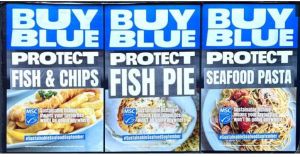
I usually see such posters when fish is promoted either by brand or generically, so I was surprised that I didn’t actually encounter any of these promotions. I subsequently learned that they targeted very specific areas of certain cities which are those frequently by Gen Z. In London, I believe that the campaign was limited to the area in and around Shoreditch. I may not be Gen Z but I do frequent Shoreditch as there is good food to be had there and yet I still didn’t encounter these posters.
Favourites: As part of their Sustainable Seafood September campaign, The MSC undertook a poll to ascertain Britain’s favourite seafood. Unfortunately, the MSC do not reveal how many people were polled but they found that 63% say that classic fish and chips is their favourite fish dish. MSC say this will come as a shock to Gen Z (60%) and Millennials (57%) who seem to prefer sushi. They also seem to like fish tacos and prawn linguine. In fact, sushi only comes in ninth place in the full list after choices such as fishcakes, fish pie and even the student favourite of tuna pasta bake, MSC say these all seem to represent comfort eating which appears to be the preferred choice of many.
The MSC are very focussed on Gen Z and have been especially keen to learn their preferences, A quarter of under 30s believe that classic staples such as fish cakes are a bit outdated along with battered cod. One in five think that cod in general is old-fashioned. I can understand this view with changing tastes. I myself prefer choices that are towards the bottom of the list such as Bouillabaisse (27/28), which is a hit with just 3% of consumers. Given the capital is such a cosmopolitan city, it is almost impossible to find anywhere serving Bouillabaisse, even amongst specialist Frech restaurants. Another favourite of mine, Moules Mariniere comes twenty third in the list with just 9% of consumers choosing this dish made from mussels. This is somewhat strange given that the MSC product of the year is a variation of this dish of Moules.
Finally, 83% of young Brits say that their generation is more adventurous when it comes to fish and seafood with salmon (65%), tuna (62%) and prawns (59%) listed in their top three fish to eat. I can see how this is adventurous given that he Big Five that account for over 80% of the fish eaten in the UK are salmon, cod, haddock, tuna and prawns. In my view this is not about whether younger people are adventurous or not but rather the dominance of the Big Five in retail and hence younger Brits who are more likely to shop at smaller convenience stores stocking a limited range are simply choosing what is available.
Oyster: According to the Times, younger consumers are also choosing to eat oysters primarily because of the informality of market stalls and the rise of £1 a pop happy hour. It has been suggested that young people are drawn to oysters because of their health benefits and their sustainability but I suspect that this is not the case. Instead, the appeal of oysters has been driven by influencers and the low-price specials. The Times reports that when influencer Georgiana Davies posted a video about £1 oysters, Richard Corrigan’s restaurant in Borough Market went from selling 400 a week to 2,500 with queues forming at the restaurant doors. Georgiana told the Times that she first tried an oyster in 2019 when she was in Berlin but was not sold on it. However, when she found oyster happy hour in London, her view changed. She said she received many comments from her followers that she had inspired them to try their first oyster after she posted a video of herself ordering and eating 60 oysters, https://www.tiktok.com/@hrhgeorgiana/video/7415128189237726496?lang=en-GB
She later ate 70!
The question is whether oysters will remain fashionable amongst the young as the influencers move on to other foods, or whether oysters will get left behind as just another fad. Only time will tell.