
PhD: A little while ago, I was sent a copy of a new PhD thesis about spatial forecasting of sea lice abundance. As I was busy, I put word out that I was interested in anyone else’s perceptions of this work and I eventually heard that the research failed to achieve its aims, and I should ignore it. However, having glanced through the thesis I noticed that there were one or two interesting graphs, so I put it aside for later consideration.
However, as it sat in my ‘to do’ list waiting for my attention, the thesis has become the subject of a commentary published on the Aquablogg website. Far from ignoring this thesis, its findings should be widely promoted. The reality is that the thesis did fail to achieve its aims but those aims were to link real life data to the established sea lice models. Its failure to achieve this is yet further proof that the models used to regulate the salmon farming industry whether in Scotland or Norway bear little resemblance to what is actually happening in salmon farms and the waters that surround them. This highlights the problem with those that promote the sea lice narrative, they simply ignore anything that doesn’t agree with their theories, and they remain theories, not proven fact. Of course, if the scientists from the Scottish Marine Directorate, or IMR or NINA take issue with my interpretation of the thesis conclusions then I would be more than happy to debate this with them face to face as I have often proposed. Strangely, none of them appear keen to do so.
What I found most interesting about this thesis, which was authored by John Phelan, is his section on acknowledgements. He later refers to the people he mentions as his ‘advisory team’, something which would never have been possible when I did my PhD. You had a supervisor and that was it. Amongst a whole range of people, the two members of his advisory team that stand out are Dr Sandy Murray, who he thanks for key guidance and feedback on model development and Dr Meadhbh Moriarty for her invaluable mentorship and perspective. Both Drs Murray and Moriarity work for the Scottish Government’s Marine Directorate yet if I want ask either of them a question, I have to submit a FOI request for an answer which arrives twenty working days after my request is acknowledged, which isn’t always on the day of request. Drs Murray and Moriarty are at the frontline of sea lice modelling in Scotland so the failure of this PhD to come up with a result must be a disappointment to them. It’s therefore not surprising that a message was put out that the thesis should be ignored
Aquablogg discuss the findings of the thesis so I will restrict my comments to the fact that weekly counts of all life stages were measured against the model’s predictions and that were all highly overestimated by the model with the adults generally overestimated by a factor of 50. Some serious questions need to be asked about these models yet the regulators such as SEPA and the Expert Group prefer to avoid all such issues.
Macnab challenge: Back in August, The Field, a monthly magazine about country living and country sports published an article titled: The Field Macnab Challenge 2025: a triumph of conservation and sporting prowess.
The article begins: ‘The feat of catching a salmon, grassing a stag, and shooting a brace of grouse all in one day is a triumph of conservation as much as sporting prowess. Are you ready for the challenge? The Field in association with their partners challenges you to bag a Macnab between 12th August and 10th November 2025.’
Unfortunately, the Field does not explain why catching a salmon (it doesn’t say that you shouldn’t kill it) killing a stag and a couple of grouse is a triumph of conservation and I don’t expect to find out but please stay with me and see where I am going with this commentary.
The Field continues that the Macnab places the grouse, the red deer and salmon on a pedestal and then goes onto explain why these three species are important. Naturally, I will only discuss the salmon here.
The Field says that out of the three species salmon are hardest hit in terms of numbers and various groups have spent countless hours fighting to stem this seemingly constant decline. However, the Field now comes to the most interesting bit:
‘Nick Measham, chief executive of Salmon & Trout Conservation (S&TC) says ‘There is sadly no silver bullet in Atlantic Salmon conservation.’
Clearly the Field seem to be unaware that the salmon angler’s organisation changed their name to Wild Fish on 7th July 2022. That is now over three years ago. Why would such a well-known magazine get it so wrong and call the group by a former name?
The reality is that this anglers’ representative organisation has a membership that consists mainly of men over sixty years of age (in fact Wild Fish have just started to offer a free will writing service, such is their membership base) and these members are slowly reducing in number. The organisation wanted to attract a younger audience (and more money) so decided to change their name to hope for a wider appeal but when talking to their main market – the country sports fraternity – they are showing who they really are – anglers who like catching fish for sport.
Mr Measham talks to the Field about ways to help stop the salmon population declining further. He highlights that the main threat to wild salmon is salmon farming wherever it takes place. He says that wild fish are killed by sea lice and pollution especially along the west coast. He concluded by saying that supporting the S&TC’s (not Wild Fish’s) Off The Table campaign by avoiding farmed salmon will help their cause!!
Whilst the ST&C or Wild Fish have shown their true colours, I was reminded of this triumph of conservation – the Macnab by the Atlantic Salmon Trust (AST) who have just launched their annual fund-raising auction. At least unlike S&TC/Wild Fish many of the AST lots are not fishing packages but offer a wide range of other lots too. However, it is the fishing lots that have caught my attention, notably Lot or item 2. This is offered by the Lord Ramsey and is to undertake the Macnab challenge at the Invermark Estate in the Angus Glens. The package includes the services of an experienced stalker, a grouse keeper and a ghillie who will act as guides and support the Macnab attempt with professionalism and deep local knowledge and whether the challenge succeeds or the pursuit is just savoured it will be an unforgettable adventure steeping in sporting tradition. It seems that the AST’s endeavour to invest in science-based conservation has been thrown out of the window in the pursuit of funds. Bids currently are around £3,000.
However, the Macnab is not the only challenge available from the AST auction. There is another one – the McFernie challenge, named after the ghillie Davd McFernie. This is to catch three salmon, one from each beat along the River Dee’s 17-mile-long stretch of the Balmoral Estate. The lot has been offered by the owner of the estate – His Majesty, King Charles III. The bids begin at £2000. Interestingly, the same package of 2 rods for 2 days has been offered elsewhere on the Dee with bids beginning at £350 and £525 so it’s clearly cheaper to fish the Dee outside the Balmoral Estate.
Finally, it is worth mentioning that despite Nick Measham of S&TC/Wild Fish saying that salmon farming is destroying west coast fish populations, the AST have managed to offer three west coast lots in their auction. These include 1 week fishing for 5 rods at the Soval Estate on the Isle of Lewis with the opportunity to stalk a stag too (£6,000), or 1 week’s fishing for 2 rods at Grimersta also on the Isle of Lewis (£4,000). The third lot is a week on the River Eachaig beginning at £150. I can only wonder whether the winners of these bids are going to find rivers increasingly likely to be devoid of salmon and sea trout.
Most of the wild fish lobby are quick to accuse salmon farming of being one of the main reasons why wild salmon are in decline without being willing to accept any responsibility for their own actions. It is clear from the auction lots offered by the Atlantic Salmon Trust and all the others raising funds in this way that the pursuit of sport trumps everything else even to the point of where such activities are seen as a triumph of conservation.
Abundance: In a recent posting, The Speyonline blog discussed the vexed issue of abundance. He says that those who have spent their life on the river know that abundance of adults creates an abundance of juveniles and that the correlation is simple and observable. Unfortunately, some scientists and river managers have promoted the idea of ‘a maximum carrying capacity’ and Speyonline says that this is utterly ludicrous because the output of any river is fundamentally dictated by its food supply and not by some arbitrary density formula.
Speyonline says that over fifty years ago, when wild salmon were much more abundant, 90% of spawning females and over 99% of spawning males died. These were years of plenty when the parent fish sacrificed themselves to die and rot and feed the next generations. Yet in years when runs have collapsed, the fish appear to know that a higher survival rate is necessary to ensure the species remains viable and female mortality has fallen to 70% or less. This means more and more fish survived to return to their marine feeding grounds. Speyonline suggests that without such abundance the species struggles to survive,
This is apparent from the continuing declines in salmon numbers, yet the scientists seem unable to grasp the importance of abundance and instead have focused on the idea that a small number of adults is enough to prepuce a viable number of juveniles. Speyonline says this misguided faith in ‘just enough’ over the reality of ‘abundance’ has been a monumental failure for wild salmon. This has been compounded by the readiness to dismiss the views of those on the ground and an over-reliance on abstract formula such as ‘Zippin’ which a way of estimating the size of animal populations. Hence, scientists have claimed rivers had enough fish and were operating at a maximum carrying capacity when in fact the rivers were simply devoid of sufficient food. This is something which has now been acknowledged by attempts to artificially fertilise rivers with deer carcasses, however by the time this approach was adopted, the damage had been well and truly done.
I’ve repeated much of what Speyonline has written because I want to provide the background to an example I want to consider of the blinkered view of modern fisheries management.
The word is that the 2025 fishing season is likely to be the worst on record with a catch estimated to be around 25,000 fish from a peak of 110,000 fish. This is not my figure but an average of the predicted numbers I have heard. Despite this disastrous catch figure, the Marine Directorate recently published the conservations measures for 2026. These were hardly different from those for 2025 or 2024. They allow angling to continue unabated with just minor changes to the number of rivers that impose mandatory catch and release or allow exploitation.
What I particularly find to be of interest was their assessment of the west coast River Leven. This includes a review of the river’s classification from 2021 onwards. In the first year, the River Leven was assessed as Poor (Grade 3) but in the next two years it was assessed as Moderate (Grade 2) and then in 2024, the river was upgraded to Good (Grade 1), For 2026, it retains this top-rated classification.
The way the Scottish Government scientists use to assess the state of the river is through a number of steps.
- Convert rod catch to number of returning salmon
- Convert number of returning salmon to number of female spawners
- Converts numbers of spawning females to number of eggs
- Egg requirement
- Number of eggs v egg requirement
Grade 1 rivers mean that there is an 80% or more chance that egg requirement. These percentages are calculated from the data from the past five years
Grade 2 have a 60-80% chance
Grade 3 have a less than 60% chance.
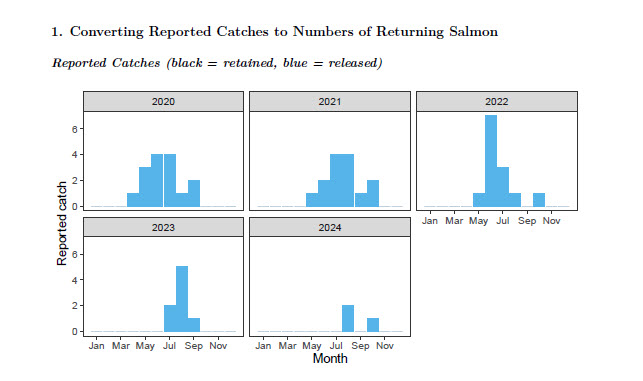
The catch data for the River Leven is shown in the following graph. From this graph, it seems that the catch for 2020 was 15 fish and for 2024 just three fish. What is interesting is that the catch data is also available from the official statistics and these are (with the graph numbers in brackets): 19 (15), 20 (14), 17 (13), 11 (8) and 3 (3). The clear discrepancy in numbers does not fill me with any confidence in the rest of the process, but regardless in 2024 we all agree just three salmon were caught from the River Leven and yet Scottish Government scientists have adjudged this river to be a Grade 1 river. How can a total catch of three salmon merit a river being classified as having a good conservation status? It makes no sense at all.
To see how they have arrived at this grading, it is only necessary to see the percentages for which the river should attain its full egg complement for the years 2020 to 2024. These range from 98.07% in 2020 down to 27.17 in 2024. Even before the Scottish Government scientists apply their calculation to these numbers, the fact the chance of achieving egg requirement dropped from 82.05% in 2023 to 27.17% in 2024 should have surely set off the alarm bells in the Marine Directorate but no, it doesn’t seem that anyone blinked an eye. Instead, the Scottish Government simply averaged the percentages from 2020 to 2024 and arrived at an average of 80.24% which is above the 80% limit and thus have classified the river as Grade 1 when the reality is that at 27%, it should be described as Poor (Grade 3). Whilst Grade 3 rivers impose mandatory catch and release, common sense, which seems to be sorely lacking at the Marine Directorate, says that these rivers should be closed to fishing.
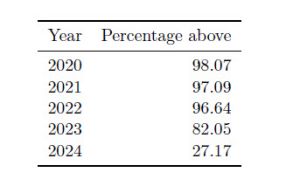
The application of a five-year average makes no sense at all. It makes no difference what happened in 2020 or even 2023. It is what happened in 2025 that matters but as Scottish Government scientists prefer that we don’t know the status of 2025 catches until May next year, it is impossible to make any assessment now, not even a rough estimate. Instead, it is business as usual for anglers even though salmon stocks across all Scotland are collapsing around us. It seems that as long as anglers can continue to fish it doesn’t really matter. I wonder if this is all Scottish Government scientists appear to care about except to make salmon farming the scapegoat for their own ineptitude.