

Sector awards: I wonder whether any reader of reLAKSation has been fortunate to park their car in Blackpool Central Multistorey Car Park, for if they have, they would have parked their car in the winner of the best new car park at the 2024 British Parking Awards.
Blackpool has many attractions, but I am not sure that an outing to its award-winning car park would be top of the list for most visitors to the resort. In fact, I am sure that this accolade is only of interest to those working in the car park sector and not to members of the general public. It seems that almost every week, there is an awards ceremony for some product or service and most remain largely unreported.
One awards event that has come to my attention simply because it is within my own sector are the forthcoming MSC/ASC awards, which are to be presented at a gala event in Scotland in October. Like the car park awards, I am sure that the only people interested in these awards are those who might wish to enter one of the categories. However, it seems that both the MSC and the ASC are keen to try to stimulate public interest in the MSC/ASC by including categories whereby consumers can pick their favourite MSC and ASC fish dish.
However, I very much doubt that consumers have a favourite dish based on whether it carries a MSC or ASC label. I am not sure how much consumers are even aware of the MSC and ASC labels. I have said for many years that I believe that if the MSC/ASC labels were removed from every pack instore, that no-one would actually notice. Certainly, in conversations I have had about fish in the retail sector, no-one has ever raised the issue of MSC and ASC. This is reflected in the fact that both label websites are not aimed at the typical consumer. If anything, any consumer looking at these websites are likely to find them very confusing.
In the case of the MSC, their website states that more than fifty species carry the MSC label, but they fail to mention what they are. I personally would struggle to list fifty different species of fish and seafood that are available in UK retail stores so find it equally difficult to believe that there are that number that are certified. Elsewhere on the website they list some sustainable species that can be eaten by UK consumers. These include the Big Five – cod, haddock, salmon, tuna, and prawns. They also list some other species such as hake, sardines, mussels, clams, cockles, coley, Alaska pollock, herring and anchovies. That makes 14 in total although if the different species of salmon and tuna are included, the number still comes to less than 20.
The MSC also say that whilst there are many MSC labelled products made from the Big Five, consumers should consider swapping their favourite species for one caught from British waters. For example, they say that whilst there is plenty of MSC certified haddock available caught locally, sustainable Alaska pollock is a smart swap for haddock. I have yet to see locally caught Alaska pollock in any store. Alaska Pollock is also suggested as a good alternative for salmon whilst Cornish sardines are suggested as a good alternative to tinned tuna. Finally, brown shrimp are suggested as an alternative to prawns however, I suspect that the prawns that most consumers eat are not these small species but rather the more widely available warmwater prawns.
However, the MSC/ASC consumer awards highlight one of the greatest areas for confusion. The MSC has selected fifteen products for which consumers can vote, whilst the ASC list just ten one of which is ‘Live Golden Shell Mussels by Loch Fyne’. The ASC website does not provide any detail about the mussels, but they are listed on the Waitrose website which says that they are responsibly grown on ropes in the Outer Hebrides. Meanwhile, the MSC products include ‘Waitrose No 1 Moules Mariniere with Wild Garlic and Chardonnay’. These too are grown on rope but in the Shetland Isles. The sustainability credentials provide by the MSC states that Scottish mussel farmers are committed to the marine environment. The obvious question is how can mussels be certified by both the MSC and ASC? Reference to rope grown and Scottish mussel farmers means these mussels are not harvested from the wild but farmed so how can they be certified by the MSC?
Interestingly, the MSC show the percentage vote for all of the products and at the time of writing, the ‘No 1 Moules Mariniere product was runaway leader’. Other products include two examples of canned tuna, two examples of beer battered cod and another of battered fish with chips. There is also one example of pet food which is ‘Sheba with sustainable tuna’. Given there are lots of examples of cat food made just from MSC fish, the choice of a dish made primarily with chicken (35%) seems rather strange as the tuna content is just 4%. This is hardly a good example of sustainable seafood when the product is made with so little fish.
The ASC list of selected products for which consumers can vote include salmon, sea bass, prawns and basa. However, there is one product that really merits discussion, and this is ‘Fish and Seafood Casserole’ from the frozen food store Iceland. This is of interest because it is the only product listed that is made from more than one species of fish and seafood. In fact, whilst the ASC label is displayed prominently on the front of the pack, so is the MSC label. This surely highlights the confusion caused by the need for two separate labels. Most consumers buy fish irrespective of whether it is wild caught or farmed and thus the use of two labels adds unnecessary complexity, if in the unlikely event it is not ignored. If there is a need for any label at all, surely one for all fish and seafood should be preferred. Yet, because of the intricacy of trying to ascribe sustainability to fish and seafood, there are two (as well as others which are not mentioned here). However, what this product highlights are that these labels are not even a guarantee of sustainability,
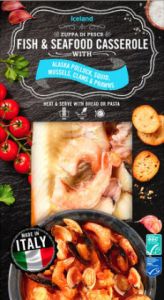
Like a number of these listed favourite products, this Iceland product has proved difficult to track down. It is not stocked in any of the Iceland stores I have visited however, if I do find it, I will revert with exact details but for time being I have used the information provided on the Iceland website. This lists the MSC portion of the product as Alaska pollock fillets (17%) Squid rings (10%), Mussels (8%) whilst the ASC products are Clams (8%) and King prawns (6%). However, the list also includes Octopus which is neither certified by the MSC or ASC. The Marine Conservation Society do not green rate octopus so there are questions as to whether it is actually sustainable. if the ingredient list is correct, and the product contains seafood that is not certified as sustainable, can the finished product be considered sustainable at all?

I wonder how many consumers will actually vote in this poll of products. To encourage them to do so, then those voting for the MSC product can win an Aquaplant Inflatable Kayak, which is probably worth around £300 with two runner-up prizes of a Finisterre Nautilus 23l backpack worth £120. By comparison, those voting for the ASC product could win one of three Le Creuset grill pans costing around £90. The Inflatable kayak seems a very strange choice of prize for a consumer vote on food products whilst the grill pan seems much more appropriate.
Voting for the MSC product runs from July 14th to August 29th and the rules allow for anyone to vote once very 24 hours which means that someone could vote nearly fifty times for one product. This does not seem very fair. By comparison, the ASC website does not appear to have any rules other than the voting closes on August 29th, although they do suggest that those voting might like to try tasting the products before voting for them.
The MSC has been in existence since 1997 and whilst they claim to now have 1,300 certified products in the UK, the absence of the label does not appear to hinder sales. Its absence also does not appear to stop retailers from stocking uncertified products even from some of the biggest brands.
According to the MSC, they were launched as an independent non-profit organisation, but their founders were the WWF and the consumer goods giant Unilever. Whilst the MSC say that they are independent, it is difficult to see how they were not influenced by their founders. Since then, they have also received significant funding which in the year to March 2024 amounted to £33.1 million most of which appears to come from logo licensing. However, there is also significant funding from a wide range of organisations including US charitable foundations such as the David & Lucille Packard Foundation, who have been previously connected with anti-fish farming campaigns. Meanwhile, the ASC has received only €15.6 million, which may explain why they can only afford to give away a grill pan. The ASC are not as open about who funds them, but the WWF remain not only a founder but also a sponsor. The problem with the MSC and ASC is that it is not always clear whose interests they are actively pursuing. In my opinion, the best way to ensure that the way that fish and seafood is either harvested or produced is to involve all stakeholders in the decision process as to what constitutes sustainable or responsible fish and seafood.
It is easy to see how the MSC for example are influenced by others. I referred previously to their suggestions for fish swaps. Why the MSC would need to make such suggestions is unclear after all if cod is awarded the MSC label then why would one need to consider swapping it for a different species. The idea of fish swaps has previously been promoted by other organisations such as Sustain and the Marine Conservation Society. Their motivation is different to that of the MSC but clearly the MSC are following the example of these organisations.
Time after time, when consumers are asked what factors drive their choice when buying fish and seafood, the answer is always the same, appearance and price. Sustainability has never been a major factor which is why the MSC and ASC labels do not feature heavily in the consumer consciousness as much as environmental organisations would like. Putting the MSC/ASC label on a product will not persuade consumers to buy it. This is why retailers still stock products without the labels,
If we want to reduce the pressure on the Big Five, then labelling it is not the answer but in my opinion when these organisations receive so much funding, there is little incentive to seek alternative ways. This is why despite claims that over 50 species are certified, the Big Five remain dominant in the UK retail sector.
Well informed: By coincidence, I have been looking at packs of fish labelled with the MSC blue tick and would highlight a pack of Iglo (part of Bird’s Eye) 4 visschnitzels, which translated into English is 4 Fish Schnitzels, something which has not as yet reached the shores of the UK. The pack comes with a code for the MSC which is C- 50470 and relates to Iglo products.
Although I know that as a consumer, it is not possible for me to trace the exact fishery the fish in the schnitzels is harvested from but it seems that in this example Iglo and the MSC are making it as difficult as possible. This is because list of ingredients lists the fish as ‘Vis’ which translates to ‘fish’. The pack does not include any information about from which fish species the schnitzels are made or from which fishing area, the fish were caught. In my opinion, this just highlights the failure of the MSC to consider the consumer. The ingredient list may have been written in error, although it appears the same on the Iglo website but why is the MSC not reviewing all packs and products carrying their label. Perhaps their minds are focused on the awards ceremony.
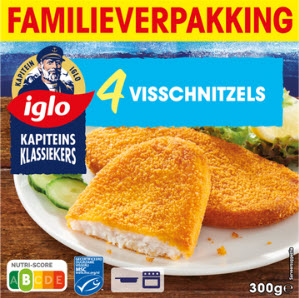
The ingredient list is as follows:
Fish 53%, breadcrumbs 15% (wheat flour, water, salt, spices, yeast), rapeseed oil, wheat flour, pickled gherkins (gherkins, water, vinegar, salt, sugar), Edam cheese (contains milk), salt, mustard (water, mustard seeds, vinegar, salt, turmeric, allspice, chili), potato starch, sugar, onion powder, paprika powder, garlic powder, salt.