

Dear Cabinet Secretary: You should take note that the Norwegian Traffic Light System has not worked and after nearly ten years of restrictions on sea lice levels on salmon farms, wild fish numbers are at the lowest level ever. It is absolutely clear that this failure is because the science is wrong.
You should also take note that the politicians in Norway have received a clear message that half the respondents to the white paper expressed major concerns about the way that the science was applied. In response, the politicians have called for a more comprehensive and thorough knowledge base on the impacts of aquaculture especially in relation to wild salmon populations. They also have called for a much greater involvement of a broader range of professionals and scientists in this knowledge base.
It has been apparent for some time that SEPA’s Sea Lice Risk Framework will not protect wild fish because like the Traffic Light System, the science is significantly flawed. Unfortunately, the small clique of scientists involved in the development of the SLRF have consistently refused to discuss any concerns and thus the SLRK remains an unworkable white elephant.
I have an example of one such concern. This week I received a letter from Marine Directorate scientists confirming that the last analysis of the wild fish sea lice data collected by the fisheries trusts was in 2017. That is seven years ago. How can sea lice associated with salmon farming be blamed for the decline of wild salmon in Scotland when Scottish Government scientists have not even bothered to analyse the data?
The solution to resolving the issue of the SLRF is not difficult, I have previously suggested that the Salmon Interactions Working Group be reestablished to focus exclusively on the science, something that was previously avoided. The message from Norway is clear. Scotland should also be reviewing the scientific knowledge base as a matter of urgency. If the Scottish Government is serious about safeguarding wild salmon and sea trout for the future, we need to review the science now.
NASCO again: It is interesting that in my experience both Scottish and Norwegian governments have been reluctant to discuss whether the science that dictates policy on sea lice is fit for purpose although Norwegian politicians have now told their government that such discussions should now take place. There is one common denominator between both governments and that is that they are members of NASCO, an angler’s representative organisation that parades as an organisation concerned about conservation, even though its real aim is to conserve wild salmon so anglers can catch them.
NSASCO have just held their 42nd Annual meeting in Cardiff, the agenda of which includes the final report on the review of the effect of aquaculture has on wild salmon, which I recently discussed. In addition, there was also a policy brief on the effect of salmon aquaculture on wild salmon populations (CNL(25)18). This four-page document is not attributed to any specific author but is based on the reports of the Expert Group on Sea Lice which I have previously discussed. This policy brief provides a little more information than the final report, although my research had already uncovered the same information from elsewhere. This is the list of researchers credited as authors of the new NASCO funded paper. The title and authors of the paper is
‘Does exposure to sea lice from aquaculture have a population-reducing effect on wild Atlantic salmon? A systematic review’ by Larsen, M.L, Rytwinski, T., Lennox, R.J., Gargan, P., Cooke, S.J., Harper, M., Dalvin, S., Shephard, S., Nilsen, F., Brady, D.C. and Vollset, K.W.
Only three of the eleven authors are members of the NASCO Expert Group however, the paper’s lead author is Mari Lei Larsen. Mari is listed as a researcher at the Fridtjof Nansen Institute and earlier this year she was in the news because on 21st March she was awarded her PhD with a dissertation titled ‘Evidence based policymaking: Exploring the effectiveness of salmon aquaculture management in Norway’. However, on looking through her thesis, the one thing that appears to be lacking is any real evidence. The research in the thesis appears to be directed towards three published papers of which the NASCO paper is the third. However, unlike the other two, the paper or a draft is not provided with the thesis.
In the thesis, Dr Larsen says that the aim of the first paper is to assess whether the current sea lice regulation is effective in reducing the infestation pressure on wild salmon. The answer is provided in the abstract of the paper which states that setting stricter lice thresholds has led to declining lice levels on farm, but such compliance has not lessened the sea lice infestation pressure on wild salmon populations. The simple answer is therefore no. It is worth mentioning that the abstract also states that more frequent de-lousing on farms has led to farmed salmon welfare problems and higher mortality. So, killing farmed salmon to help protect wild salmon has not stopped wild fish numbers declining. The obvious answer is to scrap the thresholds because they achieve nothing except provide anti-salmon farm activists more reasons to attack the industry.
Dr Larsen says the aim of her second paper is to determine what extent is there an association between sea lice from aquaculture and wild salmon mortality. She does this by aiming to examine the impact of sea lice on recreational fishing catches of wild salmon. As far as I can ascertain, this is the only ‘evidence’ that is used in this thesis. The abstract states that ‘our’ analysis fids a significant correlation between declines in wild salmon catches and increased amounts of adult female sea lice per km2’.
The catch data comes from Statistics Norway; the same source I used to plot changes to rivers around Hardangerfjord in a previous reLAKSation. However, rather than use absolute values, Dr Larsen standardised the numbers by subtracting the mean and dividing by the standard deviation. The graph of salmon caught from each production area is shown in the following graph.
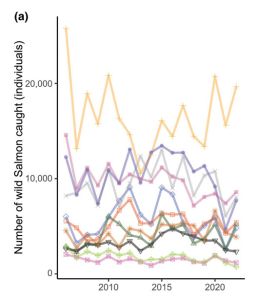
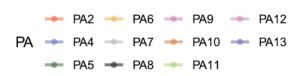
It is very difficult to see the trends of catches from each production area in this graph as the plots are very close and not made any easier by the use of some very similar colours. It is also unclear how many rivers are considered for each production area, which can make a difference in the numbers.
Unfortunately, because they excluded rivers that were partly or fully closed to salmon fishing, data from PO 1 and PO 3 were omitted from the study. From my perspective as PO 3 has been classified as red for most of the Traffic Light period and is therefore of most interest, this renders the whole study as somewhat meaningless. Comparing catches to a perceived farm lice load per km2 makes little sense since the lice are restricted to a small area and are not spread across the fjords within the production area.
I was very much interested in which rivers were used to assess the annual catch, but the supporting data listed all rivers that were partly or fully closed and were omitted from the study (as they were closed and thus there could not have been any catch, they would have been omitted from the study regardless). The notes state that 415 out of a total of 682 registered rivers were closed and a list of which rivers together in which production area the river is located was provided.
I have summarised this data into a single table
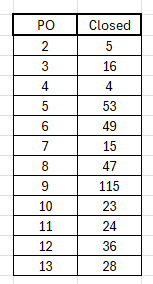
What is puzzling is that the production areas which are considered to be the greatest threat to wild salmon PO3 and PO4 have some of the lowest number of river closures, yet the production areas that have been classified as green have some of the highest. The paper claims that PO 1 and PO3 were omitted because of the high number of closures but only 16 are listed in the supporting data.
The conclusion that high sea lice numbers are impacting recreational fish catches does not come directly from analysis of the data but instead from the application of a model and we know that the results of other models used in sea lice analysis can be highly suspect.
Finally, what is of most interest to me is that whenever I have demonstrated the lack of difference between declines in salmon farming areas and areas without salmon farming, the only comment has ever been that there are many factors that influence salmon declines, and it is impossible to attribute just one as a reason for the decline. This paper fails to mention that during the period examined, recreational anglers caught and killed 1,654,158 wild salmon, but of course this is not considered as having any impact on the size of the wild salmon population in Norway.
Returning to NASCO, it does seem surprising that having appointed an expert group on sea lice – none of whom are from the salmon farming industry -the final paper is actually authored by a PhD student (although her thesis does use the word ‘we’ sixty-five times). Could this we refer to Knut Wiik Vollset who is not just a member of the Expert Group but also was one of Mari Larsen’s supervisors. Dr Vollset is also a member of the Norwegian Sea Lice Expert Group and a member of the Scientific Committee for Salmon Management (VRL). I have written about him previously especially in relation to his cooperation with Martin Krkosek, who is a close colleague of anti-salmon farming activist Alexandra Morton. It is easy to see how the idea that sea lice are the greatest threat disseminates through every part of the research. Interestingly, Peder Fiske, another member of VRL is NASCO’s Scientific Advisory Group Chair.
It seems that those researchers involved with NASCO appear only interested in investigating Randomised Control Trials (RCT) as the main evidence against salmon farming. This is the main theme of the NASCO funded paper.
By coincidence, news broke last week of the publication of another paper focussing on RCT with data exclusively collected from Ireland. Three of the authors also appear in the NASCO paper, Paddy Gargan, Robert Lennox and Knut Vollset. The fourth author is Michael Millane who seems to be the main researcher at Inland Fisheries Ireland now that Paddy Gargan has retired and Sam Shephard has moved on. The paper is published in the Journal of Animal Ecology, which seems to be currently the favoured journal of those arguing that salmon farming has a negative impact on wild fish. This is the journal that will publish the NASCO paper. Aquaculture Environment Interactions used to be the favoured journal but seemingly no longer.
The paper reports the results of a meta-analysis of 43 paired releases spanning a period of from 2001 to 2019, 15 of which are unpublished. The abstract states that there is a risk ratio of 1.22 equating to 18% less return of untreated fish.
I wanted to look at the data for myself and figure 4 provides a list of the numbers of fish released and the those recaptured for both treated and untreated, When I had transferred the list to a spreadsheet, I found the list totalled 42 trials, not 43 as suggested in the abstract. One was missing.
Table 1 also provides a list of the trials, and this list does include all 43. However, the list is provided in data order, which is fine until 2009 to 2011 when all the dates become mixed up. There was no trial in 2012, but from 2013, the list reverts to dated order.
Both these observations might be dismissed as minor errors, but it does seem that if such simple errors occur in a published paper, then what other error might be hidden away. With four authors, it does seem incredible that all four should miss these minor points.
As mentioned, the paper reports that their meta-analysis produced a risk ratio of 1.22 which they say equates to an average of 22% more treated fish returning or 18% fewer of the untreated group. I also analysed the data, but not using a meta-analysis or advanced statistics. Using straightforward maths, I arrived at a risk ration of 1.141, which is lower than the figure reported in the paper. The paper was originally sent to me by an acquaintance from the USA and he also independently undertook his own analysis of the data and reached a risk ratio of 1.145. Our results are much lower than those reported by the paper.
As a rough guide, the paper suggests that for every 10 treated fish that return only 8 untreated do so, whereas my figure would suggest that for every 8 treated fish that return, 7 untreated do so.
Interestingly, the new paper’s discussion highlights that Dave Jackson’s 2013 using 28 paired releases (which are included in the new paper) found a risk ratio of 1.14 from which they concluded that while lice induced mortality on migrating post smolts can be significant, it is a minor and irregular component of marine mortality in the stocks studied and is unlikely to be a significant factor influencing the conservation status of salmon stocks. It seems that the data from this new paper just confirms that view. We have seen from criticism of Jackson’s paper back in 2013 from Martin Krkosek and others that if you play around with the statistics enough, you can make the data show whatever you want.
This paper is likely to be very similar to the forthcoming NASCO paper. Interestingly, the NASCO policy brief argues the true impact of sea lice on wild salmon may be greater than the that reported (strangely, you never hear them say it might be less than reported). This is because of biases in experimental design and insufficient data on sea lice infestation pressure. These factors may underplay (or even overplay) the true effect of sea lice on marine mortality. NASCO also say that the use of hatchery salmon also results in lower estimates of lice impact on salmon survival. They also suggest that uptake of the chemical treatment is not always effective.
By total coincidence the new Gargan paper discusses the same issues leading me to suggest that if there are such concerns about the experimental method and the use of chemical treatments, then why has NASCO’s Expert Group opted to still use the same procedures as those used over many years? Could it be that the element of doubt allows these researchers to ensure that there is an element of doubt about their findings?
Perhaps the time has come, as the politicians suggest, that these researchers engage in wider and more open discussions about whether sea lice have an impact on wild salmon or not instead of pandering to the claims of the angling fraternity.