

There’s the catch: Wednesday 14th May at 9.30 was promoted on the Scottish Government timetable for publication of the long-awaited salmon and trout catch data. At the prescribed time, the press release was published together with two accompanying documents, one being the annual review and the other being a summary of the dataset. Under Data and Methodology, the review included a link to the full spreadsheet of catch data from 1952 to 2024. However, when the link was clicked, the page stated, ‘Access Denied’.
After repeated attempts to find someone who could rectify this issue, I finally accessed the full data set two hours after the official publication time. I do wonder had I not pursued this, whether the link would still not be working. After all, the only reason I knew that the data was being released then was because I had made efforts to find out when it was being published. In the past the Marine Directorate used to send out emails advising that the data was being released but they no longer do so.
It is puzzling that Marine Directorate scientists did not put the links up before the press release was issued or more importantly, check that the link works. As I have written previously, the scientific part of the Marine Directorate seems to have adopted a very lax attitude to wild fish data but are very much more stringent when it comes to data from salmon farming.
Anyway, the real story is not about the Marine Directorate, but about the catch data. I think that the best way to sum up the 2024 season is the saying – one swallow doesn’t make a summer.
There has been a lot of talk by the wild fish lobby about how improved the salmon catch was in 2024. Whilst the new catch statistics highlight that wild salmon rod catches have been in decline since they peaked in 2010 (although total exploitation has been in decline since the 1970s), the total 2024 catch is 114% of the previous five-year catch average and is up 42% on the 2023 catch.
However, whilst some rivers, such as the Tweed and Tay have seen catches soar this year with the Tweed catch increasing from 5453 salmon in 2023 to 9408 this year and the Tay increasing from 3502 to 6034, others have just about held their own whilst others have seen a decline. The Alness catch for example has fallen from 361 to 193 fish and the Halladale from 739 to 443 fish. The excitement about the increased catch and the hope that this might signal some form of recovery is not matched across all Scottish rivers.
The river Ewe is one river that has remained about the same with a catch of 119 salmon in 2023 and 113 in 2024. However, the Ewe is a river of interest because for many years it was the focus of the rallying cry of the wild fish lobby who claimed that the introduction of salmon farming into Loch Ewe in 1987 brought about the collapse of the sea trout fishery in Loch Maree, a freshwater loch at the other end of the river Ewe. All farming operations in Loch Ewe ended by the start of 2020 after which my full attention was directed at the annual sea trout catch from the Loch Ewe system. Despite the absence of any salmon farms, the Loch Ewe system, including Loch Maree, has seen no improvement in catches since. The total catch for 2024 was just 39 fish. This is 10 fish more than in 2023 but ten fish less than in 2022. If we believed everything that the wild fish lobby said, Loch Maree should now be teeming with wild sea trout, but it isn’t.
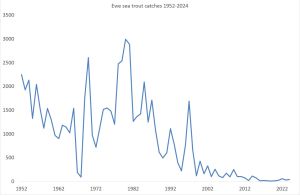
For sea trout, the overall trend from the latest data is that catches have been in decline since the 1960s, with the 2024 catch being 93% of the five-year catch average and down 12% on the 2023 catch.
Whilst many of the fishery districts are showing a decline in the number of sea trout caught, some rivers are bucking the trend including the Ythan and the Don in the east and most of the fishery districts in the Outer Hebrides, but for me the stand out improvement in sea trout catches has been seen in Shetland with an increase from 290 fish in 2023 to 475 this year. It is these later years that are of interest as clearly there was some unusual activity during the 1980s as can be seen from the graph.
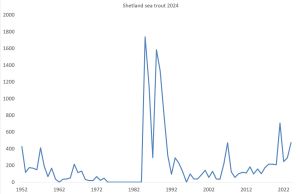
This increase should be considered against the increased focus on Shetland by some from the wild fish lobby. An ongoing salmon farm application has received a number of objections including one from Wild Fish.
“Wild Fish, formerly known as Salmon and Trout Conservation (with a history dating back over 100 years), is a charity committed to the conservation of freshwater fish species, in particular wild salmonids (wild salmon and sea trout), and their habitats. We consider the main threat to local wild sea trout, for which Shetland was once renowned, to be sea lice parasites emanating from salmon farms. Indeed, the Scottish Government’s Marine Directorate states: “Information from the west coast of Scotland and elsewhere suggests lice from fish farming can cause a risk to salmon and sea trout.” The failure by salmon farms to keep sea lice numbers within strict specified limits leads to elevated lice numbers in the surrounding marine environment. The Wells et al (2006) study indicates that 13 or more mobile sea lice per sea trout (19-70 g) can induce sublethal stress and potentially be lethal”.
They continue “the area’s sea trout have been much reduced because of, and since the arrival of, industrial salmon farming. Accordingly, it is vital that additional pressure on the remaining stocks of sea trout is not a consequence of further salmon farm expansion”.
As the graph of sea trout catches from Shetland clearly shows, catches of sea trout have been steadily increasing over recent years. Could it be that the real pressure that sea trout are under is not from salmon farms but from the very same wild fish community who complain about declining catches?
I aim to take a deeper look at some of the 2024 catch data in a future issue of reLAKSation.
Confused: I am indebted to friends in Norway for drawing my attention to a new advice note issued by ICES on 2nd May. This is their advice on fishing opportunities, catch and effort for Atlantic salmon in the Northeast Atlantic.
I don’t tend to take much note of the reports produced by the ICES (International Council for the Exploration of the Sea). This is because in 2016, I attended a workshop in Copenhagen that aimed to discuss the impacts of sea lice and escapes on wild Atlantic salmon. I was decidedly unimpressed. The meeting was dominated by the established scientific community who were totally uninterested in discussing anything but their own work. Whenever I asked a question, I was told that the subject of my question was not on the agenda, even though it had very much to do with sea lice. I was allowed to make a short presentation about sea lice in Scotland, but the participants failed to ask even one question. They simply weren’t interested in anything outside their own interests. This is something which continues even now.
The final report from the meeting was the usual focus on salmon farming and its negative impacts. I disagreed so much with the report, I asked ICES to remove my name from it which they refused.
However, this latest advice note is of interest firstly because it is not about farmed salmon and secondly because it is about the status of wild salmon stocks. This is extremely relevant given the publication of the 2024 catch statistics and thirdly this note is intended to provide catch advice to NASCO (North Atlantic Salmon Conservation Organisation), although why a conservation organisation would want advice on how much salmon to catch is a mystery!
The report highlights that Atlantic salmon was assessed as ‘Near Threatened’ in 2023 by the IUCN Red List which makes other parts of the report somewhat of a surprise. My friends in Norway have drawn my attention to Table 5 and Figure 6 of the report, the later which is reproduced below.
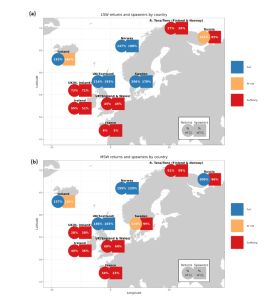
The image is in two parts – the top map representing 1SW grilse returns and spawners by country and the lower map, the same for MSW salmon. The two numbers for each country represent the stock as a percent of the conservation limit for 2024. The key point here is the stocks that are shown in blue which shows that they are at full reproductive capacity.
Only two countries are shown as blue of both 1SW and MSW stocks. These are Norway and Scotland which also happen to be the largest producers of farmed salmon from an industry which is supposed to be the greatest threat to wild salmon. Yet, according to ICES, Norwegian 1SW returns are at 247% of their conservation limit and 1SW spawners at 188%. For MSW salmon, the comparable numbers for Norway are 155% and 123%.
For Scotland, the numbers are 214% for 1SW returns and 193% for 1SW spawners whilst MSW returns are 186% and MSW spawners are 165%.
For comparison, the figure from England and Wales, where there is no salmon farming, the numbers are 45% for both 1SW returners and spawners and 60% for both MSW returns and spawners. According to ICES, English stocks are ‘suffering’ unlike their Scottish and Norwegian counterparts which are described as ‘full’.
Table 5 of the report includes data on the state of the stock for Scotland and Norway. This includes a figure for the numbers of spawners which is 375,400 for Scotland and 231,500 for Norway.
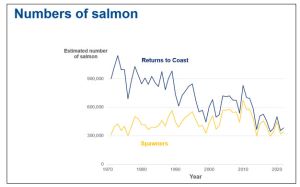
I was interested to see how these figures compared with those put forward by both countries. The Norwegian data comes from the annual report of the Scientific Committee for Salmon Management. Their latest graph seems to indicate that the number of spawners was higher, at least in 2023, than the ICES figure.
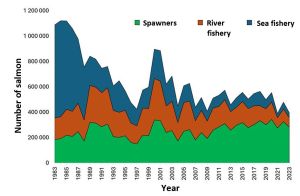
The number of Scottish spawners is from a graph shown by a government scientists at a meeting organised by one of the wild fish representative organisations. This graph does not show the latest data which might indicate that the ICES number is too optimistic.
Of course, I take the ICES numbers with a pinch of salt. It is only necessary to see from Table 4 in the report that the data is suspect. This table shows the number of rivers attaining their conservation limit in Scotland. This is 47 out of 173 but as regular readers will know, these assessments are not representative because a number of smaller west coast fishery districts have been divided into up to ten different assessment areas whereas the big east coast rivers are left as one assessment area despite being bigger than most of all the west coast fishery districts put together. These assessments should be carried out based on total area covered rather than the pretty meaningless numbers that Scottish Government has provided to ICES.
Table 7 shows the trends for returns, spawners and eggs for the whole Northeast Atlantic region and they do not instil any confidence about the future of wild Atlantic salmon anywhere.
Conviction: Towards the end of April, Stephen Kerr MSP for Central Scotland asked a question in Parliament directed at the Scottish Government. He asked – How many prosecutions have been brought for breaches of mandatory catch and release rules since their introduction and how many convictions there were.
The answer given was that there were no prosecutions where it was the main offence under the Conservation of Salmon (Scotland) Regulations 2016 between 2013/4 and 2022/3.
I was more surprised that the question had been asked than the reply. The wild salmon sector is only interested in prosecuting illegal fishing rather than legal fishers who break the rules even though the damage caused is just the same.
I suspect that the real issue is that no-one, including the Scottish Government, have no idea of the scale of the problem since none of the data would highlight any such breach of the regulations.
It is possible to see how many spring salmon have been killed before 1st April, before which it is mandatory catch and release. The number is extremely small, not least because spring salmon are now so rare that so few are caught.
The bigger number of fish caught in breach of regulations relate to the fish caught from rivers or areas that have been classified as poor or Grade 3 in the annual assessment of conservation limits. This should be easy to measure except the scientists at the Marine Directorate have made it almost impossible. As I have pointed out previously, their arbitrary division of fishery districts means that many assessment areas cannot be linked to the annual fish catch data. For example, and it is unclear why, the small fishery district of Clayburn in the Outer Hebrides has been divided into nine different assessment areas only one of which is classified as being Grade 2, the others all classified as Grade 3 poor. If a fish is reported as killed in the Clayburn area then it is impossible to know whether it was killed from the one Grade 2 river or the other eight. Regardless of this difficulty, I have made a rough calculation that just over two thousand salmon have been caught and killed since 2015 from rivers that have been assessed as catch and release only. I stress this is a rough calculation and I plan to try to refine the number when time allows.
The fact that no-one has been prosecuted for killing a salmon is of no surprise. The whole approach to wild salmon conservation adopted by the Scottish Government is extremely lax. After all, Scotland introduced the conservation regulations twenty years after England and Wales had done so. Clearly, Scottish Government scientists were in no rush to adopt a conservation policy but then they have close links to the wild fish lobby who put fishing first. Certainly, the Wild Salmon Strategy fails to mention anything to do with illegal exploitation by anglers. In fact, the strategy states that anglers are often the eyes and ears on the riverbank, reporting any illegal activities that take place (but probably not those carried out by themselves).
Wild salmon are supposed to be considered endangered. They need a more stringent approach to conservation then currently applied. The Wild Salmon Strategy makes it clear where the priorities lie as the section on exploitation begins, Fishing, and particularly angling for salmon, is an iconic image that many associate with Scotland. Ship building was very much associated with the river Clyde, but times have changed and perhaps the time for change for wild salmon is now long overdue.
Leopard: There is an old saying that a leopard never changes its spots and this certainly applies when it comes to salmon conservation. This week, the campaigning charity Wild Fish (formerly known as the Salmon & Trout Association) an organisation representing the interests of salmon and trout anglers, launched a prize draw. They say that by entering the draw, participants will help protect wild fish. However, the prize is a rod, line and reel fishing set worth £1,300.
Wild Fish promote themselves as an environmental charity yet are happy to promote a sport designed to catch fish with a hook on the end of a line. The reality is that however Wild Fish promote themselves their main aim is to promote the interests of the salmon and trout angler, not the interests of salmon and trout.
Monitoring: I highlighted in a previous reLAKSation that the 2024 sea lice monitoring data included 49 entries dated 23 May 2025. I thought I would point this out to FMS and also ask for any analysis of the data. The pdf on their website was immediately changed but I am still waiting for their analysis of the data.
Meanwhile, I also requested an excel version from the Scottish Government who unlike FMS are obliged under FOI to supply this data. The spreadsheet also includes the 2025 entries.
Does no-one ever bother to check the data they produce? I suspect that when it comes to sea lice, the fact that some wild sea trout carry some of these parasites is all they need to know, allowing them to continue their relentless attack on the salmon farming industry. I know from previous FOI’s there have been very few attempts to analyse the sea lice data and those I know of are certainly open to question.