
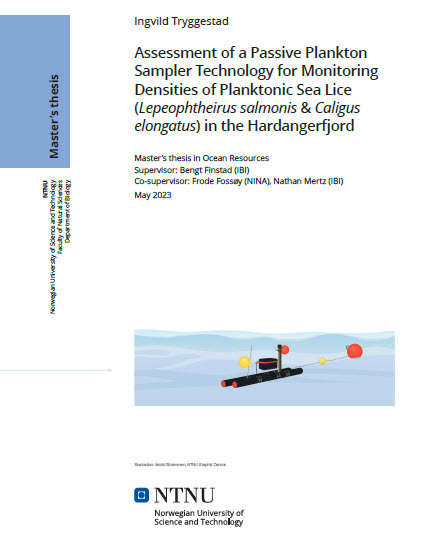
How much longer?: I have been sent a copy of a master’s thesis published by the Norwegian University of Science and Technology. The research involved catching and measuring larval sea lice from the Hardangerfjord using a passive plankton sampler. The research was undertaken by Ingvild Tryggestad (https://ntnuopen.ntnu.no/ntnu-xmlui/handle/11250/3075876).
The research supervisor was Bengt Fingstad, who is well known for sea lice research. He is best known in the UK as he was half of the team commissioned by Salmon & Trout Conservation (now Wild Fish) to write a report on the negative impacts of sea lice from salmon farms on wild salmon and sea trout and published as NINA report 1449. The report includes a short section on sea lice dispersal modelling.
The thesis is 70 pages long, but the most interesting section takes up less than one page. This is the results of the collection of L salmonis sea lice (page 20). This states:
3.1.2 Total collection of L. salmonis
Estimations of total sum of planktonic salmon larvae captured showed collection of lice larvae with the use of the PPS at both study areas (Figure 6). L. salmonis were detected in 33 samples. 14 of these samples were collected from locations in the southern study area, while 19 samples were collected from northern localities. The PPS succeeded in collecting lice in all but one locality during the study period. However, all other study localities and study sites (A/B) succeeded in collecting planktonic sea lice.
In the southern study area, the PPS collected lice at both sites at M15 and M11, while the two PPS deployed at study locality M12 did not capture any lice larvae during the total study period. Estimations showed that M15 collected around 3 (2.73) lice, while M11 collected 7,5 lice larvae throughout the study period. This resulted in a total of around 10 lice collected from all PPS deployed in the southern study area.
In the northern study area, the PPS collected lice at all study localities and sites. The area showed the highest total number of collected planktonic lice, but with variations within localities and sites. M4 collected the total highest number of lice larvae, with over 14 larvae collected at M4A. A total of 21 lice larvae were collected from M4, while around 6 and 7 lice were collected from M6 and M7, respectively. A total of 34 larvae were collected from all PPS deployed in the northern study area.
This appears to suggest that a total of 44 larval sea lice were collected during the study, which it seems ran from 11th May to 9th June 2022 for the northern study area and from the 10th May to 10th June in the south.
Yet again, another study has failed to find larval sea lice in the water column. Karin Boxaspen (now project director at the institute of Marine Research) failed to find any around the Austevoll Aquaculture Research Station in 1997, Costelloe and others failed to find any in Ireland in the mid-1990s, Penston and others failed to find any in Scotland in the early 2000s and of course the SPILLS project failed to find any, although the authors say that just because they didn’t find any, doesn’t mean they are not there.
The concept of larval sea lice being dispersed in the water column is the foundation of modelling used to assess the risk to wild fish of sea lice emanating from salmon farms. However, the models are based on particle dispersal not on the natural ecology of sea lice. I would argue that no-one has found the claimed clouds or soup of sea lice simply because they are not there because such dispersal is not how sea lice parasites find hosts.
The sea lice dispersal models form the basis of the proposed sea lice risk framework soon to be introduced to regulate Scottish salmon farms. It is a pointless measure because the predicted sea lice are just not in the sea.
Millions have been spent on sea lice research across the world, yet this basic part of sea lice biology has yet to be proven. When is someone in authority finally going to say stop and be willing to have a proper conversation about sea lice and wild fish.
Real World: The latest Coastal Communities Network newsletter reports that John Aitchison, Chair of the Friends of the Sound of Jura and CNN aquaculture spokesman has been developing a model for community groups to use to map sea lice densities emanating from fish farms on the West Coast of Scotland.
His model will make interesting viewing because it wasn’t that long ago, he talked about ‘clouds’ of sea lice but as yet has to show such clouds of lice actually exist. Even the latest work discussed above only managed to find 44 larval sea lice in a key salmon farming fjord over a period of two months (two sites of one month each).
It seems that Mr Aitichson has been awarded a further grant of £15,000 from the Highlands & Islands Environment Foundation for phase 3 of this work which will enable weaknesses in the models being developed by SEPA and the aquaculture industry to be challenged before they are used to inform regulation.
The fundamental weakness is not the models per se, but the narrative that has shaped the models. Coastal Communities Network are interested in these models because they simply don’t want to see salmon farming in Scotland.
I wonder whether the Coastal Communities Network will be attending the modelling workshop taking place at Pitlochry in the coming days. This is open only to those who exist in Model Land, whilst those of us who work in the real world are excluded. Could this be because the modellers might be asked the simple question as to exactly where these larval sea lice that have been modelled can be found because as yet, they still have to be located and identified in the places and numbers predicted?
Is the reason that the lice have not been found simply because they are not there?
Congratulations: Congratulations must be sent to Canadian biologist Alexandra Morton for her sterling efforts to restore stocks of Pacific salmon to the Fraser River. Ms Morton has written that the pink salmon returning to southern British Columbia are not only making a comeback; they are also making history. She says that this is becoming one of the most remarkable environmental successes that has been seen anywhere in Canada.
Early in August, the Pacific Salmon Commission has reported the largest number of pink salmon caught in DFO test nets along northeastern Vancouver Island. Ms Morton says that the increase over the last three generations is jaw dropping. She has provided a graph showing this year’s catch compared to previous years for the month of August. She writes that the reason for the increase is not exactly a mystery since this generation of pink salmon was protected from exposure to salmon farms by the Government’s mandate to remove salmon farms from the BC coast. Ms Morton says that the 2022 run of juveniles are now returning in historic numbers.
Ms Morton has already written a paper with Dr Rick Routledge titled ‘Effect of government removal of salmon farms on sea lice infestation in the Discovery Islands’ which is now in press. This includes examination of the 2022 juveniles which she claims have never looked as healthy since she started to study them in 2005. She claims that sea lice infestation was 96% lower than in 2020 when eight salmon farms were operating in the Discovery Islands.
Ms Morton writes that ‘The fish are talking’. However, whilst the fish may be talking, what they are saying is not crystal clear. Also, whilst the fish may be talking, Ms Morton is certainly not. If her claims are so jaw dropping, then why is she not out and about speaking to local communities about the good news whilst at the same time allowing those who disagree the opportunity to challenge her. Of course, that is exactly why she remains hidden away, she does not want to be challenged.
She writes that this astonishing pink salmon rebound after salmon farm removal is not a one off-event. However, a few test nettings do not constitute evidence of a long-term recovery. It would seem that the claims made in Ms Morton’s forthcoming paper are somewhat premature but then as this has more to do with politics than science, her claims are not surprising.
Ms Morton says that she has been studying sea lice numbers on young salmon in the Discovery Islands since 2005, yet unlike the data collected by the Salmon Coast Field Station for fish migrating through the Broughton Archipelago, it doesn’t appear to have been made publicly available. By comparison, the data from the Broughton Archipelago does not support her claims nor that commissioned by the salmon farming industry from an independent biological consultancy. Around 80% of the young fish sampled were carrying no or few lice. If they have no lice, they cannot be dying from lice infestation. Ms Morton’s claims seem to be based on observations of a small number of fish with higher lice infestations which she assumes are representative of all migrating juveniles, when they are not. In addition, a definition of a parasite is an organism that is distributed with the majority of hosts carrying no or few parasites whilst a few hosts carry the majority of parasites.
Ms Morton says that the salmon industry will claim that the record numbers of pink salmon observed from the test fishery are just coincidental with the removal of the farms. I have to say that so far, the jury is out. There are clear trends across Canada that wild Pacific are in trouble even in areas where there are no salmon farms. At the same time, historic data including from before the arrival of salmon farming to BC, shows a high degree of variability in numbers with peaks and troughs. What is clear is that one year’s data is relatively meaningless and may be the start of recovery and equally may not. From a distant perspective, it does seem that as yet, there are too many unanswered questions to draw any real conclusions. Perhaps like Ms Morton’s conclusions, my congratulations may be considerably premature.
Stacked up: The letter of the month in the latest issue of the angling magazine, Fly-Fishing and Fly Tying discusses a unique fishing experience in Loch Stack in the northwest Highlands, an area that has several active salmon farms. I will return to the experience later but first would like to mention that the angler’s bible to fishing in Scotland written by the late Bruce Sandison states that Loch Stack was once one of Scotland’s most famous and most beautiful sea trout fisheries which is now sadly suffering from the decline in numbers of fish caused by disease and pollution from salmon farms. Loch Stack feeds the river Laxford which empties into Loch Laxford, which is home to one salmon farm which is located well away from the river mouth.
The Laxford also merits a mention in the book written by the ex-Scottish Director of Salmon & Trout Conservation (now Wild Fish) Andrew Graham Stewart. He discusses both the river and Loch Stack from the nineteenth century onwards. The big charge came in 1953 when fishing in the loch was opened to the public and Mr Graham Stewart said that the demand was overwhelming. He also said that whilst there were slight declines in catches since the 1960s, the advent of fish farms to Loch Laxford in the mid-1980s was a body blow as the average catch figures show.
The following graph was published in 1987 following a symposium at the Dunstaffnage Marine Laboratory. This shows the slight decline described by Mr Graham Stewart was actually significant and well before the advent of salmon farming.
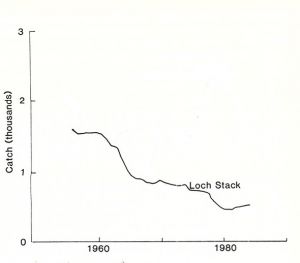
Mr Graham Stewart also supplied catch figures although these are averages for 4- or 5-years periods. He says that the figures for 1996 to 2000 should be treated with caution as they include finnock which were not included previously. I suspect he points this out to justify the increased catches despite the presence of the salmon farm, however, when if the official statistics are analysed for that period, the average catch is actually higher than that recorded by Mr Graham Stewart. More interestingly, no catches of finnock are listed at all.
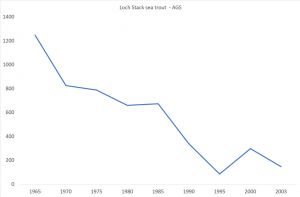
The point is that these two anti-salmon farming fishing writers both wish to portray west coast fisheries as having been destroyed by the presence of salmon farming. Which brings me back to the point of this commentary.
The letter in FFFT magazine describes how Loch Stack holds a fantastic head of brown trout, mostly about 1lb in weight. Sea trout return to the loch from July with good fish being 2-3lb “but every year much bigger ones are caught”. Salmon and grilse might be anything from 4-10lb. The letter writer describes how using the same fishing flies, his wife caught on the same day from Loch Stack, a char, a brown trout, a sea trout and salmon. He says he has never heard anything like this before and all this from a loch that is blighted by the presence of salmon farming.