
Risk to wild salmon: Regular readers won’t need reminding that the SEPA is to introduce a risk-based spatial framework for managing interactions between sea lice from marine finfish farms and wild Atlantic salmon. This is to minimise the risk that wild salmon will not be impacted by sea lice from salmon farms. In reLAKSation no 1085, I discussed such interactions with reference to one particular river the Grimestra in the Outer Hebrides. This was prompted by reports that the river had produced record catches during June this year.
The catch of salmon and grilse had been 197 fish which was one of the best returns since the early 1900s. Mr Colin Macleod, a ghillie and columnist, writing in Trout and Salmon magazine, said that more importantly than the record catch, that the fish were still coming.
Although the season is far from over, the total catch by the end of August was 516 salmon and grilse. The nine-year average from 2013 to 2021 (the only data available) is 307 fish so the season this year has far exceeded the recent average. It is difficult to compare these catches with other rivers, whether in the salmon farming area or elsewhere because such information is not made public, even though the Grimestra fishery clearly shows it is easy to do this on a weekly basis, so we won’t know for many months yet, whether the Grimestra is bucking the national trend or not.
What we do know is that the River Grimestra is located close to several salmon farms whose presence seems to have had little impact on this record catch. I can only wonder why the Scottish Government is imposing this unnecessary framework on the industry, based mainly on the claims of a whingeing salmon angling sector who blame declines on salmon farming when clearly the real problems lie elsewhere.
Lochy: As I have previously mentioned more than once, it is difficult to assess the catches of the current fishing season due to the widespread absence of any reliable fishing reports. It is only when the Scottish Government belatedly publish the data up to 18 months later than the state of wild fish stocks can be fully assessed.
The Lochy, located in the heart of the Aquaculture Zone and featured in a proposed red protection zone under the SEPA plans, does publish some fishing reports (http://riverlochy.com/news/0 including many photos of wild fish which have been taken contrary to catch and release advice. The 2022 fishing season began well on the Lochy but appears to have tailed off during August. The anticipated run of grisle has seemingly failed to materialise.
The fishing report hypothesises about a possible reason by stating ‘was this linked to the high sea lice levels on local farms in Loch Linnhe last year when the smolts went to sea? We shall never know’.
We may never know the reason why the River Lochy grilse run failed to appear in August but suggesting local salmon farms could be to blame is not unexpected given the current SEPA plans.
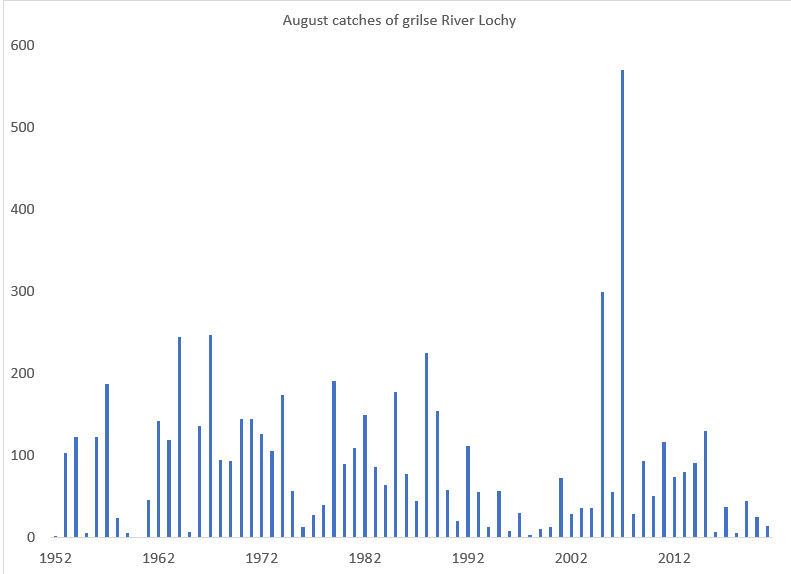
However, an analysis of grilse catches from the Lochy stretching back to 1952 shows that poor or absent grilse runs in August are not a recent occurrence. The graph of August catches of grilse shows that long before salmon farming arrived in Loch Linnhe, Lochy anglers failed to land any grilse on repeated occasions.
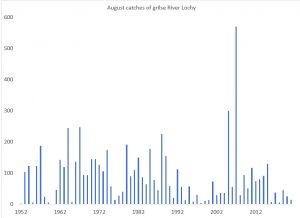
In addition, it is clear that since the late 1990s, grilse catches have increased on the Lochy despite the presence of salmon farms in the locality.
I felt that it was worth comparing August Lochy grilse catches with catches of grilse during August across all of Scotland.
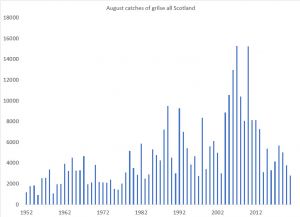
It can be seen from this graph that grilse catches do vary from year to year but what is also clear is that catches have increased steadily over the period 1950s to 2000s. This is not surprising as catches of grilse overall have increased across all of Scotland throughout this period, including across the west coast, something that the wild fish sector seem unwilling to acknowledge.
Following peak catches in 2010, there has been a significant decline in fish across all of Scotland, as acknowledged by the Scottish Government. The River Lochy is not immune from this decline so why salmon farms are being singled out for blame is unclear. It is even possible that the grilse run this year is later than anticipated. With shifts occurring due to climate change, anything is possible.
Sentinel: More than one respondent to the SEPA consultation raised concerns about the reliance of using sentinel cages to predict the impact of sea lice infestation on wild fish. Sentinel cages are small cages stocked with 30 hatchery-raised smolts and located in areas through which sea lice larvae are expected to be dispersed. My own response to the consultation focused on other parts of the science and just raised the prospect that the dynamic of a sentinel cage might better reflect what is happening in salmon cages rather than to fish in the wild. I suggested that should fish be infested then there was a possibility that the infestation could spread to other fish held in these small cages.
In response, (10.1.3) SEPA have stated that “the Norwegian researchers designed their study such that sentinel cages were not deployed for long enough for sea lice attaching to fish in the sentinel cages to complete their life cycle and generate the next generation of infective-stage sea lice.”
The Norwegian paper cited in the original consultation does not discuss this aspect of study design and the reference trail leading back to some of the original work on sentinel cages includes several internal Institute of Marine Research reports which are written in Norwegian. Instead, I would like to consider Scottish research involving the use of sentinel cages but first I would briefly return to the Norwegian paper cited by SEPA. This reports on sixteen different stockings involving several sentinel cages each. The length of time these cages were left in the water varied from two to three weeks however the authors clearly stated that the two-week period was insufficient to link any infestation in the sentinel cages to infestations in nearby farms. The three-week length trails are typical of most of the work coming out of Norway and this time period is likely to be shorter than the full sea lice reproductive cycle which according to the Irish Marine Institute would take 6 weeks at 9oC.
In Scotland, researchers adopted a different approach to sentinel cages stocking 50 fish for just one week each month. The paper by Pert et. al. (2014) states that one week is too short a time for sea lice to complete their life cycle so any mobile stages must have come from outside the cages rather than from within. In addition, the paper states that the one-week exposure allows the future number of different life stages to be inferred from numbers of settled sea lice.
Yet, there is evidence from fish caught in the netting programme that once the lice are on the fish, they are not permanent. Some fish that have been caught more than once have been found to have had lower lice counts on recapture as illustrated in my book Loch Maree’s Missing Sea Trout.
However, the most interesting aspect of sentinel cages comes from the Norwegian paper cited by SEPA. This states that “The cages are assumed to give an integrated measure of the local lice infestation pressure over the period of their deployment.” It is the use of the word ‘assumed’ that is worrying. In my opinion, when it comes to sea lice, there appears to be a lot of assumptions rather than evidence. In the case of sentinel cages, the assumption is that any infestation must come from dispersed sea lice larvae, and it may be that this assumption might be wrong. In the last issue of reLAKSation, I posed the question whether in the case of sea trout sampled several kilometres from the nearest farm whether the infestation came from lice larvae transported to the sampling location and infested the fish there or whether the fish might have travelled near to a farm and become infested there and then swum away to be later caught at the sampling site?
We do know that salmon farms are stocked with lice free fish and thus any infestation is likely to have come from passing wild fish. This has been stated in more than one paper as the most probable route for salmon farms to become infested with sea lice. If a large salmon farming cage can become infested in this way, why cannot a small sentinel cage be infested in the same way rather than it being assumed to have been infested with larval sea lice transported by the water current?
To help answer this question, I would refer to a paper from 2011 (actually a chapter in the book ‘Salmon Lice’ written by five researchers from Marine Scotland Science). The lead author is the same researcher who has produced the model of sea lice dispersion on which SEPA have based their proposed risk-based framework. The chapter includes a discussion about the use of sentinel cages in Scotland. It states:
“The (sentinel) cage data would suggest that sea lice infection is spread not only by the infective copepodids but also by preadult stages. These mobile preadults may play a role as pioneers in establishing infection more rapidly than copepodids. Since they can survive for longer periods and can be transported on wandering salmonids and nonsalmonids, this may be of particular importance in re-establishing infection after an area has been fallowed”.
Given that it is possible, according to researchers from Marine Scotland Science, that sentinel cages could become infested with preadult stages, it is also feasible that sentinel cages could become self-infective.
The underlying problem with sentinel cages is that the researchers who first proposed their use were not familiar with all aspects of the sea lice interactions but decide that sentinel cages would help their research. Unfortunately, at the time, there was little realisation of the flaws in their approach so because sentinel cages had been used in these early investigations, other researchers assumed that they were an appropriate method of assessment in subsequent research. Therefore, sentinel cages became part of the standard methodology for sea lice research without real consideration of the limitations of their use.
As I mentioned earlier, my concern about the use of sentinel cages expressed to SEPA in my consultation response was constrained as my main focus lay elsewhere. However, I did highlight that a greater concern than self-infection of the cage was how the three-week exposure used in Norway related to actual transit times of wild fish in the proposed Scottish protection zones.
SEPA state in their consultation that the Norwegian research using sentinel cages identified that the exposure threshold of 0.7 sea-lice days per square metre is indicative of sea areas where infestation pressure on wild salmon post smolts is low. At the same time, the typical passage times for a 12.5 cm fish would be 11 km in 24 hours.
In the consultation SEPA provided a list of rivers and the estimated passage time for the adjacent protection zones. In total there are 160 rivers with passage times ranging from 1 day to 8/9 days. It is suggested that these are minimum passage times but even if the times are extended by a couple of days, they are still far short of the three-week exposure used to generate the thresholds. It is also worth considering that 130 of the rivers have protection zones requiring passage times of less than 2 days and another 15 with passage times of less than 4 days. The remaining 15 have passage times from 4 to 9 days. Currently, I am unaware of which rivers fall into each category but many of these west coast rivers are actually not much more than streams, rather than rivers and have limited stocks of salmon and have done so since long before the arrival of salmon farming to the west coast.
What is apparent is that the whole of this proposed framework is based on assumptions or flawed or selective science. This approach to protection of wild salmon and sea trout needs a total and urgent rethink because what is clear, is that this framework is unlikely to safeguard any of Scotland’s iconic wild fish.
Orkney trout: Green party MSP Ariane Burgess tweeted that Orkney Trout Fishing Association says the current approach to salmon farming is failing to protect Orkney’s marine environment.

This response is not unexpected given that the wild fish sector across all of Scotland continues to argue that salmon farming has damaged stocks of wild fish, whilst generally ignoring their own impacts.
The Orkney Trout Fishing Association (OTFA) have a website which can be found at https://www.orkneytroutfishing.co.uk/index.html . Much of the fishing in Orkney is for brown trout but despite a lack of rivers, sea trout are also a target of Orkney anglers.
The most recent fishing reports on the website come from 2020:
“The season got underway on 25th February with the opening of the sea trout fishing which in Orkney takes place in the sea. A good number of anglers were out at the crack of dawn, and before, and by all accounts some reasonable baskets of silver maiden fish in the 1 lb to 2.5 lb range were taken. It was hard going though, with flat calm conditions for most of the day, and a poor tide curtailing sport.
The best fish I heard about on opening day was a cracking 3 pounder taken by Ian Robertson from the Orphir shore. Later in the week, Ken Kennedy, fishing on Hoy with Donald McIsaac had a sparkling 3 lb fish and Kenny Sinclair took a lean 4 lb 7 oz fish from the East Mainland. Brian Foreman and Jonathan Curran enjoyed good sport on Rousay with fish up to 3 lb and Ian Robertson took several on Hoy with his best at 2 lb 8 oz from Rackwick.“
News of the sea trout fishing also reaches far beyond the islands. Orkney is also sometimes featured in the fishing reports in Trout & Salmon magazine:
In Autumn 2019, (from one of the few copies of the magazine I have kept), the fishing report states:
“Harray took some time to get going this season, but when it did the fishing was second to none. The fish were in superb condition and a few sea trout were present. Some of the better baskets included 24 for 20lb 6 oz for Mr Wood, 17 for 14lb 2oz for Mr Muir, 17 for 14lb for Mr Morgan and 16 for 13lb 7oz for Mr Connachie. The best sea trout I heard about was taken by Dr Sneddon, a fine fresh run specimen at 4lb 14oz.”
This reminds me of comments made by Andrew Graham Stewart, another contributor to Trout & Salmon magazine fishing reports who wrote that a feature of salmon farming areas was the lack of mature sea trout of 5lb and above. 4lb 14oz is very close to this figure.
Although, these reports detail more than a few fish captures, they do not provide any indication of catches over the whole season. The best place to get such information is the Marine Scotland Science catch dataset, which contains details of catches of both salmon and sea trout from across all of Scotland. The most recent dataset contains 53,325 records but when I searched for Orkney, which is numbered 109 of the 109 Scottish fishery districts, my search returned nothing.
The data set is normally laid out as fishery districts starting from the Tweed round to the Solway Firth and then the outer islands, so I reordered them into district ID by number and rather surprisingly found that the list ends at number 108 for Shetland. There is no record for Orkney in the current list.
This was not always the case. Certainly, when I undertook my evaluation of catches from every fishery district back in 2015/6, Orkney featured in the list, though at the time, Marine Scotland Science did not publish the data on a single spreadsheet. This only occurred after I had completed my evaluation and I suspect that my repeated requests for data encouraged MSS to put all the data onto one spreadsheet as we have today.
The following is the graph for Orkney from my evaluation of every fishery district sea trout. In fact, the only recorded catch was for 36 fish in 1961. Every other entry between 1052 and 2014 was zero catch.
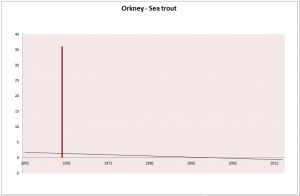
The raw data I obtained has never been properly filed as I simply have never had time, but I suspect that when the catch data was published in two separate sheets (released and retained), Orkney was never included. Why this is remains a mystery, but the likelihood is that because Marine Scotland Science never received any data from OTFA or whoever monitors stocks in the Orkney, the omission of the Orkney fishery district in the official statistics was never challenged.
The page of the OTFA website dedicated to sea trout states that ‘it would be fair to say that Orkney’s saltwater sea trout fishery is a far cry from the halcyon days of fifty years ago. This doesn’t mean that the sport nowadays is poor. Far from it, but it’s a lot harder’. The website includes a photo of a catch of eight sea trout of varying sizes including four large fish with a gentleman whose attire would suggest that the photo was taken much longer ago than fifty years ago.
What is evidently clear is that over many years, significant numbers of sea trout have been caught and retained by anglers but never recorded in the official statistics and OTFA have the gall to say that salmon farms have damaged the marine environment. There appears to be no record of the untold damage done to sea trout by unregulated angling.
Their website states:
“A word of caution however. Orkney’s sea trout are undoubtedly in decline. Contributing factors include agricultural pollution, canalisation of spawning burns, too many seals and probably the effects of global warming. But the greatest damage to the species in Orkney waters has without doubt been caused by the commercial farming of salmon and sea trout in the sea in general and sea lice therefrom in particular. Were it not for the dedicated efforts of the Orkney Trout Fishing Association’s environment committee to minimise the intrusion of fish farms into prime sea trout locations, I’m convinced the situation here would be a lot worse. “
OTFA are clearly living in their own blinkered world, but at the same time, Marine Scotland Science do not seem to have made much effort to police what has happened to sea trout in Orkney over many years.
Perhaps, MSPs such as Ms Burgess should consider a wider view of the impacts on the marine environment rather than just take the word of local groups with their own self-interest.