
Insider: In reLAKSation no 1303, I hypothesised that someone in the Norwegian Fisheries Ministry might be a passionate angler, who, like his fellow anglers, blames sea lice and salmon farming for the current crisis and which may help explain why the Norwegian Government is so intent on imposing draconian regulation of the salmon farming industry.
I was therefore interested to read the views of journalist and ex-editor Simon Kelner who wrote in ‘I news’ that:
“I am not a fussy or faddy eater, nor am I an eco-warrior, but about a year ago I stopped eating salmon. I was in northern Norway, and I had a chance encounter with a man who worked for the Norwegian Directorate of Fisheries, the body which manages the safety and sustainability of the nation’s fish stocks which represent Norway’s second biggest export, after oil and gas.
He had very strong views on salmon farming, saying that the fish bred on highly intensive farms is neither good for us nor for the environment, and is effectively the battery farming of the marine world.
He then went on to explain the damage that escaped farmed salmon do to stocks of wild fish. Because salmon are bred on farms for rapid growth, they have physical traits that differ from wild salmon. When they interbreed with wild salmon, the resulting offspring have lower survival rates and reduced genetic fitness, weakening native populations.”
This would seem to be too much of a coincidence to be anything but true. It seems utter madness that the views of an insider might be influencing government policy, but this is what could be happening. It is not so strange either as in my opinion I believe that Scottish policy is influenced by a handful of scientists who have strong links to the angling sector. These scientists advise civil servants who then advise Ministers and any attempt to challenge the science from outside is simply ignored. After all, these are scientists and must be right.
The question is whether government policy should be directed by unelected officials who do not seem accountable to anyone at all.
On Guard: Last week I attended the MASTS (Marine Alliance for Science and Technology for Scotland) annual meeting in Glasgow. The programme included a number of presentations that would be of interest to someone like me with a focus on sea lice. However, there was one that stood out as being of wider interest both in Scotland and Norway and that was a poster presentation by Katie Berry of SEPA. This is described in the programme as ‘Standardised Lice Infestation Pressure Determination (SLIPD) – Developing a new generation of sentinel cage method for sea lice monitoring.’
As regular readers will know, I am not party to the discussions between the regulator (SEPA) and the industry, but my understanding was that SEPA had commissioned the Institute of Marine Research to provide help with establishing a sentinel cage programme in Scotland for which they would be paid £200,000. Now it seems that IMR have been helping SEPA to develop a new system of sentinel cage monitoring. This is rather a puzzle since sentinel cage data is no longer the main focus of sea lice assessments by the Expert Group. In fact, looking at the data over recent years, it remains rather inconclusive.
Before I discuss this research, there is a major question to be asked and that is why is SEPA funding scientific research as presented at a science meeting? After all SEPA are the regulator and not a scientific research institution. As regulator they should be assessing others science, not generating it. In my opinion, SEPA appear determined to impose controls on the sector even though there is no evidence to show that salmon farming has an impact on wild salmon populations. I would be more impressed if SEPA were to hold an open meeting to discuss the science rather than waste £200,000 trying to produce ‘new’ science.
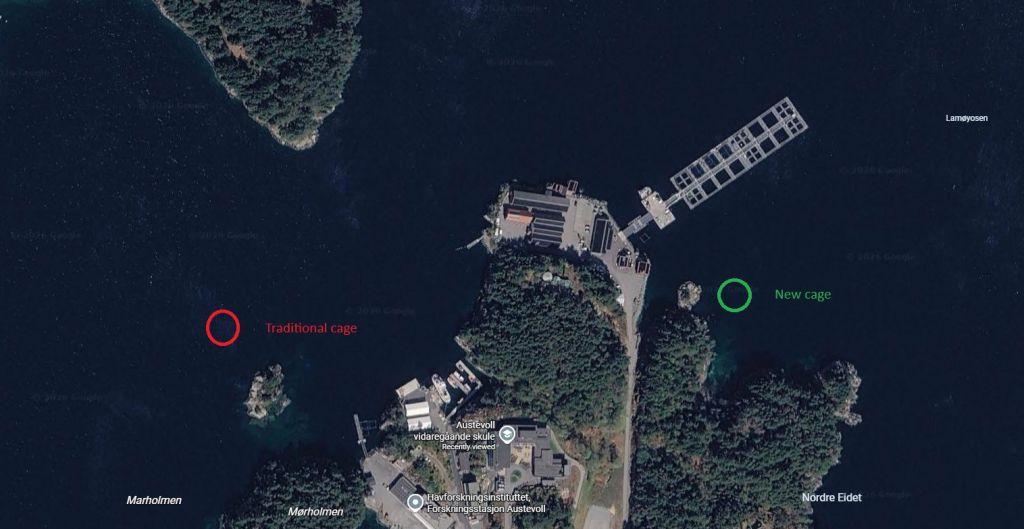
Turning to SEPA’s poster paper, I have previously written about IMR’s attempt to look at a new cage design. Whether this was promoted by SEPA’s involvement or not is unclear but the 2025 IMR sentinel cage dataset included sentinel cage data from Austevoll as well as Hardanger. The Austevoll data is from the IMR research station which is located in the area. The Austevoll data was different to the other sentinel cage data in that it was divided into two – old and new sentinel cages. No information was provided to help distinguish the difference, but my understanding is, and I may be wrong, that the new cages allow the fish access to the surface unlike the old cages which trap the fish at a fixed point in the water column. What I did know from the data was the location of these two pens in 2025.
I also knew that the new pen had an average lice count of 8.2 compared to 11.2 for the old cage in period one and 0.9 and 1.2 for period 2, which followed on immediately from period 1. The massive drop in average lice count between the two periods is of most interest to me because I do not believe that there was any significant change in the lice counts in the adjacent cages.
What is of interest here and didn’t appear relevant at the time is IMR had labelled the new cage as A01 and the old cage as A04. At the time I didn’t think as to what happened to cages A02 and A03 or even whether they existed. However, last week, it all became rather clear as the SEPA poster paper included the following image (apologies for the quality as it was taken off a TV screen with other people vying to look):
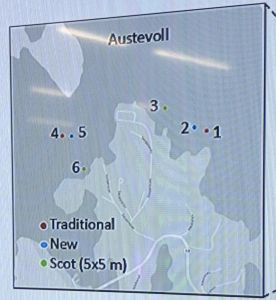
The numbering has seemingly become confused, as this image appears to suggest that cages 1 and 4 are both of the old type and not one of each. However, it is apparent that there were six sentinel pens in operation not just two. It seems that two old cages, two new cages and two Scottish cages, characterised by their much larger size, were deployed in 2025, although IMR have clearly not reported the results in the published data.
Fortunately, the poster provided a summary of the results. From the left, the first two are for the two periods in 2025 and they indicate that the fish in the Scottish cages had a higher lice count than in the old cages, which as I have indicated above, is higher than in the new cages.
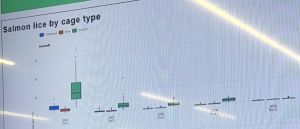
Although the count was also higher in the second period, it was much lower than in period one as the results have already indicated.
As I have mentioned, I am still waiting for the data from 2026 and I will probably be waiting for some time yet but the graph above shows that the sentinel pens were operated for three periods in 2026, none of which resulted in lice counts of any note although the larger Scottish cage did register slightly higher counts that the other two. This may be because more fish are stocked in these larger cages. Yet, what is most surprising is that as I have highlighted earlier this year, the lice counts in the adjacent cages were the highest recorded in PO3/PO4 this year. At the same time, the counts in the sentinel cages which were located almost next to the farm cages showed almost no infestation. How can this be?
Norwegian researchers have given up looking for lice larvae in the water column (because they can’t find any hence their reliance on modelling instead) but if there was the perfect opportunity to link the presence of larvae with infestation of fish in sentinel cages, then this was it. This was because of the close proximity of the farm and the sentinel cages. Unfortunately, this really was a missed opportunity.
From the poster presentation, it might seem that SEPA view their £200,000 investment in knowledge as being positive although why SEPA had to go to Norway to spend this money is unclear. Yet not all is what it seems because whilst the Scottish cages appear to have performed better than the Norwegian versions, there was a catch as can be seen in the following graph:
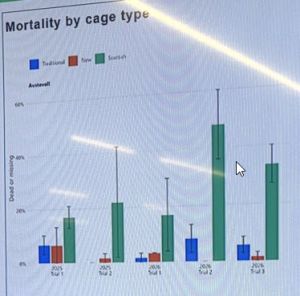
The fish in the Scottish cages suffered significant mortality and it can be seen that the mortality was significant with up to half the fish not surviving when the Norwegian cages had a maximum mortality of not more than 10%.
The question is whether this joint venture has been worthwhile and I would suggest the answer is definitely no. Like everything else about the Sea Lice Risk Framework, the regulator has just jumped in and made decisions without giving them the full consideration they merit. I have mentioned previously that I think this has been encouraged by Marine Directorate scientists, who have actively promoted the idea that sea lice have a negative impact on wild fish populations over many years. My view is that there are still far too many questions about sentinel cages that have not yet been answered and thus at present, it is not possible to trust the results of ongoing sentinel cage work as being a realistic reflection of sea lice infestation.
Finally, it is worth pointing out that the industry has also been working with SEPA investigating sentinel cage use in Scotland as part of the Sea Lice Risk Framework. A short presentation was given at the sea lice monitoring workshop also held at MASTS. No results are yet forthcoming so I must wait to hear their verdict.
Games time: Whilst at the MASTS meeting, I also attended the sea lice monitoring workshop organised by scientists from the Scottish Association of Marine Science (SAMS). This consisted of four presentations followed by a round table discussion to consider two questions. These were ‘What data is needed to effectively monitor sea lice to meet all stakeholders’ requirements’ and ‘What do we need to effectively integrate and use multiple monitoring data.’
The meeting lasted three hours and I found it disappointing. This was because I just felt like a pawn in a game in which SAMS scientists were effectively picking peoples brains for ideas to take their own research forward. I say this because no-one was permitted to ask any questions of the four presenters and there were definitely questions to be asked. The meeting then took the form of a table discussion at which delegates were assigned their seat. It was therefore impossible to know who was in attendance and their interest other than the six other people on the table.
One of the presentations was from Alan Kettle-White from the Argyll Fisheries Trust who spoke about their monitoring programme for sea lice on sea trout. His presentation was certainly one about which I would have liked to ask a question. His fifth slide is shown below and concerns the protocol set by the Scottish Fisheries Coordination Centre in 2008 setting the requirement for how the fish should be sampled.
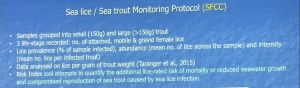
I have a copy of the protocol, and it does state that the three life stages should be recorded as well as prevalence, abundance and intensity. It also ‘strongly encourages’ that the wet weight be recorded to strengthen the validity of the data for example by calculating the number of lice per gram.
The protocol does not mention small and large fish, Taranger or risk index but it does mention other factors that have been omitted here. In 2021, Mr Kettle-White gave a presentation at another sea lice monitoring workshop. Someone later kindly sent me a copy of his presentation, which includes a slide about the protocol.
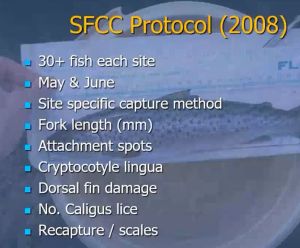
I would ask is this the same protocol because it differs considerably from the one highlighted last week. The most obvious difference was the reference to thirty plus fish caught from each site. The protocol actually states – ‘Aim to catch a minimum of 30 fish.’
I have in the past tried to obtain clarification for what this actually means, because I would argue that thirty fish should be caught in one sweep not multiple sweeps. This is because 30 sampling of one fish Is not the same as one sampling of one fish.
Mr Kettle-White showed some examples of infestation including the following graph from two sites in 2025 and 2026.
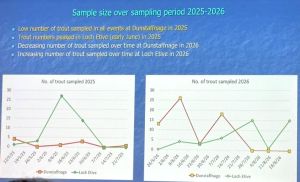
It can be clearly seen that over 24 samplings, not once were 30 fish sampled. It therefore should be argued that as the protocol has not been met, these samples are invalid and should be disregarded. It is not surprising that Mr Kettle-White removed the 30 fish sample size from his presentation.
Marine Directorate scientists have written that:
“As a general problem, many samples collected in validation of sea lice impacts are smaller than sampling protocols would aim for. Unfortunately, sampling of wild salmonid populations is opportunistic, and it is often impossible to obtain more than a few fish for a given sampling location.”
I would therefore suggest that sampling wild sea trout has very little value for the estimation of so-called lice pressure. I know that the wild fish sector will argue that some sampling is better than none but not if it doesn’t provide a true reflection of what is happening to wild fish. The problem as I see it is that the salmon industry is effectively being penalised because the wild fish sector cannot properly assess the impact of sea lice on wild fish. What makes this worse is that SEPA expects the salmon industry to pay for this flawed approach to sea lice assessment. Surely, if the wild fish sector wants to blame salmon farming for the demise of the fish they want to use for their sport, then they should not only provide accurate evidence but they should also pay to obtain it, After-all, it is they that are making all the fuss about sea lice control – no-one else.
Lice hunt: There was a special aquaculture session within the MASTS programme, and this included a presentation by Helena Reinardy from SAMS who continues research into the distribution of larval sea lice in a sea loch that has aquaculture and wild salmonids. Her research is titled – revolutionizing sea lice detection for sustainable salmon farming and conservation. Between March and October 2025, 334 samples equivalent of 10m3 of water were taken at three depts 1m, 12m and 20m. Dr Reinardy found that nauplii were found in 11% of samples whilst copepodids were identified in 53% of the samples although Leps account for just 16%. The other copepodids were either Caligus or the sprat eye maggot.
The only graph that was shown that was of interest is as follows:
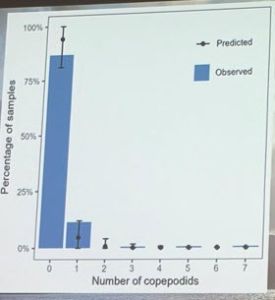
The fact is that despite strenuous efforts to find sea lice larvae in the water column, the little beasts remain totally elusive or perhaps they are just not there.