
Lice quota: It is now patently clear that the Norwegian Traffic Light System simply hasn’t done what it set out to achieve which was to protect wild salmon from sea lice said to be associated with salmon farms. Instead of taking time out to ask why (because salmon farming is not the reason why wild salmon are in decline) the Norwegian Government continues to investigate alternative strategies for trying to protect wild salmon (maybe stop people killing them for sport might be a start). The main proposals focus on a fee and quotas system for sea lice emissions, neither of which will prevent the continued decline of would salmon.
The Norwegian Government commissioned Menon Economics to assess these alternative proposals and they have produced a 130-page report which was published Thursday. I will discuss in a future commentary, the big hole the Norwegian Government is planning to dig for itself, if it decides to pursue these proposals.
Scottish complaint: In a previous reLAKSation I discussed how a representative from the Norwegian Government has asked four scientists from the Institute of Marine Research to comment on a review I had written of the Traffic Light System. Given that these four scientists, Taranger, Boxaspen, Myksvoll, and Karlsen have all been involved in the science that underpins the TLS, it was no surprise that they were rather dismissive of my review.
However, the story does not end there. Their response to the Norwegian Government includes the following:
“Researchers from Marine Scotland who work on the effects of sea lice have authored an internal memorandum regarding this report. The Institute of Marine Research (IMR) has collaborated with some of these individuals and has had the opportunity to read their internal memorandum. Given the prospect of their memorandum being published later and noting that our own analyses align closely with their conclusions, we believe it is appropriate to disclose that we have read this document.”
This was a complete surprise because as I previously mentioned, the review was written to demonstrate that the use of sea lice to regulate salmon farming as a way of protecting wild salmon was and is a complete waste of time since salmon farming is not the reason why wild fish are in decline. The review was sent to SEPA and to the Marine Directorate, neither of whom either acknowledged or responded to my comments.
This was less of a surprise since the Marine Directorate scientists have consistently refused to engage in any debate that might contradict the official sea lice narrative. I think it is now about fourteen years since I first asked if I could discuss sea lice with them and the reply was then ‘when you have had a paper published’.
Whilst members of IMR had read the document mentioned above, I certainly had not so I made a Freedom of Information request to access the relevant report. I also received a copy of three redacted emails sent between the 10th and 15th May 2024. The first refers to their written response to my review and it says that they are providing it without the names of the authors, but they would be happy to put their names to it if published.
The main content of the emails refers to the fact that I cite documents written in Norwegian saying that I appear confident in what the documents said but seemed to have missed key parts that directly contradict his assertions.
Whoever wrote this email said that he doesn’t speak Norwegian but instead has used Google Translate to interpret. He says:
“However. it is clear that’ negativ binomial’ in Norwegian does refer to negative binomial in English, and the discussion of this flatly contradicts the reassessment assertion the TLS scientists do not understand the statistics of aggregated sea lice distributions.”
I would mention that this is repeated as written so if thus if the meaning is unclear, then enquires to the Marine Directorate. What he is saying that the use of negative binomial distributions show that TLS scientists do understand the statistics of sea lice distribution. What he fails to understand is that I do not refer to the statistics of this distribution but rather but rather parasite ecology as I will discuss with reference to their report.
It is only necessary to go back to the last reLAKSation to clearly see how the TLS scientists fail to understand the relevance of aggregated distributions. These scientists said the fact that a distribution is aggregated does not means that the majority of individuals carry no or few lice. Actually, it does.
The author of the email states that he hoped to discuss the review with Norwegian colleagues in the next week. Three days later in the second email, he says that he is scheduled to speak to IMR scientists on Wednesday (15th) but there are no further emails explaining the outcome of this discussion but what is clear is that the scientists were provided with a copy of the ten-page report written by four unnamed Marine Directorate scientists.
The question of aggregated distributions is raised in the Marine Directorate report shared with IMR scientists. They say:
The assertion that sea lice distributions are aggregated is true (e.g. Murray et al. 2002), but it does not mean that most fish have very low loads, what it means is that the variance (𝜇+𝜇 2/𝑘 )is greater than the mean (𝜇). The negative binomial parameter 𝑘 is the aggregation parameter, as 𝑘 decreases the population is said to become more aggregated.
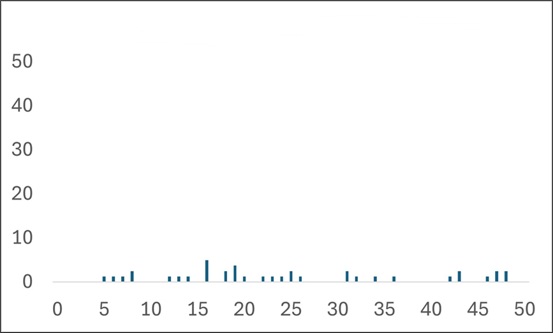
What they fail to understand is that whilst an aggregated distribution can be described as zero inflated negative binomial distribution, the aggregated distribution is also a key defining feature of what is a parasite. Thus, most fish (hosts) carry no or very few sea lice (parasites). This is the key feature not whether the fish have a variance greater than the mean. They simply cannot get to grips with the fact that if the actual distribution of the lice on the fish does not look like an aggregated distribution, then there is something wrong with the sampling, which is the real problem. I repeat the following graph of sea lice sampling from 2024 for PO9, and ask is this really representative of a parasite infestation.
If you didn’t know any better, this graph would question whether it is a parasite that they have actually been sampling. The truth is that the sampling is so poor that the results inevitably lead to a misleading conclusion.
Of course, if I am wrong then perhaps the scientists from IMR and the Marine Directorate would like to have an open face to face discussion with me instead of hiding away behind emails and discussion documents. I would be more than happy to discuss all the issues I raised.
Meanwhile, the Marine Directorate emails mention that they would be happy to reveal who wrote the document if it were published. The Norwegian scientists also mention that they expect the document to be published. However, it seems that whilst there was an expectation the criticism of my review would be published, it never was. Also, the results of FOI requests are often published but this one was not. Equally the document was not sent to me even though it states that:
“The author, who is perhaps unaware of the breadth of knowledge that exists in this field of work, will benefit from reading the evidence under the arguments summarised below.”
Besides the fact that the author of the document appears to believe that I am not aware of all the existing science, he suggests that I would benefit from reading the arguments that they then put forward. The big question is how I am supposed to benefit from their views without being provided with a copy of their document? It seems that like the Norwegian document, all the views expressed are to be kept to themselves.
Having read their document, I prepared a rebuttal which I sent to the Marine Directorate head of science. Yet again, I received no acknowledgement or response.
I therefore submitted a complaint to which I received a reply in April this year. This said that:
The report was a draft (and watermarked as draft – but not on the copy sent to me).
The report was commissioned by the former head of Marine Directorate science who moved on before the process was completed. However, the original email correspondence was in May 2024. The Norwegian scientists published their response on 20th June 2024, and the new Head of Marine Directorate science took over from her predecessor on 15th July 2024. How the process was not completed before that date when all the activity took place in late May is a total mystery.
The response to my complaint goes on to say that that the document was only shared with Norway to check that Marine Directorate scientists were not misinterpreting the working of the TL system in light of there being several references that were written in Norwegian This is extremely surprising as the document claims I am not aware of the breadth of knowledge when in fact it is the Marine Directorate scientists who actually appear deficient in the knowledge especially given that their recommendations for sea lice regulation are based on the fact that Norway had introduced a form of regulation.
They end by saying that the report remained a draft as illustrated by the fact that there is a spelling mistake in the document, which shows that editing was not completed. Work ceased and no decision was made as to whether the document should be published. They go on to say that my FOI to request this document was actually treated as a subject access request (SAR) rather than a FOI which would have required publication on the government website.
Added together, this seems to me that a decision was made to shelve the document instead of allowing it to go to publication. I suspect that the Marine Directorate did not want a challenge to their established narrative to be made public. Why the document was not shared with me remains a mystery.
The Marine Directorate letter ends by saying that if I am not happy with their response then I should take my complaint to the Scottish Public Services Ombudsman. This is now in process.
It sems crazy to me that the Marine Directorate science has advised the Scottish Government to instruct SEPA to impose new regulation on one of Scotland’s most important sectors based on flawed science and then do everything possible to avoid having to discuss any claims that their science is flawed.
Unfortunately, the SPSO has a backlog of work so it may be sometime before I can report on their outcome. This is not the first time that I have taken Marine Directorate scientists to the Ombudsman. Previously, I complained to the Information Ombudsman when the scientists wanted to reduce the number of fisheries districts in Scotland in order to protect the financial interests of the river proprietors. I won.
Sampling: Freedom of Information requests are usually published (unlike my experience) and Salmon Business has recently reported one recent example. The website reported that the ongoing legal challenge prevented SEPA from collecting charges needed to expand the monitoring of the risks that sea lice pose to wild fish.
According to published documents, SEPA had planned to roll out a national monitoring programme as part of its Sea Lice Risk Framework, however the litigation prevented SEPA from raising the charges as planned.
Official monitoring of sea lice on wild sea trout began in 1993 and was funded by Scottish Government and later from the Crown Estate. This means that data has been collected for over thirty years but interestingly, the only scientific paper that has been generated from this data covers only the years from 2013 to 2017. When the paper was originally published, I commented on its deficiencies such as the dataset showed that the number of fish sampled from the stated number of sampling sites did not tally with the numbers quoted in the paper. In addition, the paper stated that the 2009 sampling protocol was followed, yet many of the samplings did not reach the minimum requirement set by the protocol so it is questionable whether they should be included in the analysis. Despite such flaws, the paper manages to conclude that sea lice infestations on farms lead to higher lice levels on wild fish. I can only wonder that if the paper cannot provide accurate basic data, then the outcome must be questionable.
I have looked at the relationship between salmon farm lice levels and those on wild fish and do not come to the same conclusion. Sea trout do not necessarily remain in the area where they were sampled and that the paper does not give any consideration to the fact that lice infestation may have occurred naturally and have nothing to do with salmon farms.
Unfortunately, since the 1980s, anglers have consistently blamed the presence of high levels of sea lice on wild fish on salmon farming, even though infestations of over 400-500 lice can occur quite naturally. At the same time, sampling of over 21,600 fish over twenty-three years identified just four fish with such high levels.
This one paper from Marine Directorate scientists was only written in response to claims that the ongoing data from 1997 was never analysed. There is no reason why the data from 1997 could not be analysed in the same way, but it never has. As sea lice infestation is attributed to the decline of wild salmon and sea trout, it might be expected that the data would be continuously analysed but instead, there has been just one paper covering five years.
I have tried to access the latest sea lice data for 2026, but it is not yet available. Apparently just twelve sites have been sampled this year which seems few for such a large area where salmon farms operate, yet this data will be somehow applied to the SEPA sea lice risk framework. Like every other year since 1997, no sites have been sampled that have no salmon farms. In addition, like every other year, the sampling has been undertaken by the wild fisheries trust, who cannot be said to be independent impartial assessors as they are part of the salmon wild fish sector that continues to blame salmon farming for the decline of wild salmon and sea trout.