
In her words: I recently wrote about how Scottish angler Ronnie Fraser had developed a new theory using AI about the decline of wild salmon throughout Scotland. He argues that increased resistance to anti-sea lice treatments had allowed sea lice to flourish so much so that sea lice plumes are rife throughout Scottish seas including the east coast and these sea lice are responsible for the decline of wild Scottish salmon.
Ronnie argues that the salmon farms of Orkney, Shetland and Norway create an unnatural reservoir of sea lice that is washed by prevailing currents into a 200km long ‘washing machine’ that sweeps the drifting parasite plumes southwards directly into the North Sea migration corridor that east coast salmon must navigate. He says the facts and the catch data are undisputed.
Ronnie’s research has received many words of congratulation from his fellow anglers on social media. One offered his congratulations and then asked whether the corrupt politicians would take note. This comment elicited a very surprising response because amid all the comments from Scottish anglers was a response from none other than BC salmon farming critic Alexandra Morton. She wrote:
Alexandra Morton: They certainly refused to listen here on the west coast! It was some First Nation leaders who saw what was happening to salmon in their territories who cleaned them out and got wild salmon coming back. Very, very discouraging to observe the control this and probably many other industries have over elected representatives…. Very good analysis and best of luck to you and wild salmon.
Before I continue with her exchanges, I need to refer to an article in Sea West News concerning this year’s run of Fraser River sockeye. This year is the dominant year of a four-year cycle for sockeye when big runs of the fish are expected. Alexandra and another anti, Bob Chamberlain had highlighted a test fishery and claimed that the forthcoming dominant run would be enormous and that this was because the salmon farms had been removed.
However, by August the 7th, the early summer run had been downgraded for an expected 1.16 million fish to just 200,000 and test fishing described the run as very poor.
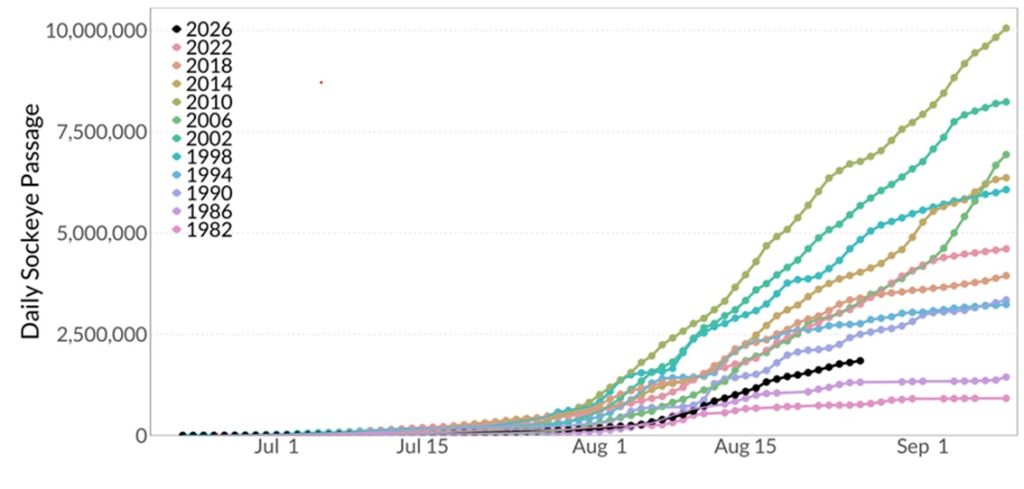
In mid-August the Pacific Salmon Commission had cut the summer run from a preseason estimate of 4.3 million fish to 2.2 million and the late run from 2.21 million to 1.6 million. The overall numbers were estimated at 4.1 million down from the preseason estimate of 7.74 million fish. How numbers compare to other years can be seen in the following graph:
The black line is 2026.
Sea West News said the low estimates recall the 2009 season when numbers also collapsed prompting the Cohen Commission inquiry which was unable to identify salmon farms or any other single factor as the cause of the collapse.
The article points out that salmon returns are genuinely volatile and it is easy to pluck out one season from decades of data to use it to support whatever claim is being made. For example, a poor return is blamed on the salmon farms and a strong one claimed as proof that closing them works.
Sea West News doesn’t report any response from the activists as to their explanation for what has happened to Fraser River sockeye this year.
I therefore thought it worth asking her:
“So, what happened to the Fraser River sockeye this year. You said that the dominant run would be enormous due to the removal of the salmon farms and yet the early summer run was just 200,000 fish. It can’t be salmon farms because as you point out, they have gone”.
I didn’t expect a reply but to my surprise she responded with the following:
Alexandra Morton Martin, try to see the whole life cycle of the fish. Is that possible for you? Notice the fires, landslides, high North Pacific Ocean water temps. All of these things negatively impact salmon. How much lower would the struggling sockeye be if they were infected with farm – source North Atlantic PRV, Tenacibaculum and unnatural levels of lice? Yes, I have been watching this generation, so heavily damaged over the past 25 years, and hoped they would be able to make a comeback. but remember, they still face the band of MOWI farms off Port Hardy where losses of up to 300,000 Atlantics per farm have occurred during the adult sockeye inbound migrations. Those adult fish were exposed to very high levels of Tenacibaculum and who knows what else and then entered the overheated nursery grounds of the young sockeye generations rearing in the river. It’s a perfect storm in the Fraser River. Try to pull your focus out to look at the extraordinary runs of other salmon into BC since removal on most salmon farms on their migration route – pink and chum runs coming in at very high numbers this year, neither of these species spend time as juveniles in rivers where farm-exposed adults are coming in. There are just too many wild salmon rebounds occurring to pretend something extraordinary is happening here. Most fish biologists have learned to be afraid of your industry as DFO is/was rife with ex-fish farmers managers. But in my opinion, it would be wrong not to examine what is going on here…
So, there we are in her own words. The problem is, as Sea West News pointed out, that the Skeena River also tells a similar story despite being hundreds of kilometers north of the nearest salmon farm. Fishery managers on the river reported a strong start to the returns but then the sockeye failed to show up. Pink salmon runs on the central and north coast including the Nass River were also weak.
Alongside her response, AI researcher Ronnie has asked Gemini why are there dominant years for the sockeye runs on the Fraser River?
Gemini says that this is known as ‘Cyclic Dominance’ and in the case of sockeye they have a strict four-year life cycle with populations divided into four distinct non overlapping generations, one of which is dominant whilst the other three are typically much smaller runs. Gemini continues that the dominance is driven by a combination of ecological and biological factors which ecologists are still trying to understand.
A further question was asked of Gemini – the dominant year was meant to be this year, but the run has not materialised. Last year was much better. How does this fit in with the removal of salmon farms.
The answer is that what is being seen this year is a real-time cycle shift. It appears that the timeline of salmon farm closures has acted as the exact environmental trigger effectively dethroning the historical dominant year and elevating an off year.
Gemini explains:
Why 2025 Boomed (The “Off-Year” Surprise)
Sockeye returning in 2025 were spawned in 2021 and migrated out to the open ocean as juvenile smolts in the spring of 2023.
This timing is critical. Following the government’s phase-out decision, the open-net salmon farms in the Discovery Islands were emptied by 2022. Therefore, the 2023 smolts were the very first generation to migrate through that narrow marine bottleneck without having to swim through a gauntlet of farm-amplified sea lice and viral effluent.
Suddenly relieved of that severe mortality burden, an unexpectedly high percentage of these smolts survived their early days at sea. As a direct result, the 2025 adult return was the highest for that specific cycle line since 1987, coming in at nearly three times the pre-season predictions.
Why 2026 is Struggling (The Fallen Giant)
This year (2026) is the historical Adams River dominant cycle—a line that used to return in the tens of millions. So why hasn’t it materialized?
To understand 2026, we have to look at its parent generation, which spawned four years ago in 2022.
- The adults that spawned in 2022 migrated out to sea as juveniles in 2020.
- In 2020, the Discovery Islands and Broughton Archipelago salmon farms were still fully operational, and sea lice and virus levels were high.
- Because of this, the 2020 out-migration suffered massive mortality, leading to a severely depressed adult return in 2022.
The source for the 2025 boomed section is the Watershed Sentinel and the 2026 struggle is attributed to Alexandra Morton’s blog.
I’m guessing that we may have to wait another four years to see if Alexandra’s explanation is correct because by then the fish will not have been exposed to any farming activity. Of course, there are still farms operating in BC and no doubt they will be in some way blamed for any future collapses of wild fish runs.
Meanwhile, biv.com has also looked at the failure of this year’s runs and spoke to Murdoch McAllister of the Institute for the Oceans and Fisheries at the University of BC. He said that another problem has been potentially identified. The stats from a very thorough analysis have shown that the biggest factor impacting salmon populations is seal and sea lion predation.
Seals were first protected during the 1970s and consequently populations in the Strait of Georgia have grown to 50,000 in recent years. In 1970, the DFO counted about 5,000 Stellar sea lions off BC’s coast yet by 2017, the number had grown to 52,000.
According to Murdoch McAllister each sea lion eats about 18kg of fish a day. He added that the biggest colonies are on the northern tip of Vancouver Island, past which the sockeye swim. They account for around 400,000 tonnes of fish or more, which means that the mammals do not have to take a big percentage of sockeye to have an impact.
Culling seals and sea lions is no longer acceptable to mainstream society so populations are allowed to grow even if it means that there is a negative impact on wild salmon numbers. It is therefore clear that those managing the rivers and fisheries face a real dilemma as do the activists who will rather blame the salmon farms than the seals and sea lions.
Ewe recovery: I have previously written that the claimed improvement in sea trout catches from the Ewe System has not been matched by the official government catch data, so it was interesting to read Andrew Graham Stewart’s Wester Ross fishing report from the latest issue of Trout and Salmon magazine.
He writes:
“It should be understood that the sea trout and finnock currently being caught on the river Ewe are simply a by-catch by those fishing for salmon. Angling activity has not been targeting sea trout, nor has there been any night fishing. There can be little doubt that the latter would have produced exceptional catches, given the number of sea trout and finnock present.
This sea trout recovery is compelling. It should focus attention on those other salmon (and rainbow trout) farms located in sea lochs adjacent to previously prolific sea trout river systems. Loch Ewe has now become a sanctuary with no more than the naturally occurring background lice levels allowing sea trout (originating in Loch Maree and its tributaries) to thrive and grow. This could readily be emulated elsewhere in the west highlands and islands by removing the most inappropriately located farms”.
I can only wonder why after five years, and reports of potentially exceptional catches, anglers would not have returned to the Ewe System in their droves and yet they haven’t meaning Mr Graham Stewart’s view has yet to be confirmed with some real data.
At the same time, prolific sea trout fisheries like Loch Stack collapsed well before the arrival of salmon farming, a collapse that affected the whole west coast and has spread to the east coast too. It is difficult to see how sea trout could rebound in exceptional numbers in this one location but I would be happy to be proved wrong.