
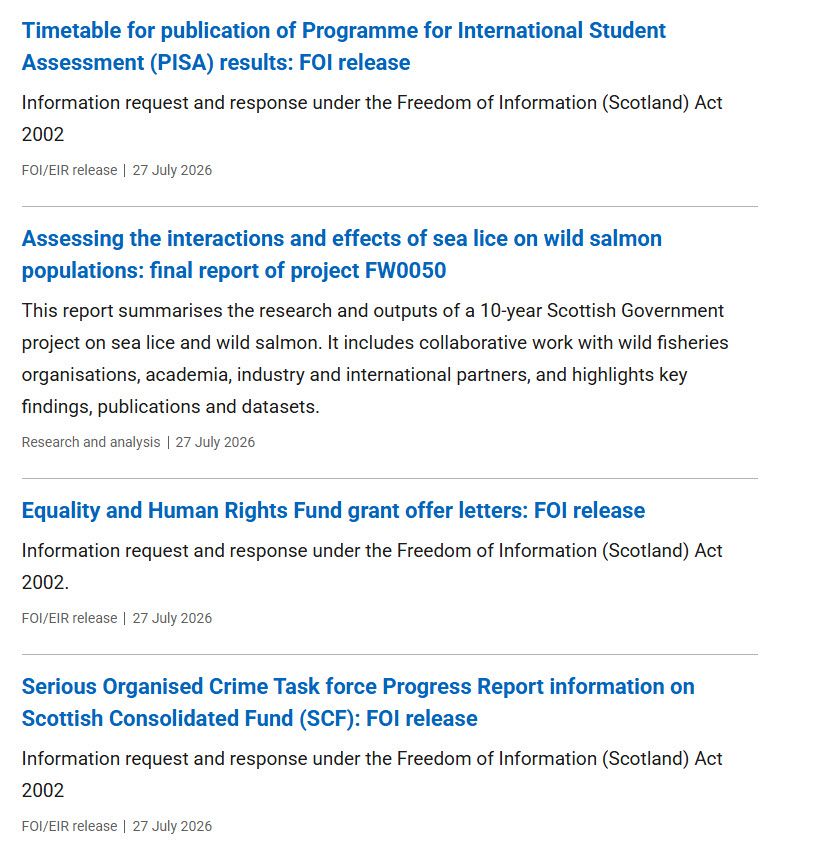
No fanfare: The Scottish Government is celebrating the end of a ten-year project on sea lice and wild salmon. Yet perhaps ‘celebrating’ is the wrong word because after ten-long years of research the project’s final report has been published with absolutely no fanfare at all. In fact, it quietly appeared as a Scottish Government publication on 27th of July sandwiched between a Freedom of Information (FOI) request about the timetable for publication of Programme for International Student Assessment results and another FOI request for Equality and Human Rights Fund grant offers.
I was aware the report was due to be published so was watching out for it, but a couple of eagle-eyed journalists managed to highlight the publication of the report in articles on their respective news websites. Otherwise, this report would have been quietly filed away without any comment.
This is all rather surprising, since after ten-years research, Marine Directorate scientists might have been expected to actively share their findings with stakeholders and anyone else interested in sea lice interactions with wild fish. I am reminded that when Bob Kindness of the River Carron Restoration Programme announced his groundbreaking results that DNA testing had shown his hatchery bred fish were successfully returning to the river to breed, he did so at a meeting held at Edinburgh’s New Club where he and his collaborators explained their work and not only answered questions but also mingled with the audience over drinks and nibbles to talk about all aspects of this long running project for which Bob was recently awarded a MBE in the King’s birthday honours list.
By comparison, the Marine Directorate have remained strangely quiet. Whilst I don’t expect Scottish government to provide drinks, I would hope that they could organise an event to explain and discuss their work. After ten years work, I would certainly want to do so, but maybe Marine Directorate scientists are not sufficiently proud of their work that they want to share it with interested parties.
However, having read their report, I can well understand that the Marine Directorate might be reluctant to make a fuss about this work. Certainly, in my opinion, I am not convinced it has greatly advanced our understanding of sea lice interactions. Of course, the Marine Directorate will disagree, but they have failed to show that wild fish are dying in Scottish waters as the result of sea lice infestation in numbers that are causing wild salmon in Scotland to be in crisis. They have also failed to identify any of the sea lice larvae that are supposed to be responsible for infestation of wild fish in any number in the waters around Scotland. What they have done is develop the models that are used to implicate the salmon farming industry in the decline of wild salmon even though the models do not reflect what is actually happening in Scottish waters.
Although I was waiting for the ten-year report to be published, I had been somewhat surprised to learn that the project was still underway. I had thought that the project had been scrapped after the failure of a major experimental project that heralded the start of the FW0050 project.
The introduction page of the FW0050 project, updated in 2020 states that:
“Existing studies in other salmon producing countries have shown that sea lice infestation of young salmon leaving the river (smolts) can affect the numbers of wild salmon returning to rivers.”
It goes on to say that:
“Currently there is no information on the impact of sea lice from aquaculture on wild salmon in Scotland, however, Marine Scotland has started a ten-year programme of research to investigate any potential risk to wild salmon from sea lice in the Scottish coastal environment. It will complement and extend another project currently being undertaken by the Scottish Aquaculture Research Forum (SARF), looking at the scale of sea lice impact on numbers of wild salmon returning to spawn by collecting data from a network of sites in which survival of smolts treated with anti-lice chemicals will be compared with controls.”
It was interesting that Scottish Government scientists wrote in 2015 that there is currently no information on the impact of sea lice from aquaculture on wild salmon because as they point out there had been plenty of studies on salmon interactions elsewhere. In addition, whilst Scottish Government scientists had not been working on salmon per se, they had been investigating the impact of sea lice on sea trout since the mid-1990s when they established a field research station by Loch Shieldaig. The relevant Scottish Government webpage lists at least 14 papers generated by those working at the field station.
The notion that there was no information about the impacts of sea lice in Scotland surfaced following the publication of the paper by Jackson and others two year earlier. Jackson found that the impact of sea lice on migrating salmon amounted to just one or two percent of the population. At the time, the paper created a great deal of outrage because the wild fish sector could not believe that the impact was so small. Jackson’s findings did not support the existing narrative that salmon farms were responsible for decimating wild salmon populations. Rather than accept Jackson’s findings and direct their research to new areas, Scottish Government scientists decided that they needed to repeat Jackson’s experiment in Scottish waters, but with modifications.
The main modification was to use wild salmon smolts instead of hatchery reared fish. Whilst this might seem to be a good idea, the reality was that the researchers were able to catch only small numbers of smolts and consequently, when it came to recapture the fish on their return, they caught just two fish, one treated and one control. The whole project was doomed to failure from the outset, but the scientists were determined to try to prove Jackson was wrong, and they didn’t. The total project cost was £600,000 and it was money that simply went down the drain. I suspect that had this been a commercial project the scientists would have not been in a job for much longer because the project was so ill-conceived it should never have been approved. The Scottish Government scientists managed to get funding through the Scottish Aquaculture Research Fund, so the industry ended up paying half the cost.
Given that the Scottish Government scientists suggested that there was no information about the impacts of sea lice on wild salmon, this ten-year project should have been the ideal opportunity to go right back to basics and try to answer some simple questions in order to gain a better understanding of the way sea lice might impact wild salmon. Perhaps, because of the failure of the SARF project, the ten-year programme was scaled back, which is why I might have thought it had been scrapped. The result appears to be a very piecemeal approach to wild salmon interactions with little to link the parts together.
The new report suggests that there were six work streams listed at the start of the ten- year project. These were:
- Migration routes and distributions of emigrating salmon smolts.
- Variation in salmon lice levels across a range of temporal and spatial scales.
- Spatial and temporal variation in the efficacy of various anti-salmon lice treatments.
- Infestation pressure experienced by salmon in relation to numbers of salmon lice in the environment.
- Impact of salmon lice on individual salmon.
- Effects of anti- salmon lice treatments on population losses of salmon released into the wild around the coast
Although there is much that can be written about these work streams, I will just focus on selected aspects of them.
- Migration routes
The wild fish lobby has a fixation with migration routes. I suppose that they would argue that if all the fish migrate past a specific farm, they have an increased risk of higher lice infestation although I am not aware that there is any evidence of such. In this report, the Scottish Government highlights the Atlantic Salmon Trusts’ west coast tracking project. This took place between 2021 and 2023, yet the report states that the work is being analysed and written up for publication, despite now being over halfway through 2026. The AST’s website says that great variability was found in approximate migration pathways as opposed to well defined migration corridors. Could it be that the work is taking so long to write up because they didn’t find anything worth writing about other than migrating salmon find their own way out to sea.
- Variation in salmon lice levels across time and space.
Even though farms were reporting lice levels from 2011, the only thing that the new report manages to say is that sea lice levels on farms have been in decline over the last ten years. They don’t say that wild fish numbers have continued to decline over the same period to an all-time low despite these low levels.
The report also mentions that the Scottish Government has funded Fisheries Management Scotland to monitor lice levels on wild fish. This is the same organisation that have been very vocal in demanding tighter regulation so can hardly be described as being impartial data collectors. Strangely FMS have not called for stricter demands on angling in order to protect wild salmon.
- Efficacy of sea lice treatments
I am not sure what medicinal efficacy has to do with this project especially with regard to modelling sea lice dispersal in the environment, which appears in the same section. This section includes reference to the SPILLS project which failed to find any sea lice in the waters around eight salmon farms.
- Infestation pressure in relation to numbers of salmon lice in the environment,
The report discusses data collection from 2011 to 2013, which I estimate to be 13-15 years ago.
- Impact on individual salmon
Another meta-analysis of existing studies is all the report offers. Many of the studies are from Norway which rather undermines the need for Scottish data. I have looked at some of these studies elsewhere and can suggest that they are not a realistic reflection of parasitic infestation.
- Effects of anti-salmon lice treatments on population losses of salmon.
This is the SARF project which I have discussed previously. The report also mentions twenty years study of sea lice infestation on sea trout which I plan to discuss in a future issue of reLAKSation.
In addition to summaries of these work streams, the report lists 32 peer reviewed papers that have been published as part of the FW0050 project, although one of these is not actually peer-reviewed. Of the remaining papers, 14 are open access and can be sourced easily. 2 were listed as subscriber access only with no other apparent way of reading. A further one paper could not be located despite extensive searching of the relevant journal. Unless one works for an institution with access to the journal network, then the other 14 papers are pay to view. To obtain an online copy for one that can be printed, I have estimated that accessing these14 papers would cost an independent researcher a total of £411.50 (plus currency fees). Given that Scottish Government scientists are funded by the taxpayer, it seems a real whammy that their work is not openly available for anyone to read.
I would mention that previously, I have written to Scottish Government scientists to request copies of a handful of papers and in response, I was told that the papers are in the public domain and it is not their job to supply them. Of course, that might have been directed just at me, as Scottish Government scientists have for many years refused to talk to me for what I can only conclude is because I ask questions they don’t want to answer.
Finally, I would end by looking at what Scottish Government scientists have concluded from their ten-years of research. I was going to summarise the points made but as their conclusion consist of just 201 words, I thought it easier to repeat it here.
Conclusion
A 10-year project on the interactions between farmed and wild salmon was
conducted by the MD. The project has led to standardisation of principles of sea lice modelling, curation of an international dataset for model testing and progress on methodologies for model validation. An increased understanding of sea lice dispersal in the marine environment has been developed, and oceanographic modelling has been greatly improved for the Scottish west coast and northern isles. Associated long-term monitoring has quantified an effect of sea lice in the environment on growth rates of sea trout.
There is now increased understanding of the epidemiology of sea lice in Scotland and their impacts on salmon. Through tracking studies, our knowledge of salmon migration and coastal behaviour has increased and coupled with increasingly sophisticated dispersal models, will inform the further development of a sustainable Scottish aquaculture industry.
Outputs of this project have made a significant contribution to develop Scotland’s policy and regulatory framework to consider and manage the risk that sea lice from fish farms negatively impact upon wild populations, leading to the development of, and contributing to, delivery of SEPA’s new sea lice risk assessment regulatory framework, with further development on future monitoring and research needs underway.
Having looked closely at their research, I am not sure that I agree with them. I don’t think this research has added much to the overall knowledge of sea lice. After ten years of research, Scottish Government scientists still cannot demonstrate that sea lice infestations are a major contributory factor in the decline of wild salmon stocks. In fact, they have dismissed any research that shows that sea lice are not the problem. In addition, they have not shown that sea lice larvae can be found in Scottish lochs as predicted by their models.
What is more worrying is that after ten years research, Scottish Government scientists are still working on sea lice, when perhaps they should really direct their effort towards identifying why wild salmon are in crisis and taking direct action to protect the stocks that currently remain.