
Ministerial advice: I heard the new minister, Jim Fairlie, speak at the opening of the Aquaculture UK event in Glasgow this week. He certainly said all the right things to encourage the future growth of the sector and also promised to resist calls for a moratorium on expansion. Like his predecessor, the minister appears fully supportive of salmon farming in Scotland.
Yet the positive messages that emanate from Government Ministers never seem to be reflected in practice, especially in relation to some of the more contentious issues such as sea lice. Despite the positive messages from Government, the industry has been saddled with new regulation in the form of the Sea Lice Risk Framework which has the potential to damage the future viability, whilst doing absolutely nothing to protect the wild salmon that anglers continue to catch and kill for sport despite claims that the species is in crisis.
Over the years, it has become increasingly apparent that whilst Ministers want a positive approach to salmon farming, their position is being continually undermined by the scientific advice provided by the scientists working for the Marine Directorate.
Although they will undoubtedly deny any such claims, in my opinion, the scientists support the views of the angling sector to the detriment of the salmon farming industry. Currently, the wild fish sector argues that wild salmon are in crisis with the lowest catches on record ever. It could be asked what measures are being imposed by Marine Directorate scientists to either slow down, halt, or even reverse this decline. The answer is none. It is still business as usual for the angling fraternity with fishing permitted in all of Scotland’s rivers. The only measure is that anglers are encouraged to return all the fish they catch, but in some rivers it is mandatory. This is despite the fact that the evidence clearly shows that catch and release has done nothing to stop the continuing decline of wild salmon populations. No rivers have been closed to fishing. Catch and release is not mandatory across all of Scotland even as a tool to encourage best practice by all anglers, and as I have indicated several times, anglers continue to post pictures of themselves holding fish inappropriately despite clearly harming the fish in the process.
Meanwhile, whilst anglers continue their sport, the salmon farming industry is to suffer Draconian regulation intended to control sea lice in order to supposedly protect wild salmon, but won’t. This is because there is clear evidence that salmon farming has little to do with the declining state of wild fish populations. The representatives of the angling sector may well tell Ministers that they accept that salmon farming is not the main driver of wild fish declines, but then they are more than happy to tell the wider public that salmon farming is the main offender.
So how have we got to this position. Firstly, the freshwater fisheries laboratory at Pitlochry was established to help monitor the state of wild fish populations. The scientists working there in the early days tended to be keen fishermen. By the time salmon farming became established, the director of the laboratory was Dr Richard Shelton who tenure was from 1982 to 2001. His position on salmon farming was clearly explained in his memoir – The Longshoreman a book that describes him as a keen wildfowler and fisherman (Atlantic Books 2004)
He wrote:
“As season followed season, and the caged fish grew ever more numerous, the more obvious it became that the new jobs on the salmon farms had been bought at a terrible price. The sea trout had been first to suffer because they spend the summer feeding close inshore, the very place where sea louse larvae tend to accumulate. Soon there were complaints from (managers of)) rivers entering the long sea lochs that the salmon populations were also in trouble as their smolts ran the sea louse gauntlet. Unlike sea trout salmon smolts are rigidly programmed to stay at sea until they reach adulthood. Theirs was a hidden Calvary far offshore as the maturing sea lice they had picked up in the sea lochs bit through the skin and destroyed the fluid balance of the worst effected fish. It would be years before a reluctant government would grudgingly accept the disastrous consequences which their regional development policies had helped create. With blooms of algae, in mid water that force the closure of valuable scallop fisheries with vile blankets of rotting ordure below the salmon cages, the sheltered waters of the west were an undersea Eden no longer.”
Dr Shelton was clearly not a great fan of salmon farming and undoubtedly as head of the Pitlochry laboratory his views permeated throughout staff working there. Consequently, a culture that was unfavorable to salmon farming developed and I would suggest it is one that still exists today.
At a time when wild salmon stocks are at an all-time low, and when the Sea Lice risk Framework is in place, researchers at Marine Directorate Science are still working on sea lice research. As I have written more than once before, speaking in 2017, our future King told the Atlantic Salmon Trust anniversary dinner that wild salmon were failing to return to Scottish rivers and that we don’t know why. I maintain that we still don’t know why, yet it appears that despite claims that wild salmon are important to Scotland, there is no research underway to understand why salmon stocks are heading towards extinction. Clearly, if we don’t know why wild salmon are in decline then how can any action be taken to safeguard their future?
Instead, the wild fish sector, including their scientific colleagues, have a ready scapegoat to blame in the form of salmon farming. They are happy to continue fishing knowing that if wild salmon stocks disappear, it will be salmon farming, not them, that will be blamed. This is why neither the wild salmon sector nor Marine Directorate scientists are willing to discuss my interpretation of the science because firstly, if they are proved wrong, then they will have to explain why they have invested heavily over many years in research targeting the salmon farming industry and secondly, the spotlight will be turned onto the wild salmon sector and this will be considered unacceptable.
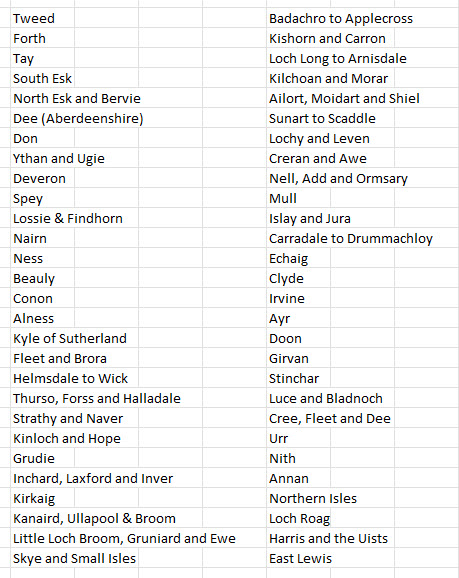
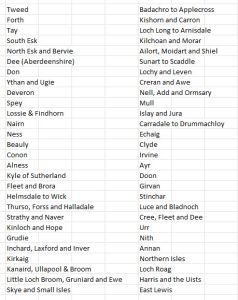
The different approaches to wild salmon fisheries and salmon farming as taken by Marine Directorate scientists can be illustrated by their handling of rod catch data. In 2016, statutory conservation measures were introduced by the Scottish Government (twenty years after they were introduced in England and Wales). Initially, these conservation measures were based on the 109 Scottish fishery districts, but some anglers argued that some rivers within some fishery districts were in better conservation status than others and the fishery district assessment did not reflect the conservation status of their river. What this meant was that some anglers complained that they were being subjected to mandatory catch and release when they believed that their river had sufficient stock for them to be allowed to kill the fish they caught for the pot. Instead of sticking to their original approach, Marine Directorate scientists succumbed to the angler’s demand and consequently, the 109 assessment areas increased to 173. In practice what this meant was that some fishery districts were broken down in to up to ten different assessment areas. For example, the Loch Roag fishery district located in the Outer Hebrides and in the heart of the salmon farming area became ten different areas. In 2026, six of these were graded Poor (Grade 3), one was graded Moderate – (Grade 2) whilst the remaining three were assessed as Good – (Grade 1). This means that subject to local rules, fish caught in four of the areas could be killed for sport. In 2025, the 360 salmon and grilse were caught from the ten assessment areas in the Loch Roag fishery district of which 11 were killed (3%). Remember, there are several salmon farms located in this area. For comparison, the Tweed district is assessed as one area and in 2025, a total of 6,692 fish were caught by anglers of which 40 were killed (0.6%). What is interesting is that whilst the Marine Directorate scientists use the number of assessment areas as a measure of the state of salmon rivers, a better measure is the size of the catchment. This is because, whilst the Tweed district is 16,187,000 square metres in size, just one of the Loch Roag areas is only 17,000 square metres and yet these are classed as equal. In total, the ten assessment areas that make up Loch Roag fisherty district are 1,010,000 square metres in size or a sixth of the size of the Tweed district.
A short video produced by the Marine Directorate explains the conservation process: -https://www.youtube.com/watch?v=ptXrKufauXo
The relevant part is that catch data is used to estimate the size of the salmon stock from which the number of eggs is estimated. The detail for all 173 assessment areas is available at https://www.gov.scot/publications/salmon-fishing-proposed-river-gradings-for-2026-season/documents/
Three of the catch data sets are shown below. One is from the river Carloway, one from the Loch Morsgail system and the other from Geisiadar. The latter has a much longer name but given that one salmon has been caught in the last five years, it hardly seems worth spelling out. In my opinion, any right-minded person would ask why these rivers are not just closed to fishing as the catches have been so low over the last five years.
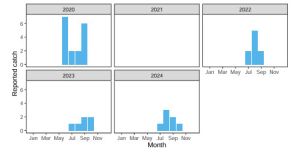
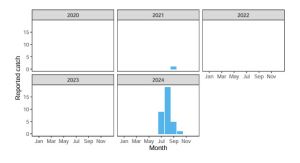
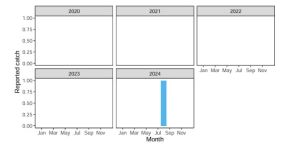
The above catch data is not available as such from the official set of catch data as all catches for the ten Loch Roag assessment areas are amalgamated together. However, as anglers have demanded that this fishery district is sub-divided, then Marine Directorate scientists must highlight the catches from each of the ten assessment areas, no matter how few salmon are caught, so they can show how they arrive at the final conservation gradings.
It is these small catches that are important in this discussion. This is because in 2019, Marine Directorate scientists amalgamated the catch data for many of the fishery districts, reducing their number from 109 to 58. For those of us who tracked catch trends across all of the fishery districts, this was a disaster. Data for the contentious Loch Ewe was amalgamated with data from Little Loch Broom and the river Gruinard. However, more puzzling was the reason for this change. It was argued that the catches in some districts were becoming so low, it would be possible to associate it with specific river proprietors and then calculate their potential income. This change was in effect aimed at protecting the financial interests of those who sell the right to fish on their beats. What these changes had to do with science was impossible to fathom, especially as Marine Directorate scientists were publishing rod catches from specific rivers in order to calculate the conservation gradings. The Marine Directorate claimed this had to do with the new GDPR regulations about protecting individuals’ data.
As usual, solicitations to the Marine Directorate scientist fell on deaf ears so I submitted a complaint to the Information Commissioner, and I won, which is why we still have access to data from all 109 fishery districts. I subsequently argue that we should have access to data from every river system, but the complaint got lost in the backlog caused by Covid.
To this day, I still have no understanding as to how catch data can be related to the financial interests of river proprietors. The Marine Directorate showed the commissioner a couple of examples so he agreed that it could be done, but how is a complete mystery. In the end the commissioners agreed that the wild fish catch data was a valuable resource that should be protected. Yet this was something that the Marine Directorate felt should be lost in order to protect those working in the fishery sector. I would imagine that the fact that those working to show that salmon farming was not the cause of wild fish decline would not have access to data would be seen as an added benefit. Marine Directorate scientists still maintain that catch data cannot be used to show that salmon farming does not have an impact on wild fish populations although they have absolutely no evidence that it does.
To me this whole debacle stunk of a double standard favouring the wild fish sector to the detriment of salmon farming.
Unfortunately, all this means that Minsters are provided with scientific advice that is intended to put the brakes on salmon farming in Scotland as demanded by their associates in the wild salmon sector. This is the sad state of affairs in Scotland today. Ministers recognize the many benefits that salmon farming brings to Scotland, but their support is tempered by advice that is based on flawed modelling and a lack of any real evidence.
A similar picture emerges in Norway, where Ministers rely on a small group of scientists with vested interests to provide advice which is not supported by evidence. In Norway too, the scientists are very close to the wild salmon sector bringing into question any impartiality.
As I have repeatedly stated. If these scientists are confident in the science they promote, then they should have no problem discussing the validity of the science with others.
The problem is that even when a forum where science could be discussed was established, such as the Salmon Interactions Working Group, any request to discuss the science was refused.
I gave a presentation at Aquaculture UK on sea lice and wild fish which lasted 45 minutes in a session which was very well attended. Clearly, there is plenty to discuss and perhaps now is the time that Ministers should demand that any questions of the science should be thrashed out once and for all. It might be argued that the Ministers have already tried to resolve questions about the science by asking the Chief Scientific Advisor to the Marine Directorate for a scientific review. Yet, his review leaves much to be desired and I would argue that he should have put out a request to hear any alternative views on sea lice science other than those provided by Marine Directorate scientists.
It had been suggested that one of the members of Marine Directorate science, Dr John Armstrong, should come and explain the interactions between salmon farming and wild fish to those attending Aquaculture UK conference and I believe that an invitation to speak was sent to him to which no response was received. By comparison, John has been regularly involved in the Fisheries Management Scotland annual conference, and his various contributions are available to watch on the FMS You Tube page.
Perhaps the new Minister might like to rely on his own agricultural experience as well as soliciting views from a wider range of experts rather than just those working for the Marine Directorate in order to ascertain what’s best for Scotland and the salmon farming sector.