
Worst ever: For some time, I have suggested that the 2025 salmon rod catch was likely to be the worst on record and so it has proved to be. On Friday 27th February, the Scottish Government quietly published the provisional salmon catch data for 2025. Consequently, the dire state of Scotland’s wild salmon population has received no publicity.
In 2025, the total Scottish rod catch was 28,020 fish of which 452 were killed despite a recommendation for anglers to practice catch and release. (A further 913 wild salmon were caught and killed by those net fisheries that have been allowed to continue fishing).
This worst ever catch is down 40% on the 2024 catch and 14% lower than the previous worst ever catch. In 2010, salmon rod catches peaked at 110,890 fish (although the Scottish Government have said elsewhere the figure was 111,405).
This latest data raises a number of issues:
Firstly, the data is expressed as catches from east and west coast rivers on separate spreadsheets. This is a real puzzle since the main data set makes no reference at all to this divide and usually is only highlighted in relation to salmon farming. Why this divide is relevant to the release of catch data for all of Scotland is unclear except if the intention is to show the alleged detrimental impact of salmon farming on wild salmon. If that is the intention then it has backfired because whilst the overall decline in catches is 40% on last year, the decline from the two coasts is as follows:
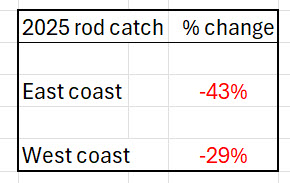
One wild fish commentator has said that it is very difficult for west coast catches to go down much when they are already at rock bottom but sadly that is a very blinkered view from those who believe that salmon farming has destroyed the wild catch. The reality is that in 2024, the total salmon catch from the west coast (as defined by Marine Directorate scientists) was 6,513 fish whilst last year the number dropped to 4,598 which represents about 16.4% of the total Scottish catch, which is actually up on the 2024 catch when west coast catches represented 13.8% of the total catch. Historically, the west coast has represented about 10% of the total catch so actually, west coast catches are far from rock bottom. It should also be mentioned that even though the west coast is said to be at rock bottom, anglers still managed to kill 30 wild salmon from west coast rivers and a further 422 wild salmon from Scottish rivers elsewhere. Wild salmon stocks are said to be in crisis, yet 422 fish were prevented from spawning and producing the next generation. I thought salmon had been classified as being endangered.
There is a little wriggle room in the overall numbers because the latest spreadsheet compared the provisional catches for 2025 with the provisional catches for 2024 when clearly, the Scottish Government published their finalised data on 14th May 2025.
Tweed cuckoo: The dire state of wild salmon stocks was not picked up by the mainstream media although the BBC News website did carry a story about salmon on the river Tweed. This coincided with coverage of the river on BBC Countryfile last weekend.
The BBC story suggests that former River Tweed bosses can be credited with keeping wild salmon numbers healthy on the river. It was feared that last season’s droughts, high water temperatures and algal blooms would have had a major impact on rod catches. However, the river authorities have just released figures for the 2025 catch of 6,957 fish which they say are just above the five and ten-year average. The BBC say that at a time when nearly every other river is reporting steady declines, Tweed managers are delighted with the numbers, which they attribute to the work of former managers who helped improve the river.
However, the river managers admit that the 2025 catch is down on the previous year’s catch of 9,947 which equates to a decline of 30%, which is less than the figure for all Scotland, but the Tweed managers must be living on cloud-cuckoo land if they are happy with the 2025 figure. Instead, they say that to hold our five-year average in a year of exceptional environmental pressure demonstrates the underlying resilience of the River Tweed. They do admit that this ‘stability’ must not be mistaken for long-term security adding that Atlantic salmon face significant pressures both in freshwater and at sea and we must remain vigilant and science led in our response. Of course, dragging 6,957 salmon around with a hook in their mouths and then displaying them for a photo is not really considered a pressure. At the same time, the press release sent to the BBC does not mention how many of the fish were killed. The numbers caught on the Tweed account for 25% of the total Scottish catch so with 422 salmon killed on east coast rivers, it might be expected the over one hundred of the fish killed were taken from the Tweed. We will have to wait for the full data set to be published in May to see exactly how many Tweed salmon were returned.
Catch and Release: The percentage of salmon caught and then released during 2025 was 98.4%, which is better than the 97.6% release rate during 2024. However, despite almost all fish that are caught being released, the policy of catch and release is clearly not having any impact on wild fish numbers. This has been apparent for many years from the data coming out from the River Dee which implemented mandatory catch and release over twenty years ago. The reality is that both catch and release and conservation limits have not produced any improvement in wild salmon numbers, something which is not being discussed because as we know all the wild salmon organisation are too busy blaming salmon farming to consider anything else. Sadly, whilst managers on the Tweed, for example, say that any response must be science -led, the reality is that there is no science in this at all. Just a desire to keep on fishing regardless.
Salmon in crisis: One of the most surprising inclusions in the witness list for the recent Rural Affairs Committee meeting was Fisheries Management Scotland (FMS). This is because the indication was that this was a meeting for industry and regulators to update the committee on progress being made. FMS are certainly not a regulator, and it might be predicted that they would indicate that any progress made by the industry would not be good enough for this wild fish body and so it proved to be.
Dr Alan Wells, FMS Chief Executive, told the committee that ‘as a sector, we do not feel that adequate protection is on place at the moment to minimise the risk that farm derived sea lice pose to wild fish adding that whilst the current appeals are in progress wild salmon remain exposed to sea lice pressures during the smolt run and no material effort has been made to reduce that risk.
What Dr Wells fails to do is to translate this alleged risk into real numbers. The last time anyone estimated the mortality was in 2019 in Norway. Applying Norway’s estimates to Scottish west coast production, then as a rough guide an estimated 3,755 salmon smolts a year would be said to die from sea lice infestation. However, whilst Norway’s figures are an estimate, Norwegian scientists have yet to demonstrate whether any of these fish actually died from sea lice. It is simply conjecture.
Based on Norwegian estimates only, over the run of the REC/RAIC inquiries from 2018, an estimated 30,000 salmon smolts might have died or not died from sea lice infestation. This is the estimated risk that Dr Wells wishes to protect but one he cannot quantify. Meanwhile, over the same period 654 adult salmon have been caught and killed from west coast rivers, and a further 3,055 fish are likely to have died from mortality associated with catch and release. Clearly these fish risk death but what protection do they have. Whenever such concerns are expressed, they are immediately dismissed by the wild fish sector. Instead, salmon farming is made into the scapegoat for all wild salmon’s problems.
This is illustrated by further comments made by Dr Wells who told the committee that because sea lice have a planktonic stage, the point at which the interaction takes place can be quite distant from a farm. He said that understanding where these lice go through the modelling and then managing that risk is another important element of the Sea Lice Risk Framework. Unfortunately, Dr Wells does not appear interested in understanding that the modelling produces just a model and bears no resemblance to what happens out in Scotland’s sea lochs.
Finally, he expressed regret that the salmon farming industry did not proactively engage with FMS prior to submitting the appeals because as a key stakeholder FMS have a key interest in what is happening. Sadly, my own experience would suggest that FMS have no interest in what is happening unless it agrees with their view.
Dr Wells also told the committee that he would welcome a further investigation into how we manage wild salmon, something which I am sure would be welcomed by all those who care about wild salmon as long as it just doesn’t turn into a case of ‘woe is us’ which is how it appears now. Representing the salmon farming sector Ben Hadfield questioned how much conservation work is undertaken by the wild salmon sector. Because it was referenced elsewhere in the meeting, Ben Hadfeld mentioned the good conservation work undertaken in the River Carron. To which Dr Wells replied that whilst he did not want to dismiss the work that is going on, the catch last year was just one grilse and 13 salmon. Mr Hadfield responded that stating one year’s data is highly selective because Bob Kindness has done fantastic work on hands on coalface conservation.
The river Carron is an interesting example. It is clearly evident from the graph of catches where Bob Kindness became involved.
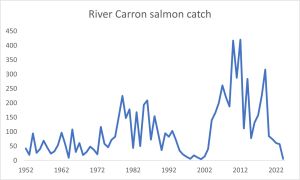
It can also be seen that catches have collapsed in recent years, but the Carron graph needs to be compared with the graph of salmon catches from all of Scotland as published by the Scottish Government.
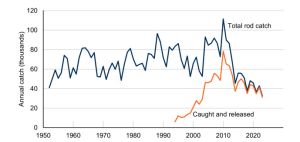
There has been a collapse across all of Scotland since 2011 as illustrated by the latest catch data for 2025. With more support, especially from the wild fish sector and Marine Directorate science, Bob might have been able to help the river Carron withstand the wider pressures but as one man working on his own, even Bob cannot perform miracles.
Finally, Dr Wells raised the issue of escapes. He told the committee that the electrofishing programme had demonstrated the widespread presence of genetic material from farmed fish especially in areas of Scotland where there is fish farming. What he fails to acknowledge is that during the 1980s, several river managers actively bought young fish from salmon farm hatcheries to restock their rivers. It is therefore not surprising that genetic markers are present in today’s wild populations. However, even more importantly, the latest scientific paper from Norway’s leading researcher on escapes, now concedes that the impact of genetic introgression has been highly overstated.
The committee meeting went on for longer than the convenor had indicated which was due to the fact that the meeting was constantly diverted by questions that had clearly been raised by critics. Had the committee not been so distracted, the members would have heard that the salmon farming industry has made real progress over the last twelve months. It is just that such good news is not what some want to hear.