

Contradiction: This week, I again attended the annual Norwegian Seafood Summit at Fishmongers Hall with about 300 other people from Norway, the UK and beyond. The event to celebrate the close contact between Norway and the UK and of course to celebrate Norwegian seafood.
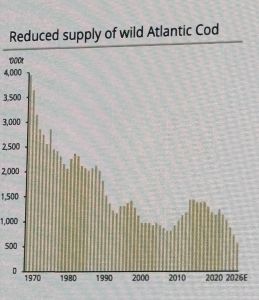
Norway prides itself on supplying the UK market with cod, haddock and salmon amongst other species, yet at the same time, there is concern about the state of stocks of wild caught cod and haddock, meaning that competition in the global markets for these species is pushing up prices as I have witnessed myself in the UK retail market. Whether cod and haddock will continue to flow into the UK at the same levels as in past is unclear which reinforces the increasing importance of salmon farming to the Norwegian economy and to exports.
As someone who crosses the divide between production and consumption, it is increasingly puzzling that the Norwegian Government and its agencies are so ready to listen to the views of just a small scientific community about the alleged impacts of farming salmon without a wider consultation. If you believe the views of this scientific clique then salmon farming is having a devastating impact on wild salmon stocks and needs to be controlled by increasingly reducing production, whilst ignoring the fact that salmon farming is a major contributor to the Norwegian economy.
There could be an argument about balancing the needs of the economy with those of wild fish if only the claims against salmon farming could be substantiated, but real-life evidence is sorely lacking.
Consumer confidence: A similar debate was played out at the Scottish Parliament’s Rural Affairs Committee’s revisit to salmon farming. I will be discussing the meeting in a future reLAKSation but there was one point which was made from the outset that must be highlighted. This was that the industry had to be more transparent if there was to be improved consumer, or public, confidence in the industry. The industry representative did respond to this later in the meeting, but it needs to be stressed again and again. The UK consumer has near on total confidence in the salmon farming in Scotland. Of 190 thousand tonnes of fresh chilled seafood bought in the 12 months to the beginning of February, 37% was of salmon. This compares with 10% for cod, the next biggest seller. This does not include smoked, ready- meals and frozen salmon or fish eaten out of home. Salmon is the most popular and most consumed fresh fish in retail and consumers must be confident if they buy it in such high volumes.
When the members of the Rural Affairs committee talk about public or consumer confidence, they really are referring to the vocal minority of industry critics who wish to bring about an end to salmon farming regardless or whether their complaints are valid or that salmon is such an important part of both local and national economies. Of course, none of these ‘consumer’s eat any salmon at all preferring to campaign instead to try to persuade real consumers to stop eating it.
Sadly, whilst their confidence is low or non-existent, none of these critics are willing to discuss the issues as was apparent from the meeting but more about this another time.
Transition: Fish and chips is certainly a meal choice that is in transition as highlighted by the BBC news website. Andrew Crook, president of the National Federation of Fish Fryers (NFFF) has noticed an increasing shift in Britian’s takeaway culture with high prices, rising energy costs and the appeal of other choices forcing chippies to diversify or close. In the 1920s and 30s there were at least 25,000 chippies in the UK whilst the number is now about 9,000. Yet not all takeaway food shops are in decline. Fried chicken is on the rise growing by 7.2% year on year compared to 1.7% across all takeaway food choices. What is different about fried chicken is that the customers tend to be young with 52% of Gen Z and 47% of millennial fast-food consumers reporting to have eaten from a chicken shop. The BBC report that other food takeaways are now choosing to offer chicken alongside their standard offering. In the case of fish and chip shops, Millers fish and chips near York have opened Millers chicken to try to future proof the business and they have consequently seen a 10% increase in younger consumers coming to their shop.
However, many fish and chip shops have already diversified with pies, pizza and sausage, but these do not seem to have the same appeal to younger consumers as chicken. There are now concerns that fish and chip shops could lose a whole generation because of the appeal of fried chicken to younger consumers.
Alternatives: BBC News also reported that one fish and chip shop had sought to combat the rising cost of cod and haddock by introducing their consumers to tilapia and chips. Riverside fish and chips in Cambridgeshire began a trial with tilapia three months ago and report that their customers love it. They told wary shoppers that they would refund their money if they didn’t like the fish and so far, no money has been returned.
Riverside say that the firmness of tilapia flesh makes it excellent for cooking in their shop and its increasing popularity locally has made it the fish of choice. Riverside sell tilapia for £6 compared to £8.50 for regular cod, however, what they don’t say is that a quick glance at their menu, shows that Riverside also offers a wide range of alternatives to fish and chips.
The BBC say that other fish and chip shop owners are now saying that it is time to give cod a rest with hake as the replacement of choice. Whist tilapia is a good, farmed option as well as basa, which is used more widely in more ethnic fish and chip shops, it does remain a puzzle why other locally sourced fish species such as whiting, coley and ling have never really made it to the fish and chip shop menus. Maybe, there is simply no-one championing the use of such species and of course imported cod gets the publicity as the Fish and Chip awards are principally sponsored by the Norwegian Seafood Council.
Fishy: It is 8.06 am on Tuesday 24th February and BBC Radio 2 breakfast DJ Scott Mills tells the audience that it must be Fish and Chip Awards or something as he said a load of fish and chips had just been delivered to Broadcasting House adding that the building now stinks. He added later that it’s like Captain Bird’s Eye has been to visit (and could someone get rid of them). Clearly, a great piece of marketing by someone from the fish and chip sector, especially as the Fish & Chip Awards were to take place on the following day. The 24th was in fact the date that the Norwegian Seafood Council held their annual summit in London where fish and chips was also on the programme with well-known chef Galton Blackiston spoke about fish and chips – a British icon in transition. Galton is the chef at his hotel Morston Hall in Norfolk where Atlantic cod appears on the sample menu and cod on the lunch menu. Galton is also associated with the fish and chip shop in nearby Cromer. The chippie is called No 1 Cromer which according to its websites prides itself in serving ‘premium quality Icelandic fish’ despite claiming that locally sourced produce is at the heart of our menu.
Diversify: I was interested to see that a PhD studentship is being offered by the University of East Anglia to look at ways to diversify UK seafood choices. Given the range of fish species available in UK waters and the reliance on cod and haddock, this would seem a well-intentioned project however I suspect that this project could be scraping the barrel when it comes to looking at how such diversification might take place. This is because the primary source of information is to come from recreational sea anglers, who the project background says catch and eat more seafood and a much wider range of species and therefore understanding their preferences offers a unique opportunity to explore how to diversify fish consumption habits. I am not so convinced, and this is because I believe that angling is more of a sport than hunter gathering. You only need to look at freshwater angling, which is said to account for about 70% of all fishing activity to see that other than salmon and trout, virtually all freshwater fish are returned to the water. Even salmon and trout are now mostly returned. It is the sport that is key and hence species such as conger eel, tope, sharks, and rays are sought after because they put up a big fight. By comparison, I have seen pier fishing for mackerel using multiple-coloured feathers as bait and as soon as the line enters the water it is retrieved with two or three mackerel attached for very little effort. Clearly, line caught sea bass are widely regarded as good eating, but sea bass is ubiquitous in supermarkets and yet has not reached the demand as that of more traditional white fish. Pollack is one white fish that is said to be good to eat but is sought more by anglers because it does tend to fight back.
Confidence again: Returning to chicken, the BBC reported that major UK restaurant chains have ditched a commitment to improve chicken sourcing standards in the UK as demand for poultry soars. Eight chains have said that they no longer support the Better Chicken Commitment (BCC) in which they pledged to stop using fast growing chicken. Critics say these Franken chicken mature quickly but also have higher rates of premature death and muscle diseases.
The eight chains representing 18 brands say that they no longer believe that the BCC is the right framework to drive the next phase of progress on welfare. They say slower growing chicken increase greenhouse gas emissions but also cannot keep up with demand. Critics say it is all about money. The industry says that at a time when production costs are going through the roof and slow planning approvals in the industry, added costs are unlikely to be met by the consumers.
Of course, consumers have a choice, and it will be interesting to see if they prefer lower-cost faster growing chicken to more expensive slow-growing birds.